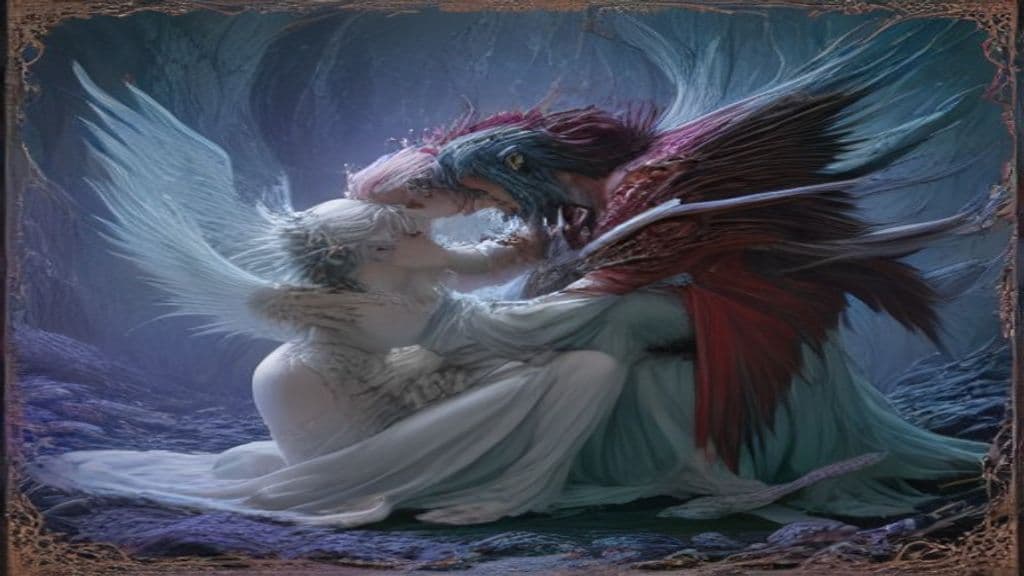
There is no single mythic origin described in the provided sources; instead the term appears in two separate narrative lineages. In Dante's Inferno Alichino is presented as a named member of the Malebranche, a cohort of devils charged with guarding Bolgia Five in the Eighth Circle (Malebolge). Scholarly and popular commentary commonly regards the name as derived from or related to Arlecchino/harlequin and to medieval hellecchino/hellequin topicalities. In Kouyu Shurei's manga Alichino is reused as the label for a class of beautiful demons that offer wishes to desperate people in exchange for their souls; within the manga world a balancing agent called kusabi is born to kill Alichino to protect humanity.
Dante's Malebranche (including Alichino) are depicted collectively in translations and commentary as grotesque, comic, and brawling infernal devils; specific physical detail for the named Alichino in the Dante episode is limited in the cited materials. In Kouyu Shurei's manga Alichino are described as "beautiful demons," often attractive or seductive in appearance; named exemplars include Myobi (white-haired, red-eyed) and other individualized Alichino (e.g., Yui, Matsulika), indicating morphological and gender variation used to lure victims.
In Dante's account Alichino functions as one of the Malebranche who participate in guarding Bolgia Five, engaging in the group's characteristic combativeness and trickery during the canto's episode; the sources emphasize collective policing, quarrelling, and deceptive behavior rather than unique feats of an individual. In the manga Alichino are a class of beings that offer wishes to desperate humans and exact souls as payment; they seduce, bargain with, and can prey upon humans. Individual Alichino exhibit variable behavior — for example, Myobi protects certain humans and delights in fighting other Alichino, while Yui rules a city and permits worship of his human targets rather than immediately consuming their souls.
Weaknesses
- conditionexistence of kusabi (manga)
Wards
- otherkusabi (born counter-entity to kill Alichino in the manga)
Algaut
Algaut (also rendered Algöt or Algaut Gautreksson) is a semi-legendary Geatish king of West Götaland recorded in Scandinavian saga and genealogical tradition. Saga summaries (via Snorri Sturluson's Heimskringla as reported in later compilations) record that he was the father of Gauthild and was burnt to death by his son-in-law, the Swedish king Ingjald Ill-ruler.
Algea
In Greek myth the Algea (singular Algos, Greek Ἄλγος; plural Algeai, Ἀλγαί) are personified daimones of pain, sorrow, grief, and distress. They are literary/theological abstractions—named spirits that embody forms of suffering—and are listed among the offspring of Eris in Hesiodic genealogies and later mythographic summaries.
Alhkwʼntam
Alhkwʼntam, given the English title "Maker of All Things" in the cited source, is presented in a brief Nuxalk (Bella Coola) account as the being who, at the beginning of time, created the Four Supernatural Carpenters and directed them to carve the first humans from a cosmic tree (Tcncniyaaq). The available account is concise and provides no extended narrative, ritual, or iconographic detail.
Alicante
Alicante is attested in available reference sources as the proper name of a mythological snake identified with Mexico. The surviving entries provide only the name and a categorical label (mythological snake) without accompanying narrative, attributes, or ritual context.
Alicanto
A nocturnal, flightless bird-like being from Chilean Atacama desert folklore whose glowing wings indicate the presence of underground ores; it can guide a stealthy prospector to a mother lode or, if offended or detected, extinguish its light and mislead or endanger the seeker.
Alice (Alice's Adventures in Wonderland)
Alice is the fictional little girl protagonist of Lewis Carroll's 1865 novel Alice's Adventures in Wonderland. Portrayed as a curious child who follows a White Rabbit down a rabbit hole, she serves as the reader's point of entry into the dreamlike realm of Wonderland and is not described in the provided sources as a supernatural being.
Alicia Masters
Alicia Masters is a fictional, non-superpowered human character from Marvel Comics, introduced in The Fantastic Four #8 (November 1962). A blind sculptor and empathetic confidante, she serves as a recurring supporting figure for the Fantastic Four and the Silver Surfer, and has been a romantic interest of Ben Grimm (the Thing).
Alignak
Alignak is named in modern reference works as an Inuit deity associated with the moon and with dynamic natural phenomena such as weather, water, tides, eclipses, and earthquakes. The available sources provide only terse domain associations and do not supply narrative, iconographic, or ritual detail.
Aliguyon
Aliguyon is the eponymous warrior-hero of the Ifugao epic cycle Hudhud ni Aliguyon, an oral-chant tradition of the Ifugao people in the Cordillera region of the Philippines. He is presented in sources as a storied human protagonist whose exploits are performed during harvest rituals and used to transmit social values and communal memory.
Alinda of the Loch
A literary character from a modern children's fantasy novel (published 2009) that blends Sleeping Beauty motifs with the Loch Ness legend; Alinda is presented as the daughter of Queen Aurora who falls under a 500-year enchanted sleep guarded by a young dragon called Nessie.
Alipherus
Alipherus is a mythological Arcadian prince in ancient Greek tradition, named among the many sons of King Lycaon. He is chiefly remembered as an eponymous founder of the town Aliphera and as a participant in the impious episode in which Lycaon's sons served a meal to Zeus containing human entrails and were destroyed by divine lightning.
Alisanos
Alisanos is a theonym attested in two Gallo‑Roman votive inscriptions from the Côte-d'Or (near Dijon) and interpreted by Celticists as a localized landscape divinity (possibly 'of the rock' or of certain trees). Separately, the name has been repurposed in modern fantasy literature as a sentient, predatory deepwood; the two usages are distinct in origin and evidence.
Community Record
- [1]Alichino (manga) — Wikipedia. Wikipedia, 'Alichino' (manga) entry — synopsis and character descriptions (Kouyu Shurei).wiki
- [2]Alichino (devil) — Wikipedia. Wikipedia, 'Alichino (devil)' entry — Dante reference and Malebranche placement.wiki
- [3]Inferno 23 – Digital Dante. Digital Dante, commentary and text for Inferno Canto 23 describing the Malebranche and their episode.literary
- [4]Barbelith — notes on hellecchino/Harlequin associations. Barbelith article noting medieval name-forms and connections between Alichino, Arlecchino/harlequin and hellecchino traditions.other
- [5]The Magdalena Project — Il viaggio di Arlecchino / Commedia dell'Arte commentary. The Magdalena Project pages discussing Arlecchino/harlequin traditions and possible resonance with Dantean naming.other
- [6]Calcabrina — Wikipedia. Wikipedia entry for Calcabrina as a related named Malebranche (contextual reference to the Malebranche cohort).wiki