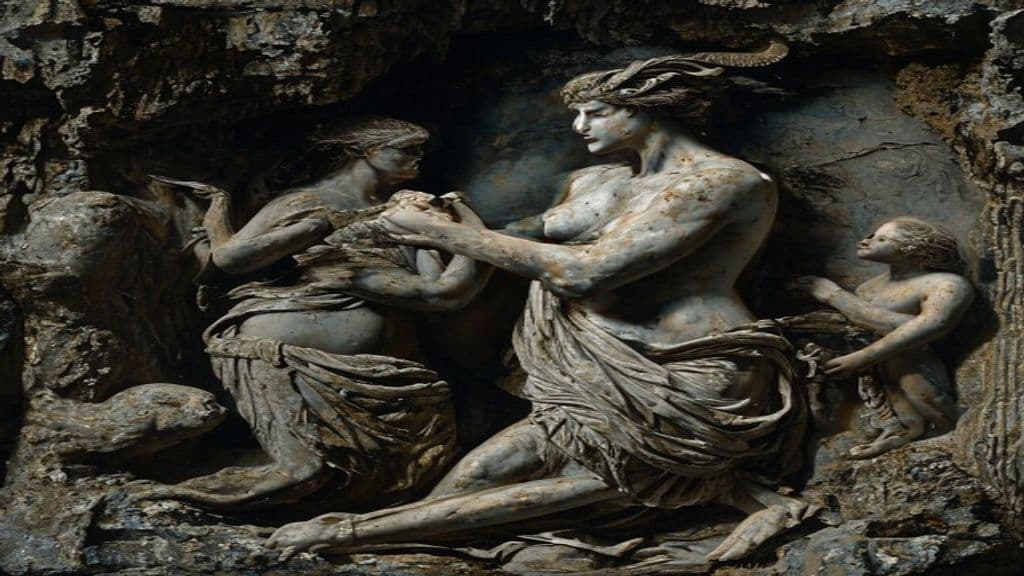
Amalthea appears in narratives about Zeus's infancy. In older and varied accounts Zeus is hidden and nurtured in Cretan settings (caves on Crete, guardians such as the Kouretes). Some authors present Amalthea as a nymph who owns or tends a goat whose milk nourishes the child; Hellenistic poets such as Callimachus and later Latin authors sometimes identify Amalthea explicitly as the goat. Separately attested is the older horn-of-plenty motif (the "horn of Amalthea") attested in archaic poets; later compilers and poets (e.g., Ovid and mythographers summarizing Pindar/Apollodorus) weave the horn tradition together with the nursing-guardian tradition. Genealogical attributions vary across sources (e.g., traditions naming her related to Melisseus or as daughter of Oceanus in some accounts); scholarly sources treat these variants as alternate local or poetic versions rather than a single fixed origin.
Literary descriptions are sparse and vary. In narrative sources Amalthea appears either as a nurturing nymph (female nature spirit) who nurses Zeus or as the goat that provides his milk; extant art—reliefs and coins—occasionally depict her nursing the infant between attendants such as the Kouretes. Hellenistic and later authors sometimes conflate or alternate these identities. Aratus identifies Amalthea with the star Capella in an astralizing tradition.
In myth Amalthea's chief functions are caregiving and protection of the infant Zeus—nursing him (directly or via a goat), hiding him in Cretan localities, and enabling protective measures (narratively, gathering the Kouretes to dance noisily so the child's cries are masked). Separately, the horn associated with her (the horn of Amalthea, later the cornucopia) is an independently attested motif—extant from archaic poets—which is described as a magical horn capable of producing unending food and drink; later mythic accounts and literary treatments merge that horn-legend with the Amalthea caregiving tradition. The sources do not attribute wider cosmic or hostile powers to Amalthea beyond nourishment, protection in the infancy narrative, and association with the horn-of-plenty motif.
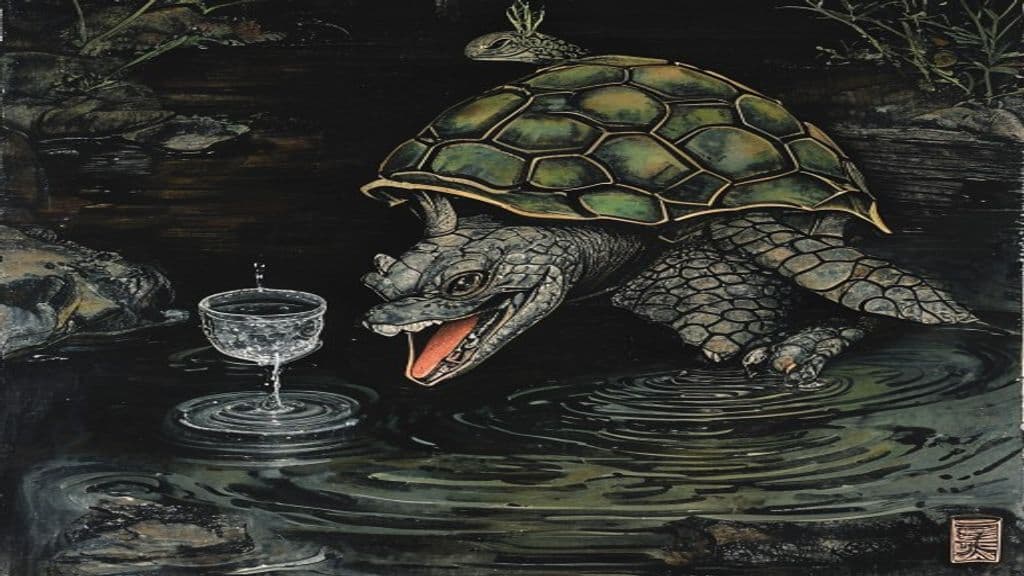
Kappa
A water-dwelling imp of Japanese folklore with a bowl of water on its head. Mischievous but bound by strict codes of politeness; dangerous near rivers.
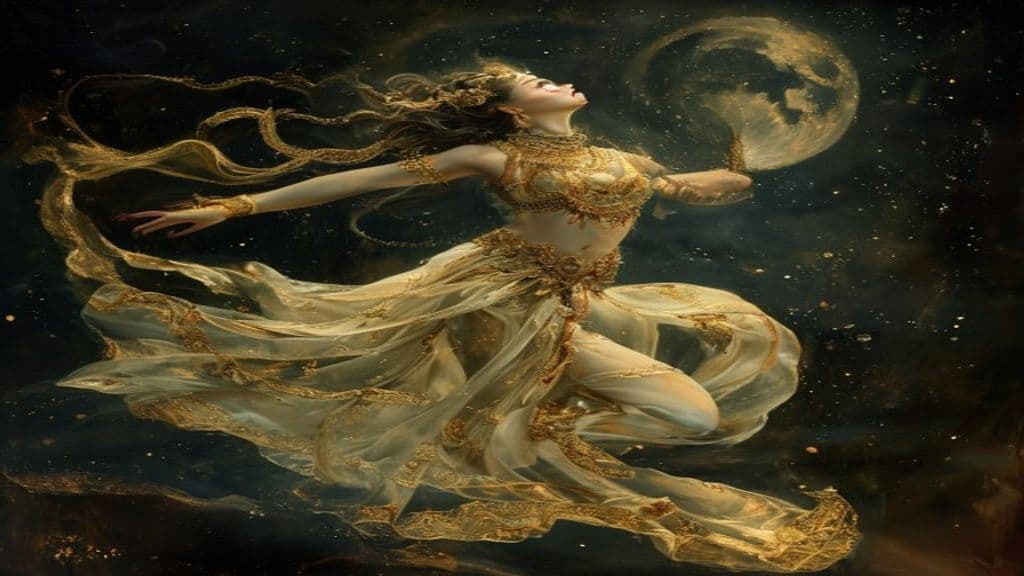
Apsara
Celestial dancers and water nymphs of Hindu cosmology — beautiful semi-divine beings who dance at the court of Indra and, by his command, descend to earth to distract sages from excessive asceticism.
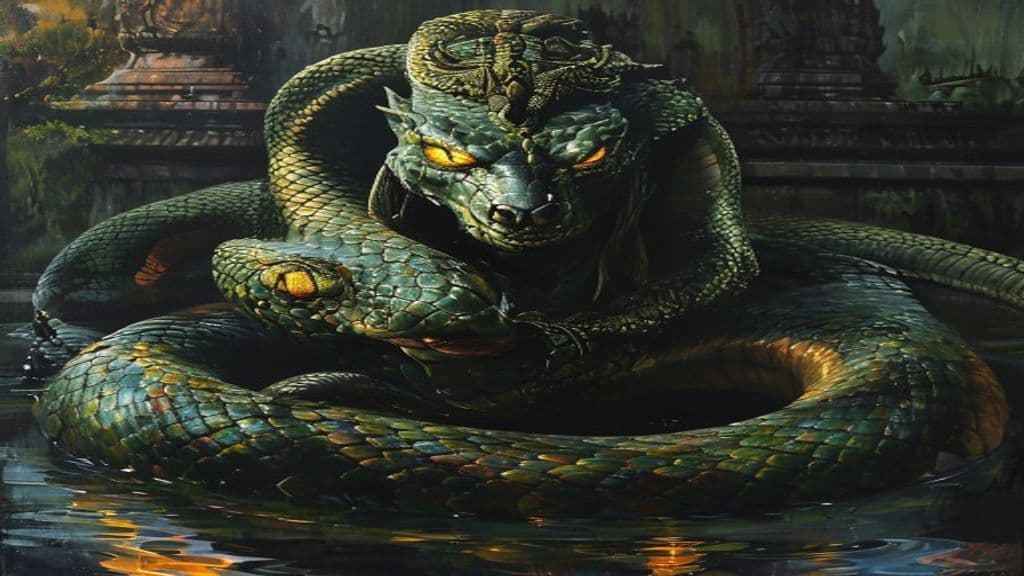
Naga
Divine serpent beings of Hindu, Buddhist, and Jain cosmology — powerful guardians of water, earth, and underground treasures. Revered as deities in South and Southeast Asia.
Acis and Galatea
A pair of lovers from ancient Greek myth: Galatea is a Nereid (sea-nymph) traditionally counted among the daughters of Nereus and Doris; Acis is a mortal youth in classical accounts who, in Ovid's poetic version, is killed by the Cyclops Polyphemus and transformed by Galatea into a river-spirit, explaining a Sicilian stream.
Actaeon
A mortal hunter of Greek myth who, in multiple traditions, is transformed into a stag and torn apart by his own hounds after transgressing the goddess Artemis. He functions as a mythic exemplar about proper deference to divine boundaries and, in some locales, became the focus of cultic rites and memorials.
Aesepus
Aesepus is the personified river-god (potamos) of the Aesepus River in the Troad / northern Mysia of Anatolia. Attested in Hesiod's catalogue of river-children and in Homeric and geographic passages, Aesepus functions primarily as a topographical divine ancestor and eponym for a town and local genealogies.
Aethra
Aethra (Ancient Greek: Αἴθρα, romanized Aithra, lit. 'bright sky') is a name borne by multiple women in Greek myth, most prominently a princess of Troezen who is mother of the hero Theseus. In some traditions an Aethra is also listed among Oceanids, indicating a separate, water‑nymph identity in certain genealogies.
Aganippe (naiad)
Aganippe is the local Naiad of the spring called Aganippe at the base of Mount Helicon in Boeotia. The spring and its nymph are traditionally associated with the Muses and with poetic inspiration; the name Aganippe is also used as an epithet in other, sometimes divergent, local mythic or cultic contexts.
Alegenor
Alegenor (Ancient Greek: Ἀλεγήνωρ) is a minor mortal figure in Greek mythic genealogies, attested as a son of Itonus and the father of Clonius and Promachus. He functions in the sources as a genealogical ancestor situating his more active descendants among the Boeotian leaders of the Trojan War rather than as an independently acting supernatural being.
Alexander (name / epithet)
Alexander is primarily an Ancient Greek personal name (Ἀλέξανδρος, Aléxandros) meaning 'defender/protector of men.' In the assembled sources it functions as an anthroponym and occasional divine epithet (e.g., Hera Alexandros) rather than a single, discrete supernatural entity with a consistent mythic ontology.
Alexida
Alexida (Ancient Greek: Ἀλεξίδη) is an attested mythological figure in Greek literary tradition, presented as a daughter of Amphiaraus and the eponymous ancestress from whom the Elasioi (Elasii), averters of epileptic fits, were believed in Argos to descend. She is preserved in surviving references as a genealogical origin rather than an active cultic agent.
Alpheus
Alpheus (Ancient Greek: Ἀλφειός) is the personified river and river-god of the Alpheios in the Peloponnese. He is classed among the river-deities descended from Oceanus and Tethys and appears in myths linking the Arcadian/Elian river to the Sicilian well Arethusa, to Artemis, and to the labors of Heracles.
Amnisiades
The Amnisiades (Ancient Greek: Αμνισιαδες / Αμνισιδες) are a group of naiads — freshwater nymphs — associated with the Amnisos river in Crete. They are attested in Hellenistic poetry as members of Artemis's retinue and are linked by scholarship to cult activity at a cave of Eileithyia on the Amnisos.
Amphictyon
Amphictyon (Greek: Ἀμφικτύων) is a mytho-historical ancestral king in Greek tradition associated with the generation after the great flood and with the foundation/organization of communities that dwelt around sanctuaries (the Amphictyons). He appears in variant genealogies as son of Deucalion and Pyrrha or as son of Hellen, is called king of Thermopylae and in some accounts king of Athens, and is etiologically linked to the Amphictyonic League and early cultic practice.
Amyrus (Ἄμυρος)
Amyrus is a mythic eponym in Greek tradition: a legendary figure after whom a river and town in western Magnesia, Thessaly, were believed to be named. Surviving sources present variant traditions that cast him as a son of Poseidon or as an Argonaut; otherwise he functions chiefly as a place-founding or name-giving ancestor in literary and geographic accounts.
Community Record
- [1]Amalthea (mythology) - Wikipedia. Wikipedia, 'Amalthea (mythology)'wiki
- [2]Moons of the Solar System (archive). Archive resource listing Amalthea among modern named referencesother
- [3]Jupiter : the giant planet (archive). Archive reference noting Amalthea as a modern namesakeother
- [4]Myths, gods & fantasy (archive). Modern myth compendium entry referencing Amaltheaother