
Ame-no-oshihomimi is produced in the kami-generating episode between Amaterasu and Susanoo. According to the cited sources, Susanoo took Amaterasu's beads and crushed them in his mouth, which created five male kami; Ame-no-oshihomimi was the first to be born. He is presented within the heavenly genealogy as Amaterasu's first son and as an intermediary in the sequence that links heavenly authority to earthly rulership. In some versions of the narratives Amaterasu offers him the role of ruler of the earth, but he declines that offer. He later falls in love with Takuhadachiji-hime and fathers Ninigi-no-Mikoto, continuing the line that becomes associated with the Imperial ancestry.
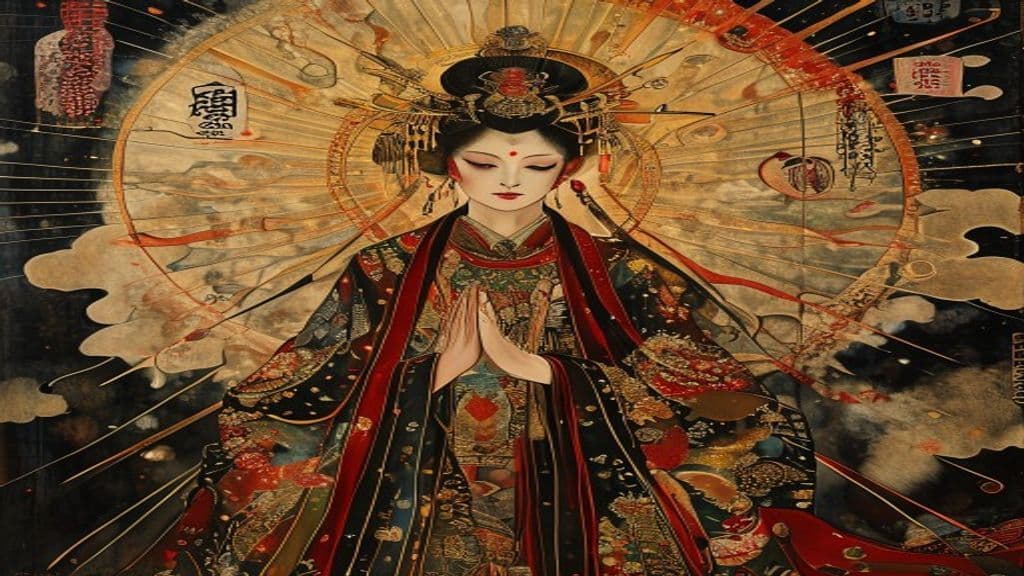
The supplied sources do not provide a physical description or stable iconography for Ame-no-oshihomimi. He is primarily attested and recognized through genealogical and mythic roles—his identity is established by name, etymology, and familial relations—rather than by visual depiction in the provided material.
The sources emphasize his status and roles in lineage and succession rather than enumerating specific supernatural powers. He is described as the first son of Amaterasu and therefore qualified within the myths to be offered rulership of the earth, which he in some versions refuses. He is also described as fathering Ninigi-no-Mikoto through Takuhadachiji-hime. The supplied material does not catalogue explicit magical abilities, elemental control, or other powers beyond his function as a heavenly progenitor and link in the divine-to-imperial succession.
Amatsuhikone
Amatsuhikone (天津日子根命 / 天津彥根命) is a kami in Japanese mythology described as a son of the sun goddess Amaterasu. He functions primarily as a member of the heavenly genealogy used to legitimize clan lineages and is later identified as the shintai (sacred body) of Mount Mikami, where Mikami Shrine stands to venerate him.
Ame-no-Koyane-no-mikoto
Ame-no-Koyane-no-mikoto is a male Amatsukami (heavenly kami) in classical Shinto myth, presented as the ritual-official ancestor of the Nakatomi clan and linked genealogically to the Fujiwara. He functions as a divine ritual specialist—performing divination and liturgical speech in foundational myths (notably the Ama-no-Iwato episode) and as guardian of the sacred mirror—and is venerated at major shrines such as Kasuga Taisha and Hiraoka Shrine.
Ame-no-Minakanushi
Ame-no-Minakanushi (天之御中主) is a primordial kami named in Japan's classical creation texts as one of the very first deities to come into being in Takamanohara (High Heaven). Presented in the Kojiki and Nihon Shoki as a solitary, hidden first god, he functions primarily as a mythic point of cosmic origin rather than an actively intervening deity in surviving narratives.
Ame-no-Tajikarao
Ame-no-Tajikarao is a kami in Japanese Shinto myth notable for exceptional physical strength. He appears in the Ama-no-Iwato narrative as the deity who pulls Amaterasu from the heavenly rock cave, and he is venerated at numerous shrines across Japan with associations to physical power and local lineage claims.
Ame-no-Tokotachi
Ame-no-Tokotachi is a primordial kami in classical Shinto cosmology attested in summaries of the Kojiki and Nihon Shoki tradition. Sources identify a very early solitary or among-the-first deity who manifests at the creation of heaven and earth; supplied materials also reference a closely related name, Ame-no-Minakanushi, in English summaries of those chronicles.
Ame-no-Uzume-no-Mikoto
Ame-no-Uzume-no-Mikoto is a Shinto kami of dawn, mirth, revelry and the performing arts whose comic and erotic dance at the entrance of Amano‑Iwato lures the sun goddess Amaterasu from hiding, restoring light; her action is cited as the mythic origin of kagura and of certain ritual/performance lineages.
Ame-no-hohi
Ame-no-hohi (also rendered Ame no Fuhi) is a male kami in Japanese mythology identified in sources as the second son of the sun goddess Amaterasu. He is principally attested as an ancestral figure: historical rulers of Izumo and the modern heads of Izumo Taisha and Izumo-taishakyo claim descent from him.
Ame-no-wakahiko
Ame-no-wakahiko is presented in the provided sources as a kami in Japanese mythology, described specifically as a god of grains and counted among the Amatsukami (heavenly deities). The sources identify him as a son of Amatsukunitama and note a medieval prose narrative, the Ame no Wakahiko Monogatari, exists about him.
Amechania
Amechania (Ancient Greek: Αμηχανία / Αμηχανίην; also Amekhania, Amakhania; Latin: Amechania) is a personified spirit (daimona) of helplessness, want, or impossibility attested in ancient Greek literary and lexicographic sources. She is cited as a close companion or sister of Penia and Ptocheia and is described in some modern references as virtually identical to Aporia. No cultic practice or iconography is attested in the supplied sources.
Amefurikozō
Amefurikozō (雨降小僧 or 雨降り小僧) is an Edo-period yōkai figure depicted in classical illustrated and popular print culture as a youthful attendant associated with rain. Classical sources (notably Sekien Toriyama's Konjaku Gazu Zoku Hyakki) present it as a kozō-type servant linked by captional wordplay to a rain deity; later popular literature elaborates its rain-producing role and playful mischief on rainy nights.
Amelius (Gentilianus)
Amelius (Gentilianus) was a 3rd-century Neoplatonic philosopher and one of Plotinus's chief disciples, known for prolific writings, memorization of Numenius, and for promoting the preservation of Plotinus's doctrines. The name also recurs later as a personal name in medieval and modern contexts.
Amemasu
Amemasu (雨鱒, アメマス), sometimes Ō-amemasu (大アメマス), is a giant fish- or whale-like lake-being in Ainu-related and regional Japanese folklore. Tales attribute to it dangerous behaviors (capsizing boats, drowning people), landscape-changing effects (blocking lakes, causing floods), and a cosmological role in which very large individuals can affect earthquakes by 'holding up' the earth.
Community Record
- [1]Ame-no-oshihomimi — Wikipedia. Wikipedia contributors. "Ame-no-oshihomimi." Wikipedia, The Free Encyclopedia.wiki
- [2]Ame no Oshihomimi — Wikidata. Wikidata entry Q462555: Ame no Oshihomimi.wiki