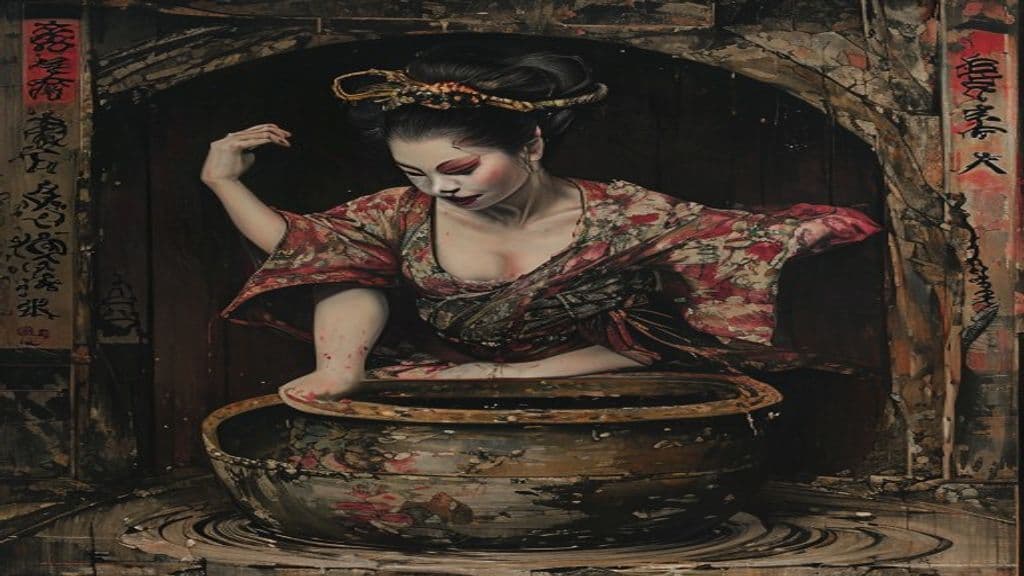
In the central Amano‑Iwato myth, Amaterasu withdraws into the Heavenly Rock Cave and the world is plunged into darkness. The kami Ame‑no‑Uzume overturns a tub near the cave entrance, hangs a mirror and polished jewel as part of the scene, and performs a comic, sexually provocative dance—tearing off clothing in front of the assembled deities—which provokes laughter and curiosity and lures Amaterasu out, allowing the sun to return. She later accompanies Ninigi on his journey to earth (by Amaterasu's command), meets Sarutahiko Ōkami at the boundary between heaven and earth, persuades him to allow passage, and falls in love and marries him; that marital union is linked in the sources to the foundation of the Sarume clan.
Mythic texts emphasize Uzume's actions rather than a fixed physical portrait: she is described performing atop an overturned tub and tearing off clothing to provoke laughter. Later performance and popular imagery present her as the comic/sensual female figure Okame in kyōgen theatre. Shrine and festival merchandise sometimes show masks or pictures of Uzume paired with Sarutahiko at events such as Tori‑no‑ichi, but the supplied sources do not establish a single canonical iconographic appearance.
The myth credits Uzume with persuasive power enacted through embodied performance: comic, sexually charged dance and stagecraft that can change the mood and decisions of other deities and thereby effect cosmic change in narrative terms (noted most clearly in the luring of Amaterasu and the restoration of light). She is described as a model or originator for kagura (sacred dance) and is associated with later shamanic elements incorporated into Shinto ritual forms (for example, links to Omoto Kagura, Hana Matsuri, and Hayachine Kagura are drawn by sources). She also functions as mediator and companion in mythic journeys and as an ancestral figure for performance lineages (the Sarume). A minor narrative motif records her cutting a sea cucumber's mouth during the descent to earth.
Ajisukitakahikone
Ajisukitakahikone is a kami in Japanese mythic literature (Kojiki/Nihon Shoki). He appears in the transfer-of-rule cycle between heaven and earth, is described as a son of Ōkuninushi, associated with the Kamo cult (called Kamo no ōmikami in some modern museum/catalog entries), and features in narratives that explain landscape formation and meteorological genealogy.
Amaterasu Ōmikami
Amaterasu Ōmikami is the sun deity and a principal kami in Shinto tradition, presented in classical Japanese sources as ruler of Takamagahara (the High Celestial Plain) and the mythic ancestress of the Imperial House through her grandson Ninigi. She is central to shrine cult at Ise and to ritual nomenclature and practice within institutional Shinto.
Amatsumara
Amatsumara (天津麻羅), also called Amenomahitotsu, is a Shinto kami presented in sources as the divine smith of Takamagahara who is said to have aided in making the mirror used in the Amaterasu cave episode and who serves as a patron of earthly blacksmiths.
Ame-no-Koyane-no-mikoto
Ame-no-Koyane-no-mikoto is a male Amatsukami (heavenly kami) in classical Shinto myth, presented as the ritual-official ancestor of the Nakatomi clan and linked genealogically to the Fujiwara. He functions as a divine ritual specialist—performing divination and liturgical speech in foundational myths (notably the Ama-no-Iwato episode) and as guardian of the sacred mirror—and is venerated at major shrines such as Kasuga Taisha and Hiraoka Shrine.
Ame-no-Minakanushi
Ame-no-Minakanushi (天之御中主) is a primordial kami named in Japan's classical creation texts as one of the very first deities to come into being in Takamanohara (High Heaven). Presented in the Kojiki and Nihon Shoki as a solitary, hidden first god, he functions primarily as a mythic point of cosmic origin rather than an actively intervening deity in surviving narratives.
Ame-no-Tajikarao
Ame-no-Tajikarao is a kami in Japanese Shinto myth notable for exceptional physical strength. He appears in the Ama-no-Iwato narrative as the deity who pulls Amaterasu from the heavenly rock cave, and he is venerated at numerous shrines across Japan with associations to physical power and local lineage claims.
Ame-no-Tokotachi
Ame-no-Tokotachi is a primordial kami in classical Shinto cosmology attested in summaries of the Kojiki and Nihon Shoki tradition. Sources identify a very early solitary or among-the-first deity who manifests at the creation of heaven and earth; supplied materials also reference a closely related name, Ame-no-Minakanushi, in English summaries of those chronicles.
Ame-no-hohi
Ame-no-hohi (also rendered Ame no Fuhi) is a male kami in Japanese mythology identified in sources as the second son of the sun goddess Amaterasu. He is principally attested as an ancestral figure: historical rulers of Izumo and the modern heads of Izumo Taisha and Izumo-taishakyo claim descent from him.
Ame-no-wakahiko
Ame-no-wakahiko is presented in the provided sources as a kami in Japanese mythology, described specifically as a god of grains and counted among the Amatsukami (heavenly deities). The sources identify him as a son of Amatsukunitama and note a medieval prose narrative, the Ame no Wakahiko Monogatari, exists about him.
Amenohoakari
Amenohoakari (天火明) is a Japanese kami associated with sunlight, heat, and the ripening of grain; he functions as an agricultural deity and a divine ancestor claimed by multiple clans and hereditary priestly lineages. Textual sources place him within heavenly genealogy (tensonzoku) while other records give alternate parentage, producing divergent traditions about his origins and relationships to other kami.
An (案)
An (案) is a small table, desk, or platform used in Shinto ceremonies to bear offerings. It is a liturgical furnishing and material mediator in shrine rites rather than a sentient supernatural being.
Atago Gongen
Atago Gongen (愛宕権現) is a syncretic mountain guardian venerated around Mount Atago as a local gongen (manifestation) of the bodhisattva Jizō and as a protective kami. Traditionally worshipped by Shugendō practitioners, townspeople, and samurai, the cult emphasizes protection from fire, theft, and disaster and developed through honji-suijaku fusion of Buddhist and Shinto ideas.
Community Record
- [1]Ame-no-Uzume. Wikipedia: Ame-no-Uzumewiki
- [2]Ame no Uzume (Wikidata). Wikidata: Ame no Uzumewiki
- [3]KOJIKI 古事記 (Hi-Res Audiobook). Kojiki source material (archive)literary
- [4]Chapter 28 Sacred Undressing V 3 2. Archive discussion of sacred undressing motif in mythother
- [5]Kagura and The Kojiki | Home of Japanese Mythology 'SHIMANE'. Shimane tourism / mythology page linking Uzume to kagurafolk
- [6]Shinto: Susano-o in Drag? (blog). Blog discussing speculative readings of the Amano‑Iwato dancerother
- [7]Shinto: January 2004 Archives (blog). Blog archive with commentary on related mythsother