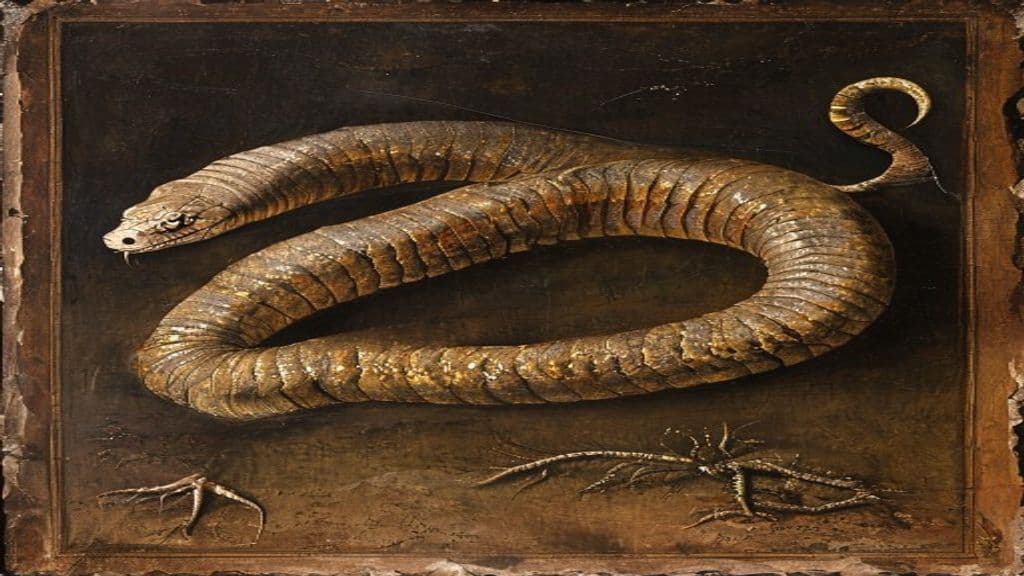
In some classical accounts the amphisbaena is given a mythic origin: Lucan (Pharsalia) relates that amphisbaenae were spawned from the blood that dripped from the Gorgon Medusa's severed head as Perseus flew over the Libyan desert, placing the creature genealogically among monsters produced by Medusa's blood. This Lucanian origin is one attested classical tradition alongside other natural‑history listings that treat the creature as an exotic animal of Libya or India (as in Pliny and later travel lore).
Core descriptions across classical and medieval sources depict a serpentine or lizard‑like creature with a functional head at each end of its body—one in the normal anterior position and a second where a tail would normally be. Because of this arrangement it is said to be able to move forward or backward without turning. Medieval and later illustrations and bestiary variants sometimes add features such as feet, wings, horns, or dragonlike embellishment; some later descriptions depict glowing eyes while Nicander (an early source) describes it as "always dull of eye," and his phrasing suggests blunt chins at both ends.
Classical sources emphasize bidirectional locomotion (it can run or retreat using either head as the lead). Accounts of diet vary: Lucan places it scavenging on corpses in Libya, while some lexica or summaries call it an ant‑eating serpent (the dietary claims are inconsistent across sources). Later folkloric claims and materia medica attribute a range of human‑directed uses to the animal or its parts—Pliny reports folk practices such as wearing a live specimen for safe pregnancy, wearing the skin as a supposed cure for ailments like arthritis or cold, and nailing a carcass or skin to a tree to keep woodcutters warm—but these are recorded as beliefs or remedies rather than proven inherent supernatural powers.
Weaknesses
None recorded.
Wards
- substanceamphisbaena (worn live)
- substanceamphisbaena skin (worn as cure)
- otheramphisbaena carcass or skin nailed to a tree
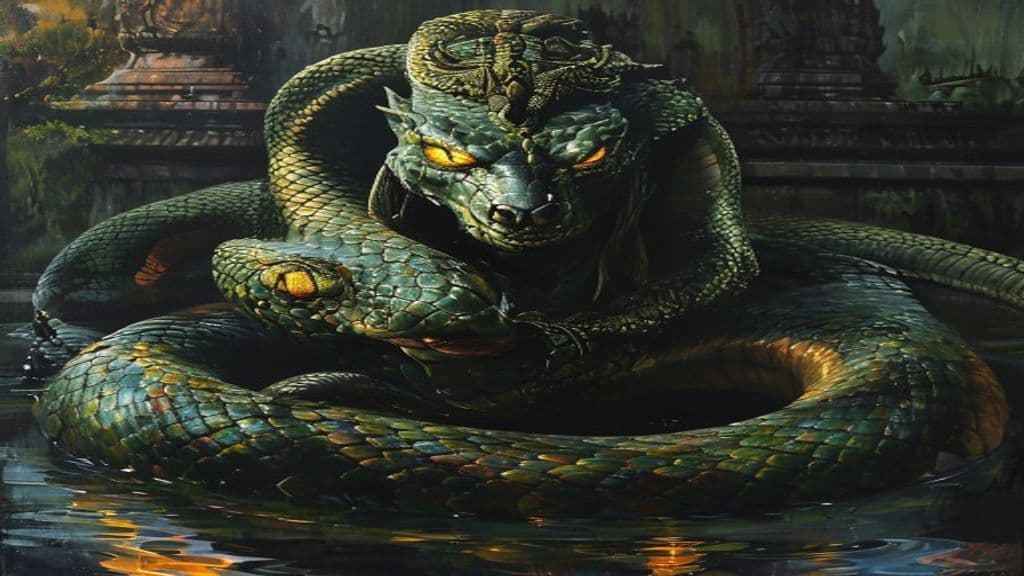
Naga
Divine serpent beings of Hindu, Buddhist, and Jain cosmology — powerful guardians of water, earth, and underground treasures. Revered as deities in South and Southeast Asia.

Medusa (the Gorgon)
Medusa, also called Gorgo or the Gorgon, is one of the three Gorgons in ancient Greek mythology. She is described as a mortal woman whose hair is composed of living snakes and whose gaze turns onlookers to stone; she is usually named as a daughter of the sea-associated figures Phorcys and Ceto and sister to Euryale and Stheno.
Achates
Achates is the faithful human companion and attendant of Aeneas in Virgil's Aeneid, conventionally known by the epithet 'fidus Achates' and used in Latin literature as the by-word for an intimate, loyal companion.
Catoblepas
A legendary Greco‑Roman monstrous beast reported from Ethiopia: a mid‑sized, sluggish quadruped with a heavy head habitually pointed toward the ground and described in sources as possessing lethal properties expressed either as a deadly gaze or poisonous breath.
Forest Bull
A marvelous bovine attested in ancient natural-history and medieval bestiary traditions, the Forest Bull (Aethiopian or Ethiopian Forest Bull) is described by classical authors as an extraordinary, dangerous breed of cattle reported from Ethiopia and depicted with hyperbolic size, strength, and near-invulnerability.
Amphinomus
Amphinomus (Ἀμφίνομος) is a personal name borne by several human figures in Greek tradition, most notably a princely suitor of Penelope in Homer's Odyssey; other bearers appear in local genealogies, a Catanian civic legend, and a later historical record as a geometer. The sources treat Amphinomus as mortal personages rather than a supernatural being.
Amphion
Amphion is a figure (or set of figures sharing a name) in Greek myth best known as the son of Zeus and Antiope, twin brother of Zethus, husband of Niobe, and famed in some traditions for using music to raise the walls of Thebes. The name also appears for several minor mythic characters (an Argonaut, an Achaean at Troy, a centaur), indicating multiple onomastic uses in the Greek corpus.
Amphion and Zethus
Amphion and Zethus are twin brothers of Greek myth who function as the culture‑founding heroes of Thebes: Amphion the musician and Zethus the hunter/herdsman who together conquer Thebes, build the Cadmea, and rule jointly. Their story links human founders with gods (commonly Zeus as father; Hermes, Apollo and Artemis as intervening deities) and ends in later family tragedy surrounding Niobe and divergent accounts of the brothers' deaths.
Amphiptere
A heraldic creature described in available sources as a winged serpent used in European heraldry; presented as a graphic emblem rather than a living supernatural being in the provided material.
Amphirho
Amphirho (Ancient Greek: Amphirho) is attested in the supplied sources as one of the Oceanids — daughters of the Titans Oceanus and Tethys — and is named in a brief mythological taxonomy entry. The name is said in that source to possibly mean "surrounding-river" (from amphi- and rhoos). Modern uses of the form "Amphiro/Amphirho" appear in the provided sources as taxonomic and commercial names (e.g., Wikidata taxon entry, a butterfly species, and a company/product), but those uses are not presented in the supplied materials as folkloric attestations.
Amphithea
Amphithea (Ancient Greek Ἀμφιθέα) is a recurring personal name in ancient Greek mythic genealogies, borne by several mortal women who function as wives, mothers, and sisters within Argive, Nemean, Odyssean, and Aeolian family networks. She is not presented in the sources as a supernatural being but as a human figure whose primary narrative role is genealogical linkage among heroic lineages.
Amphithemis
Amphithemis (Ancient Greek: Ἀμφίθεμις) is a name applied in Greek literary tradition to at least two distinct mythic figures: a semi-divine progenitor, son of Apollo and Acacallis connected with Libya and eponymy (also called Garamas), and, in a later poetic treatment by Nonnus, a centaur among Dionysus' retinue. The figure appears in genealogical material (Apollonius/Hyginus tradition) and in Late Antique epic (Nonnus' Dionysiaca).
Amphithoë
Amphithoë is a named Nereid in Greek mythology, listed among the fifty daughters of Nereus and the Oceanid Doris and identified in modern summaries as the Nereid associated with sea currents. She is attested as a member of the collective of sea-nymphs but is not the subject of independent myths in the supplied sources.
Amphitrite
Amphitrite is an ancient Greek sea-divinity, queen of the sea and consort of the sea-god Poseidon; in poetry her name is often used metonymically for the sea itself. She is counted among the daughters of Nereus and Doris in Hesiod and in some accounts is also listed among the Oceanids, and appears chiefly in mythic narrative and iconography rather than as an independent civic cult figure.
Community Record
- [1]Amphisbaena — Wikipedia. Wikipedia entry 'Amphisbaena' (summary of classical and medieval traditions, including Lucan, Nicander, Pliny references and Códice Casanatense note)wiki
- [2]Amphisbaena (ancient Greek monster) — Marvunapp. Ancient Greek monster account summarizing classical attestations and later receptionother
- [3]Medieval Bestiary: Amphisbaena (beast144). Medieval bestiary entry describing the two‑headed lizard/serpent and noting bidirectional movement and later iconographic variantsliterary
- [4]Medieval Bestiary: Amphisbaena (beastsource144). Source notes and translations relating to medieval bestiary treatments of the amphisbaenaliterary
- [5]Amphisbaena (lizard) — Wikipedia (modern reptile genus). Modern biological usage of the name and discussion of real worm‑lizards that may have inspired classical reportswiki
- [6]Códice Casanatense (summary on two‑headed snakes of India). Reference in the Wikipedia summary to an illustration in the Códice Casanatense captioned 'two headed snakes of India are harmless' (early modern travel/inventory context)wiki