
Amun is attested in Egyptian sources from the Old Kingdom (Pyramid Texts) where his name imn conveys a hidden or invisible quality. Initially a local Theban tutelary deity and paired with a consort (Amunet), his cult gained political and religious importance with Thebes' ascendancy; by the 11th Dynasty and especially during the New Kingdom (16th–11th centuries BC) Amun became Egypt's preeminent god. In the New Kingdom he is frequently fused with the sun‑god Ra to form Amun‑Ra, portrayed as a transcendental, self‑created creator deity and king of the gods. As Egypt expanded its influence, Amun was identified with local high gods in conquered or neighboring regions (for example a ram deity in Kush) and later equated with Zeus/Jupiter Ammon in Greco‑Roman contexts.
Egyptian iconography presents Amun in several related modes. He is commonly portrayed in anthropomorphic form (male deity imagery in temple statuary and reliefs) often associated with a tall double‑plume headdress in Egyptian art (noted in broader Egyptological literature). After contact and identification with Nubian/Kushite religious forms, Amun is also represented with ram attributes—ram's horns or ram‑headed forms, and in Kushite contexts specifically as a woolly ram with curved horns. The provided sources emphasize the ram‑horn motif and the deity's traditional anthropomorphic cult images at Thebes and Karnak.
Sources describe Amun (especially as Amun‑Ra) as a self‑created, transcendental creator deity and king of the gods. He functions as a royal patron whose favor legitimates pharaonic rule and is credited with military and political success. Votive texts portray him as a compassionate intercessor ‘‘who comes at the voice of the poor in distress,’’ one who forgives and rescues supplicants, upholds Ma'at (truth and proper order), and acts as protector—described in sources as a champion of the poor, protector of travelers, and a divine advocate in personal piety. The Siwa oracle is singled out as his named oracular locus in Western Egypt.
Weaknesses
- conditionNo specific supernatural weaknesses recorded in provided sources
- conditionInstitutional/political suppression noted: diminished prominence during the Atenist period under Akhenaten (sources describe this as a heretical suppression rather than a mythic weakness)
Wards
- ritualConfession and demonstration of worthiness (petitionary protocol)
- otherCultic propitiation through temple offerings, building works, and votive stelae at Karnak and other precincts
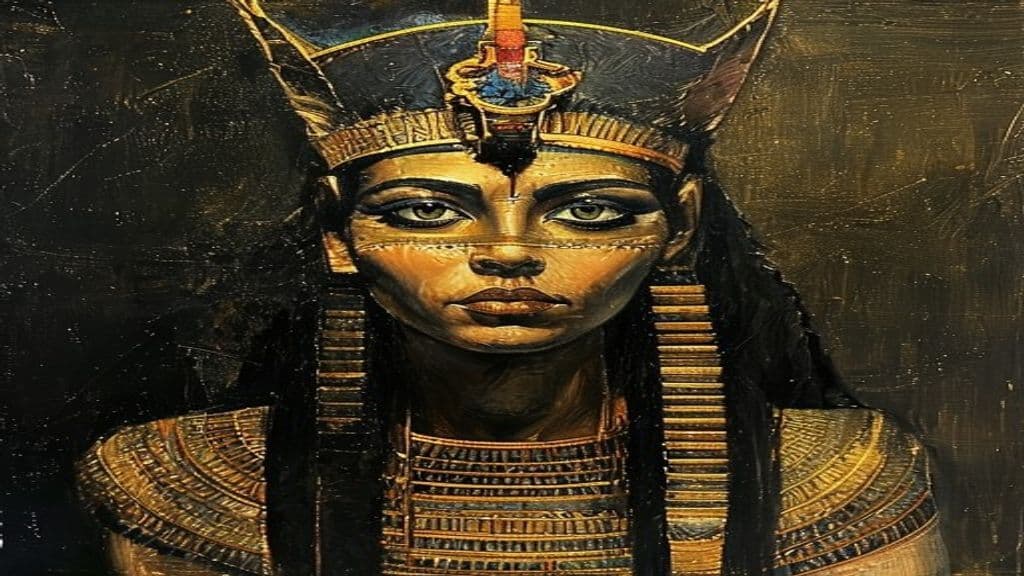
Mut
Mut is an ancient Egyptian mother goddess associated with the primordial waters (Nu), the Theban Triad, and the Eye of Ra corpus. She functions as a cosmic maternal principle, a local patroness of Thebes with temples and priesthood, and a shifting consort/maternal figure within Amun-centered theology.

Zeus Ammon
A Greco-Roman syncretic identification of the Egyptian deity Amun/Ammon with the Greek chief god Zeus, centered on Amun's oracle at the Siwa Oasis and used in Hellenistic and Roman contexts for religious, political, and iconographic purposes.

Community Record
- [1]Amun — Wikipedia. Wikipedia: 'Amun' entry (sections on name, worship, Amun‑Ra, votive texts, Siwa oracle, Nubian identification).wiki
- [2]Amun — Wikidata. Wikidata entry for Amun (identification as Egyptian and Berber deity; linked data).other
- [3]The Kingdom Of Kush: Elite Power Through Religious Synthesis And Trade Monopoly (c.1070 BCE–350 CE). Archive text discussing Kushite identification with Amun and ram representation in Nubian contexts.other
- [4]For Dreams, For Magic, For Truth, And For Freedom.. Collected excerpts and translations cited in research notes (votive texts and discussion of petitionary religion).other