
According to Tamil Vaishnava tradition, Periyalvar found a baby girl under a tulasī plant in the garden of the Srivilliputhur temple and named her Kotai; she was raised by him and became the only female among the twelve Alvars. Hagiography and temple narrative hold that she vowed to marry only Viṣṇu, composed devotional poetry in that spirit, and was eventually ritually united with Ranganatha (Viṣṇu) at Srirangam. The tradition also identifies her as an avatar of Bhūmi (an aspect of Lakṣmī), linking her human life-story to divine embodiment. These narratives provide the basis for calendrical observances such as her birth festival (Adi Puram), her wedding day (Panguni Uthiram), and the Margazhi season recitation of the Tiruppavai.
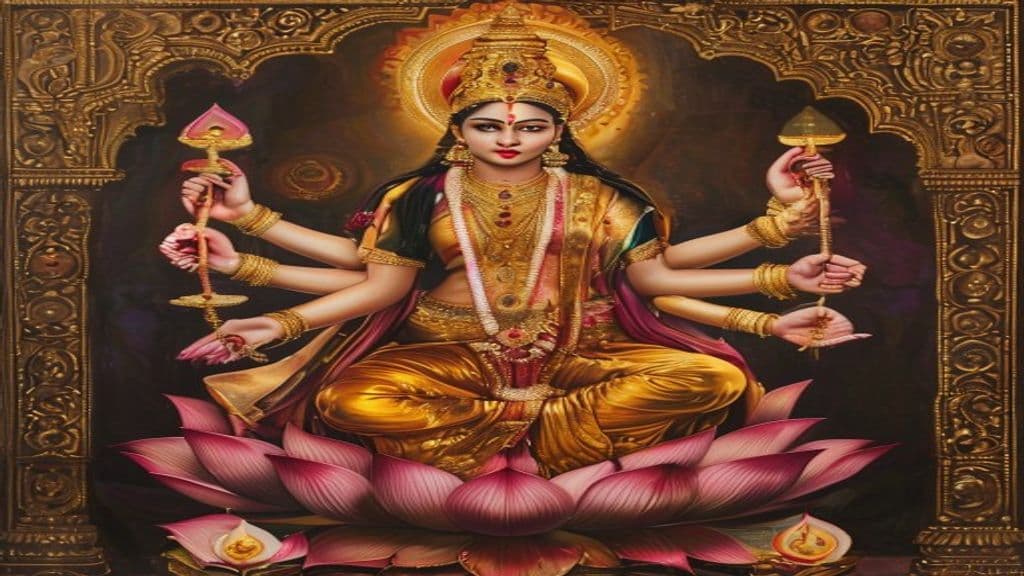
Descriptions are drawn from temple iconography and poetic tradition rather than eyewitness biography. Temple images show her with an ancient Tamil hairstyle — a side-bunned tuft adorned with jasmine and elaborate jewellery — and frequently holding a handcrafted parrot in her left hand (in Srivilliputhur the daily parrot is made of fresh leaves, pomegranate flower for the beak, bamboo sticks for legs, banana for the body, oleander petals for feathers, and a pinwheelflower for the head). Literary portrayals often cast her imaginatively as a gopi or bride devoted to Kṛṣṇa/Viṣṇu.
The sources attribute to Andal literary, devotional, and ritual efficacy rather than overtly supernatural powers. She composed the Tiruppavai (30 verses) and the Nachiyar Tirumoli (about 140 verses), works that model total bhakti and are ritually recited (especially during Margazhi). Hagiographic tradition recounts miraculous motifs—most notably the garland episode in which only the garland worn by Kotai was acceptable to the temple image of Viṣṇu—framing her as uniquely dear to Viṣṇu and justifying ritual practices that transfer her worn garland between shrines. She is regarded within the tradition as an incarnation of Bhūmi/Lakṣmī and as a paradigmatic bride-consort of Viṣṇu.
Ancient Kings of Finland
In early literary sources, the Ancient Kings of Finland are described as hypothetical or mythical monarchic systems associated with ancient Finland. (Note: 1. Power tier: Lower to Primordial (given the lack of specific abilities and behaviors) 2. Abilities and behaviors are described as 'generally vague', so this section should be reworded or removed 3. )
Ancient Mesopotamian Underworld
The ancient Mesopotamian underworld is a fundamental aspect of their cosmos, described as a 'lowermost part of the ancient near eastern cosmos', where the dead reside and continue a transpositional version of life on earth. (Note: * Power tier should be Ancient (deity-level) instead of Primordial (cosmic), as it is not a fundamental aspect of creation, but rather a concept within their cosmos. * Abilities: Inhabitants do have s)
Ancient One
A name/title applied to multiple fictional characters across comics, film, animation, and tabletop gaming. Most prominently a long-lived mystic in Marvel Comics and the Marvel Cinematic Universe who served as mentor to Doctor Strange and as Earth's chief sorcerer; other unrelated uses include a Pathfinder Gloomspires ghast and occasional separate comic/animation characters.
Ancile
The Ancile is a sacred shield in Roman tradition, said to have fallen from heaven and perpetuating Rome's sovereignty. (Note: 1. Power tier should be Ancient (deity-level) instead of Primordial. 2. Origin story should note that it is said to have "fallen from heaven" but does not imply direct supernatural or divine origin. )
Ancius
Ancius (variant Ancus) is attested in the supplied materials as an ancient Roman personal/family name that appears in classical textual indexes, Latin passages, and in modern bibliographic usages (e.g., as part of the name attributed to Boethius). The provided sources do not support treating Ancius as a supernatural being or folkloric creature.
Ancyor
Ancyor (Ancient Greek Ἀγκύορα, transl. Ankyora) is an Arcadian prince in Greek myth, listed among the numerous sons of King Lycaon. He appears in genealogical compilations and myth summaries as one of the brothers who, with their father, offended Zeus and were slain by the god as punishment.
Andariman
Andariman is a named antagonist in the Shahnameh cycle of Greater Iran, depicted in manuscript illustrations and genealogical lists as an enemy combatant—described in a manuscript caption as "one of the Turkman host"—who fights the Iranian hero Gorgin (Gurgin) and is shown slain in illustrated episodes.
Andarta
Andarta is a local Celtic goddess attested by votive inscriptions in and around the town of Die (modern Drôme) in the territory of the Vocontii during the Roman imperial period. She is recorded in seven dedications as Dea Augusta Andarta (c. 150–200 AD) and appears to have functioned as a tutelary deity associated with civic welfare, victory, and Romanized cultic practice.
Andhrímnir
Andhrímnir is the named cook of the Æsir and the einherjar in Old Norse myth, responsible for slaughtering and preparing the beast Sæhrímnir daily in Valhalla and for producing the gods' mead from Heiðrún's milk. He is attested in the Poetic Edda and summarized in modern reference works.
Andjety
Andjety is an ancient Egyptian regional deity of the ninth nome (Andjet/Busiris) associated with kingship, funerary renewal, and local underworld functions; he appears in Pyramid and Coffin Texts and is often syncretized with Osiris in temple imagery and royal ritual.
Andlang
Andlang (Old Norse Ǫndlangr / Andlang) is presented in Snorri Sturluson's Prose Edda as the second of a ninefold scheme of heavens, placed between the first heaven (containing the halls of the gods) and the third heaven, Vídbláin. In Snorri's account Andlang functions as a shelter and dwelling-place for the souls of the dead during and after the destruction of Ragnarök.
Andraemon
Andraemon (Ancient Greek: Ἀνδραίμων, Andraímon) is a personal name borne by several mortal figures in Greek myth and genealogical tradition. The name appears across variant accounts as husbands, fathers, kings, colonists, and a suitor; it functions within heroic genealogies and local foundation stories rather than as a supernatural being.
Community Record
- [1]Andal. Wikipedia article 'Andal' (access provided research notes)wiki
- [2]Wikidata entry for 'Andal' (Q37240679). Wikidata entry Q37240679 (noted as providing only a label in the research notes)other
- [3]Miguelito Magno Castaneda and Lea Andal Castaneda (PACER record). Archive record (legal case metadata) noted as unrelated to the saintly figure in the research notesother