Andlang is attested in Snorri Sturluson's Prose Edda, which records a ninefold scheme of heavens and names Andlang as the second heaven. Modern scholars (e.g., Holtsmark, Simek) argue that Snorri's depiction may have been influenced by medieval Christian-Latin concepts of a 'spiritual heaven' (Latin Coelus Spiritualis) as found in the Elucidarius; Holtsmark proposed that an Icelandic formulation andlegr himinn ('spiritual heaven') informed Snorri's terminology and that the and- element encouraged associations with Old Norse andi/önd ('spirit'/'breath'). The conception of Andlang as a distinct heavenly tier with a post-Ragnarök refuge function is thus preserved in Snorri's text and interpreted by later scholars in light of possible syncretism with Christian theological vocabulary.
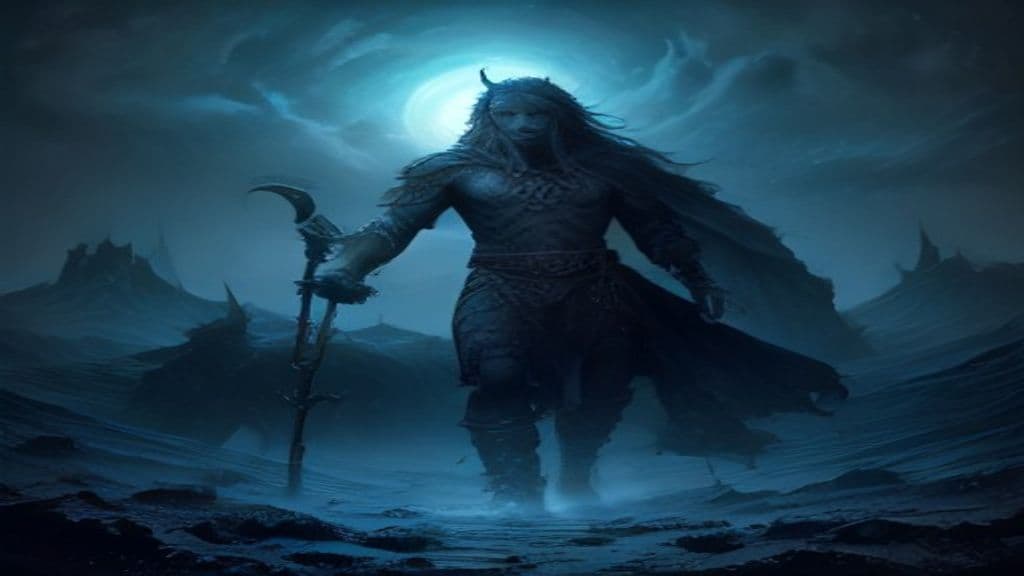
The primary attestations do not provide sensory or pictorial description of Andlang's landscapes or structures; Snorri identifies it only by its position as the second heaven between the gods' heaven and Vídbláin. Scholarly commentary draws on etymological possibilities—associations with andlegr ('spiritual'), andi/önd ('spirit'/'breath'), or senses of extension such as 'extended' or 'endlessly long'—to suggest conceptual resonances (spiritual heaven, extended aether) but the sources contained in the provided material give no concrete visual, auditory, or material details.
As a cosmological region rather than an animate being, Andlang's described function in the sources is ontological: it 'will serve as a shelter and dwelling place for the souls of the dead during and after the destruction of Ragnarök.' The realm's capacity is therefore to receive and house souls in the eschatological aftermath; no agency, motion, speech, or active behavior is attributed to Andlang itself in the cited texts.
Ancyor
Ancyor (Ancient Greek Ἀγκύορα, transl. Ankyora) is an Arcadian prince in Greek myth, listed among the numerous sons of King Lycaon. He appears in genealogical compilations and myth summaries as one of the brothers who, with their father, offended Zeus and were slain by the god as punishment.
Andal
Andal is the sole female Alvar (Tamil Vaishnava poet-saint) venerated in the Sri Vaishnava tradition; traditionally placed in the 8th century CE, she is simultaneously remembered as a human poet-devotee and as an incarnation of Bhūmi/Lakṣmī who becomes ritually united with Viṣṇu. Her corpus (Tiruppavai and Nachiyar Tirumoli), temple cult at Srivilliputhur, and festival practices (including Margazhi recitation and the sending of her garland to major Viṣṇu shrines) form the core of her devotional presence.
Andariman
Andariman is a named antagonist in the Shahnameh cycle of Greater Iran, depicted in manuscript illustrations and genealogical lists as an enemy combatant—described in a manuscript caption as "one of the Turkman host"—who fights the Iranian hero Gorgin (Gurgin) and is shown slain in illustrated episodes.
Andarta
Andarta is a local Celtic goddess attested by votive inscriptions in and around the town of Die (modern Drôme) in the territory of the Vocontii during the Roman imperial period. She is recorded in seven dedications as Dea Augusta Andarta (c. 150–200 AD) and appears to have functioned as a tutelary deity associated with civic welfare, victory, and Romanized cultic practice.
Andhrímnir
Andhrímnir is the named cook of the Æsir and the einherjar in Old Norse myth, responsible for slaughtering and preparing the beast Sæhrímnir daily in Valhalla and for producing the gods' mead from Heiðrún's milk. He is attested in the Poetic Edda and summarized in modern reference works.
Andjety
Andjety is an ancient Egyptian regional deity of the ninth nome (Andjet/Busiris) associated with kingship, funerary renewal, and local underworld functions; he appears in Pyramid and Coffin Texts and is often syncretized with Osiris in temple imagery and royal ritual.
Andraemon
Andraemon (Ancient Greek: Ἀνδραίμων, Andraímon) is a personal name borne by several mortal figures in Greek myth and genealogical tradition. The name appears across variant accounts as husbands, fathers, kings, colonists, and a suitor; it functions within heroic genealogies and local foundation stories rather than as a supernatural being.
Andragius
Andragius (also attested Androgius) is a legendary king of the Britons recorded in Geoffrey of Monmouth’s pseudo‑historical regnal lists and later compilations. He appears as a node in a constructed sequence of rulers—not described as a supernatural being—and is principally attested by name, genealogical relationships, and position in succession.
Andras
Andras is a named infernal spirit from the Western grimoire/Goetic tradition, described as a hostile officer who sows discord and is dangerous to conjurers; modern roleplaying adaptations recast him as a demon raised from murderous souls with a purpose to destroy mortals.
Andrast
Andrast is a Sindarin place-name in J. R. R. Tolkien's Middle-earth, denoting a long coastal cape or peninsula in southwest Gondor (also identified with Ras Morthil). It is a geographic toponym recorded in Tolkien's maps and scholarly indexes rather than a sentient or supernatural being.
Andraste
Andraste (also attested as Andrasta or Andate in some passages) is a named supernatural figure invoked by the Iceni in the Roman account of Boudica's rebellion (AD 60). Recorded by Dio Cassius as a recipient of Boudica's rallying prayer, Andraste functions in surviving sources as a tutelary war figure associated with victory and the preservation of liberty.
Andrea Beaumont (the Phantasm)
Andrea Beaumont is a fictional human character in the DC Animated Universe who, as the masked vigilante known as the Phantasm in Batman: Mask of the Phantasm (1993), stages a Death‑like avenger persona. Her apparent supernatural effects are produced by theatrical devices (not innate powers) and she functions narratively as a foil and dark parallel to Bruce Wayne/Batman.
Community Record
- [1]Andlang — Wikipedia. Wikipedia, 'Andlang' (summary of Snorri's account and scholarly commentary)wiki
- [2]Andlang — Wikidata. Wikidata item Q1609889 for Andlangother
- [3]Holtsmark (1964) on Andlang and the Elucidarius. Holtsmark, 1964: argument that Andlang derives from andlegr himinn and association with andi/ånd; discussed in research notes providedacademic
- [4]Simek (1995) on Andlang and Coelus Spiritualis. Simek, 1995: explores functional connection between Andlang and the Latin Coelus Spiritualis in the Elucidarius; referenced in research notes providedacademic
- [5]Prose Edda (Snorri Sturluson) — nine heavens scheme. Snorri Sturluson, Prose Edda: attestation of a ninefold heaven with Andlang as the second heaven and Vídbláin as the third; summarized in the provided materialliterary