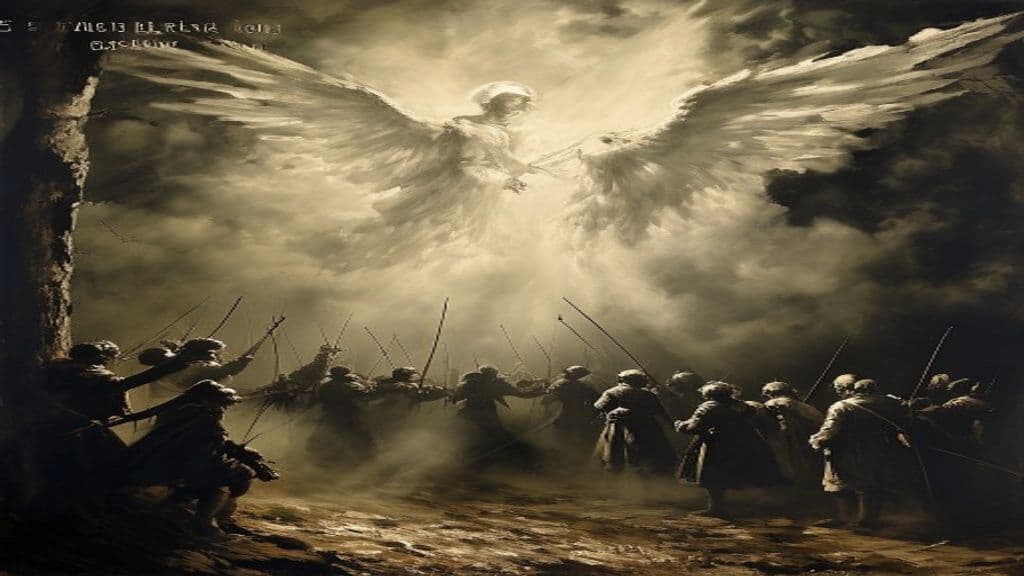
The legend traces to Arthur Machen's short story "The Bowmen," published 29 September 1914, which fictionalized phantom Agincourt longbowmen summoned to destroy a German host. Machen's tale, originally not labeled as fiction in its first newspaper appearance, was absorbed into wartime rumor. From late 1914 into 1915 the image circulated via newspapers, spiritualist magazines (an account published 24 April 1915 is noted in sources), parish magazines, sermons and songs; by May 1915 the angels were frequently invoked in sermons as evidence of divine providence. Machen later denied factual intent and added prefaces, but his fictional imagery had already seeded multiple variant eyewitness and press reports that transformed the story into a widely believed legend.
Accounts vary. Machen's fictional depiction described "a long line of shapes, with a shining about them" framed as phantom medieval longbow archers. Later contemporary reports and popular retellings shifted toward a "strange luminous cloud" and ultimately to explicit "angelic warriors." Some memoirs and spiritualist-circulated testimonies mentioned visions of Joan of Arc or the archangel Michael alongside or instead of bowmen. Sources record this evolution and disagreement among descriptions.
Reported actions in sources credit the phenomenon with timely martial intervention: protecting British troops during the retreat at Mons and, in Machen's tale and subsequent rumors, destroying or inflicting bizarre wounds on German forces (e.g., arrow wounds). Sources emphasize that many concrete behavioral details derive from Machen's fiction and from rumor-amplification in newspapers and spiritualist outlets; there is no single verified eyewitness or official military corroboration in the supplied materials. The phenomenon functions in sources as a providential, battlefield-assisting apparition.
Angel of Portugal
A Catholic devotional national guardian angel venerated as the heavenly custodian of Portugal. Recognized in popular devotion, private revelation narratives (notably the 1916 visitations connected to Fátima), and in Portuguese liturgical practice through a feast instituted in the early 16th century and restored in the 20th century.
Angel of the Lord
A recurring divine messenger in the Hebrew Bible and New Testament who appears on behalf of the God of Israel, acting as God's representative in speech and deed. The figure—Hebrew מַלְאַךְ יְהוָה (mal’ākh YHWH)—functions as intermediary, guide, protector, judge, and announcer at decisive narrative moments.
Angel of the Presence
A high-ranking heavenly attendant described in Hebrew and Second Temple literature as one who "stands in the presence" of God and acts on God's behalf toward Israel. Sources treat the figure either as an elite created angelic office (one of the attendants who enter before the Lord) or, alternately, as a scriptural idiom referring to God's own saving presence.
Angelia
Angelia (Ancient Greek: Ἀγγελία) is an ancient Greek poetic personification of 'Message', attested in Pindar (5th century BC) as named a daughter of the messenger-god Hermes. She functions in the literary-cosmic vocabulary as the embodiment of a delivered message rather than as a separately attested cultic deity or independent supernatural class.
Angelos (Angelia)
Angelos (Ancient Greek: Ἄγγελος) or Angelia (Ἀγγελία) is a minor divine figure in Greek myth attested only in a scholion on Theocritus' Idyll 2. She is described as a daughter of Zeus and Hera who was entrusted to and raised by nymphs; the preserved account is fragmentary and breaks off abruptly.
Angels (Malāk) in Islam
Heavenly beings in Islamic doctrine created from light, part of the unseen (ghayb) and the divine order, who obey God and perform functions such as conveying revelation, recording deeds, and executing divine commands. Belief in angels is one of the six articles of faith in Islam and they occupy roles across cosmology, eschatology, and devotional teaching.
Angerona
Angerona (also Angeronia; local form Ancharia at Faesulae) is a polyvalent goddess in ancient Roman religion associated with relief from pain and sorrow, protection of Rome (including custody of the city's "sacred name"), and a calendrical role at the year's turning (Angeronalia/Divalia near the winter solstice). She is attested in state cult practice (pontiff-offered sacrifice) and in local altars, and is discussed by modern scholars as a tutelary, healing, and liminal deity.
Anggitay
A Philippine folkloric female equid–human hybrid often described with the upper body of a woman and the lower body of a horse. Frequently compared to the Greek centauride and sometimes presented as a female counterpart to the tikbalang; traditionally associated with an attraction to gemstones and jewelry and with a local homeland in Santo Tomas, Batangas in some accounts.
Angharad Golden-Hand
A literary heroine of medieval Welsh romance, Angharad Golden-Hand (Welsh: Angharad Law Eurawc) appears as a lady of King Arthur's court in the tale of Peredur son of Efrawg. She functions in the narrative as Peredur's beloved whose spoken declaration of love for the Mute Knight permits Peredur to break his vow of silence. The name is later reused in Renaissance and modern literature with different meanings.
Angharradh
Angharradh is a triune elven deity of the Seldarine in the Forgotten Realms setting, described in sources as a single greater goddess who contains three aspects. She is associated thematically with motherhood, union, and triadic unity and is worshiped by elven clergy within the setting's fiction and game materials.
Angiras
Angiras (Sanskrit Aṅgiras/Aṅgirāḥ) is primarily a Vedic rishi (sage) and eponymous lineage (Angirasa) associated with authorship of Vedic hymns, priestly/fire functions, and transmission of mantras; later Puranic accounts multiply his identities in genealogies and lists of sages.
Anglo-Saxon Deities
A list of deities from the Anglo-Saxon pantheon, likely derived from Old English and other Germanic languages. (Note: 1. Power tier: Primordial seems too high given the sparse written record and limited information on abilities. 2. Appearance: Delete statement as no physical descriptions are provided in available sou)
Community Record
- [1]Angels of Mons. Wikipedia contributors, 'Angels of Mons,' Wikipedia, The Free Encyclopedia.wiki
- [2]Wikidata: Angels of Mons (Q1132734). Wikidata entry Q1132734, 'Angels of Mons'.other
- [3]Skeptoid / Archive summary: The Angel of Mons. Archive: 'The Angel of Mons' (Skeptoid summary / archive copy).other
- [4]China Mail, 7 September 1915 (press circulation example). China Mail, 7 September 1915 (archival newspaper reproduction referenced in notes).other
- [5]Sud 872701 (archival item cited in notes). Archive item 'Sud 872701' (referenced in notes on wartime press circulation).other