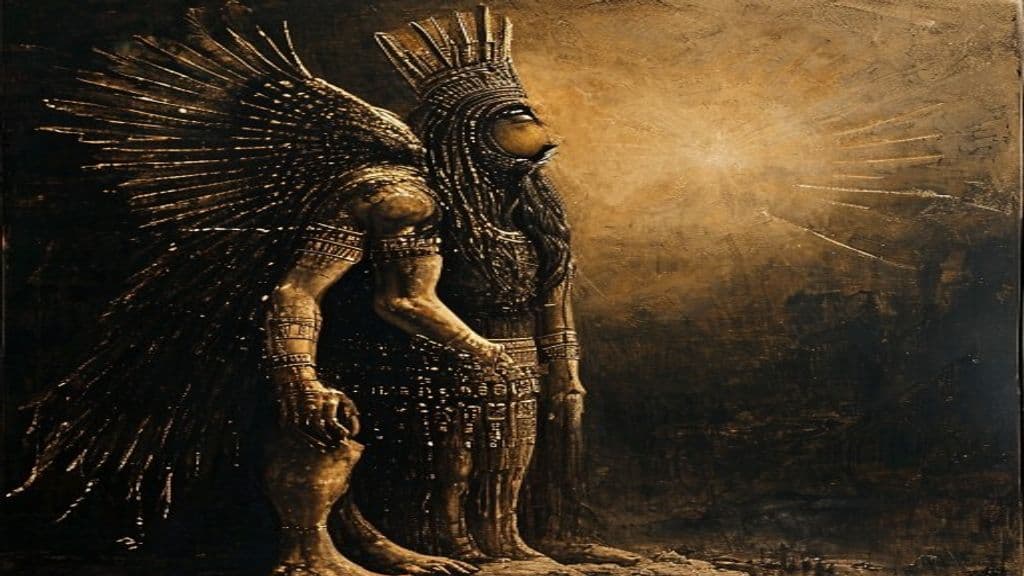
The name An (Sumerian) literally means "sky" or "heaven" and functions both as the common noun for the sky and as the theonym; thus An/Anu is the personified sky itself. God lists (e.g., An = Anum) place him at the head of the pantheon as the progenitor or ancestor of many deities. Traditions vary about his consort—attested pairings include Ki (Sumerian earth), Urash, Antu (Akkadian earth goddess), and more sparsely Nammu—and many gods are listed as his descendants. In Hurrian/Hittite‑transmitted myths Anu appears as a prior ruler who is overthrown by Kumarbi, and in Mesopotamian textual history theologians in late Seleucid Uruk redefined Anu into a more actively worshipped deity.
Primary sources and the supplied summaries provide no stable anthropomorphic iconography; instead Anu is primarily identified as the sky/heaven personified. Linguistically his Sumerian name An doubles as the sign for "sky," and the divine determinative normally used before names was not applied to An in Sumerian texts because the sign itself reads as An. No consistent visual attributes are recorded in the supplied material.
Anu is chiefly attested as the source of legitimation—he bestows anûtu/anuti ("heavenly power" or "Anuship") that underwrites divine and royal authority. Astronomically, Mesopotamian schema assign him the middle celestial band (one of three "Ways" alongside Enlil and Ea). Narrative episodes show selective agency: in the Epic of Gilgamesh Anu is father to Ishtar and grants her the Bull of Heaven; in the Adapa tradition Anu summons Adapa and orders food and water of immortality to be offered (which Adapa refuses following Enki's warning); and in the Kumarbi cycle Anu is a former ruler who is overthrown when Kumarbi bites off his genitals, a succession motif. Overall, however, many periods portray his practical cultic and mythic activity as limited compared with other city deities.
Weaknesses
- otherNo specific weaknesses attested in supplied sources
Wards
- otherNo protective wards or rituals against Anu are documented in the supplied sources

Community Record
- [1]Anu. Wikipedia entry "Anu" (accessed via supplied research notes)wiki
- [2]Anu (Wikidata). Wikidata item Q11852312 (referenced in supplied research notes)other