
Enlil appears in early Sumerian tradition as a chief god whose name combines EN ('lord') with the element LÍL (variously interpreted as wind, storm, or a spirit-term). In the cosmogonic role attributed to him, Enlil effects the separation of An (heaven) and Ki (earth), thereby making the world habitable for humans. His chief cult center at Nippur, where the E-kur temple served as the 'mooring-rope' between heaven and earth, functioned as the ritual and political locus of his authority; kings sought legitimization through rites at Nippur. Over time his preeminence in Mesopotamian theology declined (notably with the rise of Marduk in later Babylonian religion), though his cult and the symbolism of Nippur remained ritually important.
Direct iconographic descriptions of Enlil are scarce in the provided materials. Hymnic tradition emphasizes his overwhelming holiness—one hymn states he was 'so holy that not even the other gods could look upon him'—and employs metaphorical epithets likening him to a raging storm or a wild bull. Temple descriptions (E-kur gates) include carved scenes such as Imdugud slaying a lion, but these are features of the temple environment rather than detailed, consistent physical depictions of the god himself.
Enlil is depicted as a cosmic agent who orders the universe (separating heaven and earth), a patron of agriculture (credited with inventing the mattock), a legitimizer of kingship, and an administrator of divine justice. Mythic narratives present ambivalent behaviors: in some flood traditions (e.g., the Babylonian flood myth) Enlil sends a catastrophic flood as punishment, while in other accounts (e.g., the Eridu Genesis) he rewards the flood-survivor Ziusudra with immortality. He fathers other important deities (such as Nanna and Ninurta) and functions within a divine court whose decisions affect human society and the cosmic order.
Weaknesses
None recorded.
Wards
- ritualDaily offerings and cult-statue maintenance
- ritualRoyal legitimization rites at Nippur

Ninlil
Ninlil is a principal goddess of ancient Mesopotamia, worshipped chiefly at Nippur and Tummal as the consort of Enlil. She shares with Enlil authority in determining fates and in appointing other deities, is portrayed as mother of major gods in some traditions, and is attested from early Sumerian texts through later Akkadian/Assyrian forms.
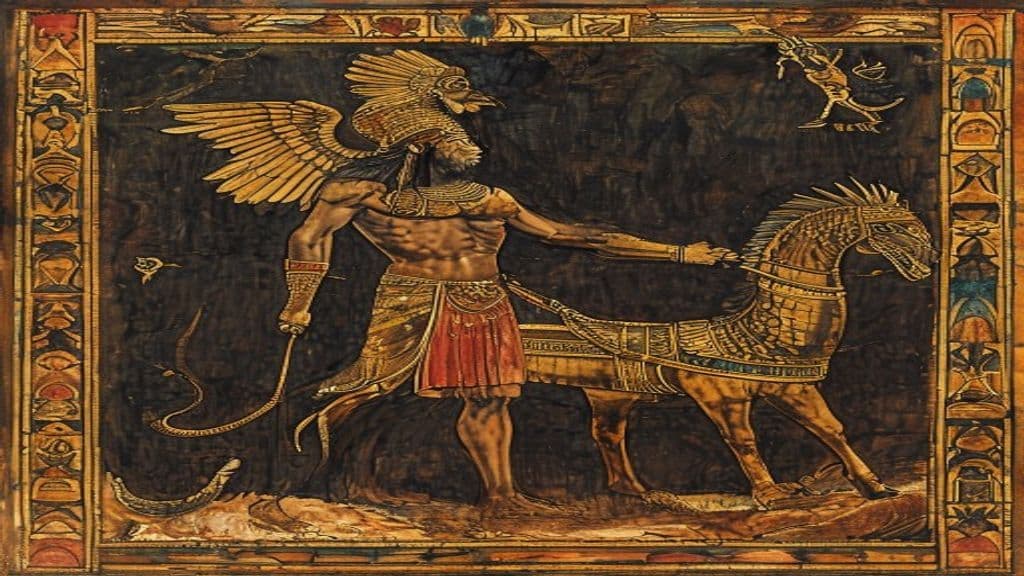
Ninurta
Ninurta is a major deity of ancient Mesopotamia (Sumerian–Akkadian–Assyrian–Babylonian) whose roles include agriculture, healing/exorcism, law and scribal authority, and martial champion of the gods. He is attested from the mid-third millennium BC onward and was venerated at city cult-centers such as Nippur (Eshumesha), Girsu/Lagash (as Ninĝirsu), and later in Assyrian Kalhu.
Community Record
- [1]Enlil - Wikipedia. Wikipedia, 'Enlil' article (selected excerpts compiled in research notes).wiki
- [2]Enlil and Ninlil (myth text). Wikipedia, 'Enlil and Ninlil' (myth summary referenced in research notes).literary
- [3]Enlil and Ninlil - Gateways to Babylon. Translation and text of the 'Enlil and Ninlil' myth (cited in research notes).literary
- [4]Enlil - GatewaysToBabylon (god summary). Summary of Enlil's cult and attributes (used in research notes).other
- [5]Aspects of religious belief and practice in Babylonia and Assyria (archive). Scholarly work on Mesopotamian religion (noted in research materials as broader ritual reference).academic