
Aoandon's best-known representation comes from Toriyama Sekien's Konjaku Hyakki Shūi, where Sekien illustrated a creature labeled Aoandon and associated it with the Hyakumonogatari Kaidankai parlor-game. Sources link the name and concept to the practice of placing candles in blue-paper andon lamps during that ritual; Sekien's compilation presents Aoandon as the spirit that appears after the final (one-hundredth) tale is told. The available sources do not assert whether Sekien invented the figure or recorded a preexisting folk belief beyond his illustration and labeling.
In the cited illustration and descriptions Aoandon appears as a womanlike figure with a blue complexion, twin horns emerging from the brow, and sharp teeth. The depiction ties the blue coloring to the name (blue andon) and frames the being as a personified uncanny presence rather than a naturalistic animal or human.
Classical sources provided do not record specific powers, actions, or interactions for Aoandon beyond its representational role: it is described as the spirit that appeared during Hyakumonogatari Kaidankai after the last story was told. Modern popular-culture works (for example the mobile game Onmyōji) reinterpret Aoandon as a storytelling shikigami who delights in tales; such portrayals are contemporary adaptations rather than documented aspects of the classical descriptions.
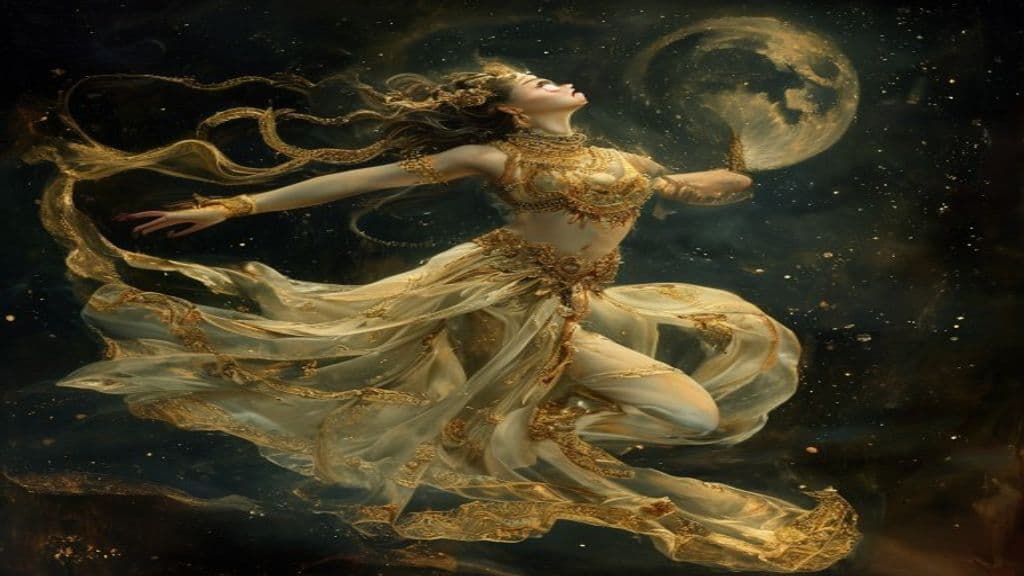
Apsara
Celestial dancers and water nymphs of Hindu cosmology — beautiful semi-divine beings who dance at the court of Indra and, by his command, descend to earth to distract sages from excessive asceticism.
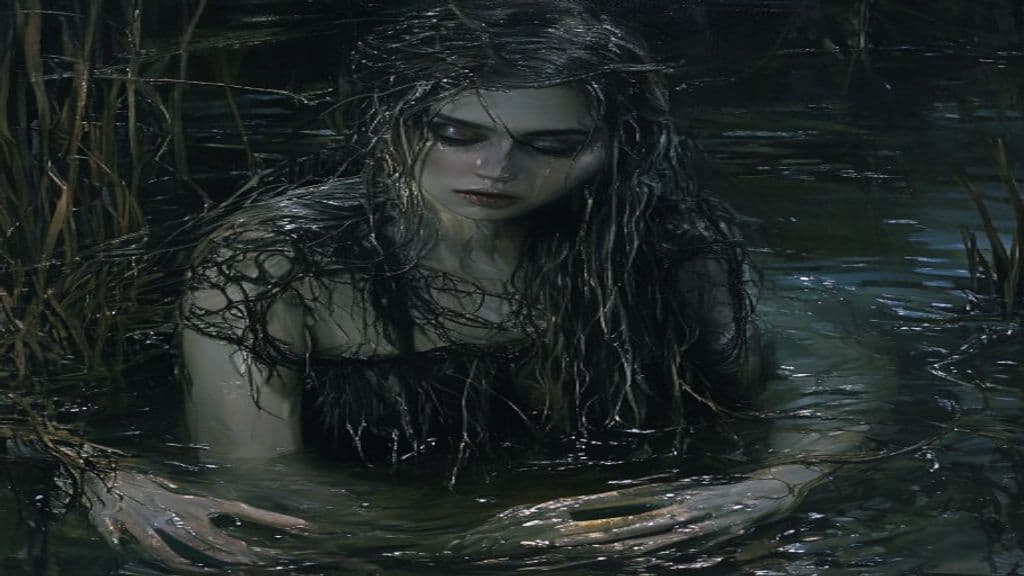
Rusalka
Water spirits in Slavic folklore — the spirits of young women who died by drowning or suicide, bound to rivers and lakes. Beautiful and dangerous, they can bewitch men to their deaths.
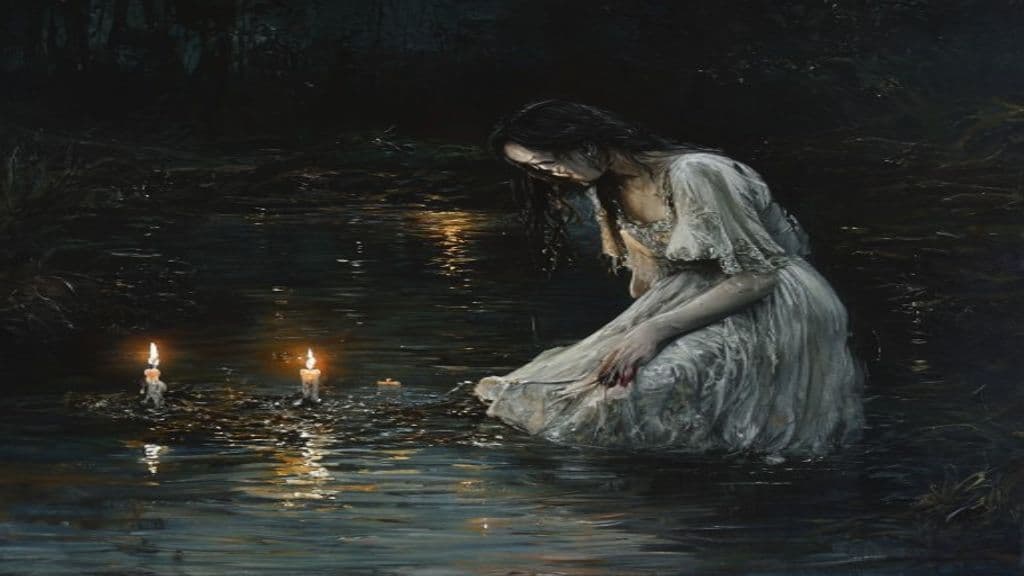
La Llorona
The Weeping Woman of Mexican folklore — the ghost of a mother who drowned her children and now wanders rivers and lakes, weeping for them and taking other children she finds at night.
Akugyo
Akugyo (悪魚) are a class of monstrous aquatic yōkai in Japanese tradition: enormous sea creatures—described in different accounts as giant fish, gigantic ningyo-like merfolk, or fire‑breathing sea monsters—that threaten sailors and fishermen by capsizing boats and devouring drowning people.
Ayakashi
Ayakashi (アヤカシ / あやかし) is a category of yōkai in Japanese folklore associated with phenomena that appear above the surface of bodies of water. The term covers a range of regional reports including atmospheric ghost lights, apparitions, and sea-serpent–type illustrations, and in some locales is identified with vengeful sea-spirits or hazardous marine occurrences.
Dodomeki
A Japanese yōkai depicted in Toriyama Sekien’s collections as a woman cursed with unusually long arms covered in many bird-eye–like marks; the form is described in source material as tied to habitual theft and appears in a Muromachi-period tale where religious preaching leads to its repentance.
Anzu wyliei
Anzu wyliei is a species of caenagnathid oviraptorosaurian dinosaur from the Late Cretaceous Hell Creek Formation of North Dakota, South Dakota, and Montana. The genus name intentionally evokes the bird-like Mesopotamian daemon Anzû, but in the supplied sources it is presented and treated as an extinct biological taxon rather than a living supernatural being.
Anzû (Imdugud)
Anzû, also called dZû or Imdugud, is a large storm-associated bird-figure in Sumerian/Akkadian/Babylonian myth. Portrayed as a hybrid (commonly a massive bird with a lion's head or as a half-human storm-bird), Anzû is credited in mythic narratives with seizing the Tablet of Destinies and thereby challenging the authority of chief gods such as Enlil.
Anárion
Anárion is a proper name attested as a fictional character in J. R. R. Tolkien's legendarium and as a contemporary proper-name used in music and online handles. The supplied sources identify it primarily as a literary/historical name within Tolkien's secondary world and as modern cultural usages (band name, user credits).
Ao Guang (Dragon King of the East Sea)
Ao Guang is the Dragon King (Dragon God) who presides over the East Sea (Dōng Hǎi) in Chinese mythology, literature, and folk-religion. He is presented in sources as a regional aquatic deity associated with water and weather and appears as a named supernatural figure in classical vernacular novels such as Journey to the West and Fengshen Yanyi.
Ao Kuang
Ao Kuang (also attested as Ao Guang) is the Dragon King of the East Sea in Chinese mythology and folk religion, one of a quartet of sea-dragon sovereigns associated in folklore with the cardinal seas. He appears in classical literature and later popular media as a ruler of maritime waters whose favor or displeasure is connected to tides, rain, floods and storms.
Aobōzu
Aobōzu (青坊主, "blue priest") is a Japanese yōkai whose depiction and behavior vary by locality. Appearing as a priestly humanoid with blue coloration or as a priest-faced apparition, it functions in regional legends as a frightening presence that can kidnap, threaten, or haunt people—especially children and schoolchildren—and is sometimes identified as a disguised animal or a mountain deity.
Aoede
Aoede (Ancient Greek: Ἀοιδή, literally 'Song') is an ancient Greek personification named among early lists of Muses. Attested in literary sources as an inspirer of song and poetry, she appears in variant local traditions (three or four Muses) later supplanted by the canonical nine.
Aoi Mac Ollamain
Aoi Mac Ollamain (also Ai Mac Ollamain; recorded as Mac Ollamo and Mac Ollavain) is attested in early Irish material as a member of the Tuatha Dé Danann and is identified specifically as a god of poetry. Surviving references are brief and provide little detail beyond name, group affiliation, and a narrative detail about his birth and survival.
Aonghus mac Úmhór
Aonghus mac Úmhór (older orthography Aengus mac Umor) is a legendary Irish king portrayed in early tradition as ruler of the Fir Bolg of Connacht and eponymous founder associated with settlements on the western coast and the Aran Islands, notably the fortress Dún Aonghasa on Inishmore.
Community Record
- [1]Aoandon — Wikipedia. Wikipedia contributors, "Aoandon," Wikipedia, The Free Encyclopedia.wiki
- [2]Aoandon — Wikidata. Wikidata entry Q1152318: Aoandon.wiki