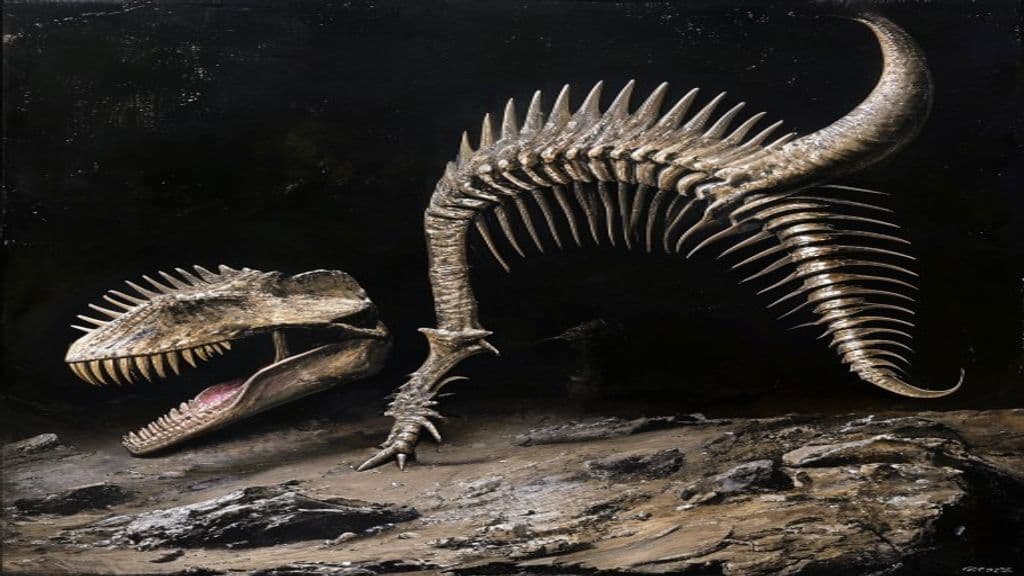
Argentoconodon was erected as a genus to classify fossil material recovered from the Cañadón Asfalto Formation (Patagonia). The taxon was named for its Argentine provenance and its cone‑like (triconodont-like) molariform tooth morphology; the holotype tooth (specimen MPEF-PV 1877) is housed at the Museo Paleontológico Egidio Feruglio. The original description emphasized the tooth's mixture of primitive and derived features and noted that affinities were challenging; subsequent material described around 2011 provided additional cranial and postcranial data that permitted comparisons with taxa such as Volaticotherium, Ichthyoconodon and Jugulator.
Known principally from a single molariform tooth and later supplementary cranial and postcranial remains, Argentoconodon is diagnosed by a triconodont-like molar with cone-shaped cusps and a combination of primitive and derived characters. Postcranial elements (reported in later descriptions) include a femur whose shape and proportions resemble those of Volaticotherium: a specialized morphology described as lacking a distinct femoral head and optimized for leg extension and resistance to stresses interpreted as associated with aerial locomotion. No soft-tissue, integumentary, or coloration data are preserved in the sources; reconstructions of membranous gliding surfaces are inferential and based on comparison to related taxa.
Inferences from dental and postcranial morphology indicate Argentoconodon was most likely animalivorous/carnivorous, with shearing-adapted molars consistent with a diet of vertebrate or other animal prey. Several postcranial similarities to the Jurassic gliding eutriconodont Volaticotherium have been used to infer arboreal and gliding capabilities for Argentoconodon; this interpretation rests on comparative femoral anatomy (specialized, without a clear femoral head) and functional arguments rather than direct preservation of a patagium. Phylogenetic placement is uncertain due to fragmentary remains, so ecological reconstructions remain interpretive.
Amphilestes
Amphilestes is a genus of extinct eutriconodont (triconodont-grade) mammal known from Middle Jurassic dental and mandibular remains from the Stonesfield Slate, Oxfordshire, United Kingdom. It was among the earliest Mesozoic mammals discovered and played a role in the nineteenth-century history of paleomammalogy.
Aretos
Aretos is an ancient Greek anthroponym borne by several distinct mortal figures in epic and mythographic traditions (princes, warriors, and a king). The name does not denote a unified supernatural being; rather, multiple individuals named Aretos appear across disparate episodes such as the Trojan War, the Argonautic/Bebrycian episode, and Dionysus’ Indian campaign.
Aretus
Aretus is a personal name borne by several mortal figures in Greek myth — princes, kings, and warriors appearing across the Trojan, Argonautic, and Dionysian cycles. The name does not denote a recurring supernatural class; individual Aretuses are human actors within narratives where gods and seers intervene.
Arevakhach’
The Armenian eternity sign is an ancient national symbol representing the Armenians' spiritual and celestial connection. It appears as a geometric figure on khachkars and church walls, embodying the significance of faith and symbolism in Armenian tradition. (Note: - Power tier: Primordial (as it's described as an "ancient" national symbol, but there's no indication that it's deity-level) - Appearance: Not enough detail is provided; the source material only ment)
Argaliatherium (tradition)
The provided sources do not document Argaliatherium as a mythic or supernatural being. They concern paleontological and taxonomic literature about Mesozoic mammals (trechnotherians, tribosphenic mammals) and list fossil specimens and related papers; no folkloric tradition, rituals, or supernatural attributes for an entity named Argaliatherium are present in the supplied material.
Arge
Arge (Ancient Greek: Ἄργη, Árgē) is a name applied to several distinct female personages in Greek mythic traditions — a boastful huntress transformed by a god, one of the Hyperborean maidens honored at Delos, and a Cretan nymph attested in a rare variant of Dionysus’ birth. The name functions as an individuated personal name across local narratives rather than as a coherent supernatural taxon.
Argeia (Argia / Argea)
Argeia (Ancient Greek Ἀργεία; variants Argia, Argea) is primarily attested as a mortal name in Greek mythic genealogies — notably a daughter of Adrastus of Argos, wife of Polynices and mother of Thersander, Adrastus, and Timeas. The lexical form Argeia is also used in modern scientific taxonomy as a genus of parasitic isopods and as a species epithet (e.g., Chimarra argeia) in entomology.
Argeus
Argeus (Ancient Greek: Ἀργεύς, "the hunter") is a personal and place-name attested across classical, Christian, and modern contexts. The name labels several distinct referents — mythological individuals (including a king of Argos), a historical/legendary pretender, a Christian saint, and a Roman toponym for Mount Erciyes — rather than a single supernatural being.
Argia (Argea / Argeia)
Argia (Ancient Greek: Ἀργεία), also spelled Argea or Argeia, is a name borne by several women in Greek myth; the attested figure in the supplied sources is an Argive princess, daughter of King Adrastus of Argos, wife of Polynices, and mother of his sons. She is presented as a mortal genealogical figure linking Argive and Theban royal lines rather than as a deity or supernatural being.
Argia of Argos
Argia (Argeia/Argea) is a mortal royal woman of Argos in the Greek epic and mythographic tradition. Daughter of King Adrastus, she is best known as the wife of Polynices of Thebes and mother of his sons, and is associated in poetic sources with the Necklace of Harmonia as an ill-omened heirloom she at times bears.
Argiope
Argiope is a name applied to multiple female freshwater nymphs (naiads) in Greek myth. Figures called Argiope appear in distinct local and genealogical traditions (e.g., an Eleusinian naiad, a Nile-associated wife of Agenor, and a lover of Philammon), principally as consorts and mothers of notable mythic figures.
Argonauts
A band of human heroes in Greek myth who sailed aboard the ship Argo under Jason to Colchis to retrieve the Golden Fleece. Their identity is defined by membership in the celebrated voyage and by shared heroic lineages; membership lists and details vary by source.
Community Record
- [1]Argentoconodon — Wikipedia. Wikipedia contributors. "Argentoconodon." Wikipedia, The Free Encyclopedia.wiki
- [2]First Jurassic triconodont from South America (archive). Archive: Rougier et al., "First Jurassic triconodont from South America" (description and discussion of molariform and affinities).academic
- [3]Volaticotherium — Wikipedia. Wikipedia contributors. "Volaticotherium." Wikipedia, The Free Encyclopedia. (Comparative functional morphology and gliding inference.)wiki
- [4]Argentoconodon | Fossil Wiki | Fandom. Fossil Wiki entry summarizing taxonomic history and comparisons.other