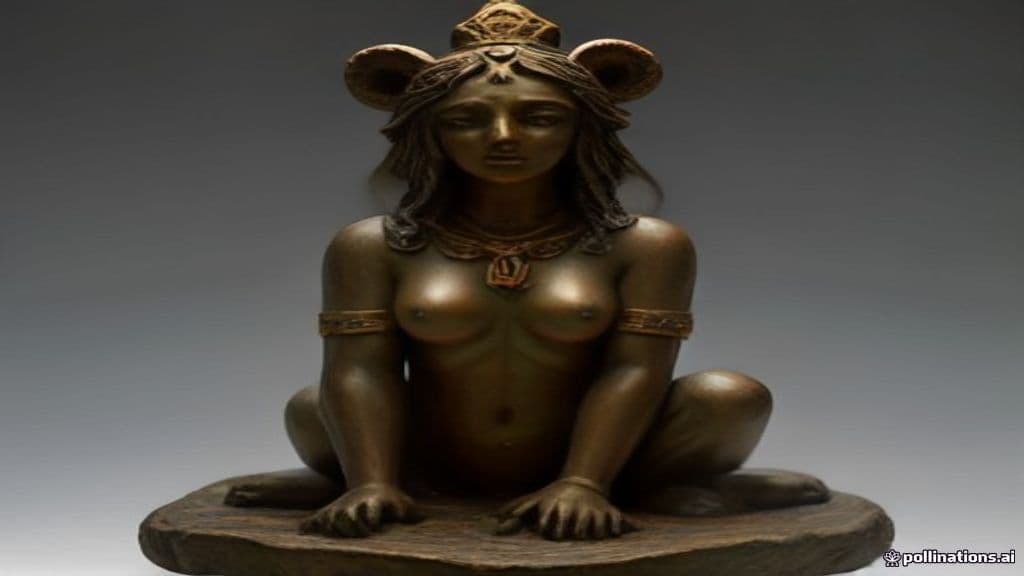
No mythic origin narrative for Artio survives in the provided material. Attestation consists of two short epigraphic dedications—Muri (base of the bronze group) reading 'Deae Artioni Licinia Sabinilla' and a rock-face inscription near Ernzen reading 'Artioni Biber'—and the Muri statuette group itself. From these vestiges scholars reconstruct Artio as a local or regional animal-associated goddess active in rural cult practice among Celtic-speaking communities under Roman influence (Helvetii and Treveri), but the sources supply no life-story, cosmogony, or narrative origin.
The primary iconographic evidence is the Muri bronze statuette group: a seated female figure approximately 20 centimetres high beside a large bear, with a tree behind the animal. The female figure holds a patera containing fruit; the bear faces her and leans forward as if to take the fruit or to threaten her. The base of this group bears the Latin dedication to the goddess. No further detailed description of clothing, colour, or facial features is preserved in the supplied sources.
No miraculous narratives or explicit supernatural powers are recorded in the provided material. Scholarly interpretation based on the inscriptions and iconography reads Artio as a goddess who embodies or represents the bear-word (Gaulish *arto-), acting as guardian or protector of bears and as a mediator between humans and wild animals. Miranda Aldhouse-Green characterises her role as ambivalent—guarding bears while also protecting hunters and travellers who risk encounters—while other scholars emphasise her identification with the animal itself. The sources do not attest transformation, possession, or other specific magical feats.

Abnoba
Abnoba is a Gaulish theonym and toponym attested in Roman-era sources and inscriptions: a localized deity associated with woods, springs and the sources of rivers (notably the Danube) and simultaneously the name applied to a mountain or mountain range in the Black Forest/Baar/Odenwald region. Roman altars equate her with Diana, reflecting syncretic cult practice in frontier provinces.
Arduinna
Arduinna is a local Gallo-Roman tutelary goddess of the Ardennes (Arduenna) — a divine personification of wooded heights — attested in two inscriptions and later equated with the Roman Diana. Iconography associating her with a boar-riding huntress exists in modern literature but the identification is uncertain.

Andarta
Andarta is a local Celtic goddess attested by votive inscriptions in and around the town of Die (modern Drôme) in the territory of the Vocontii during the Roman imperial period. She is recorded in seven dedications as Dea Augusta Andarta (c. 150–200 AD) and appears to have functioned as a tutelary deity associated with civic welfare, victory, and Romanized cultic practice.
Community Record
- [1]Artio — Wikipedia. Wikipedia, 'Artio' article (selected excerpts on name, etymology, Muri group, and dedication).wiki
- [2]Muri bronze statuette group inscription and description (as cited). Description of the Muri group and the inscription 'Deae Artioni Licinia Sabinilla' as summarized in the provided sources.wiki
- [3]Scholarly interpretations (Miranda Aldhouse-Green, Jan de Vries, linguistic notes). Summary of scholarly interpretations and linguistic etymology (Gaulish *arto-, Proto-Celtic *arto-, Indo-European *h₂ŕ̥tḱos) as presented in the compiled sources.other
- [4]Archive: Ep. 15: Artio (audio archive record). Archive item titled 'Ep. 15: Artio' included in provided materials (content referenced as part of source collection).other