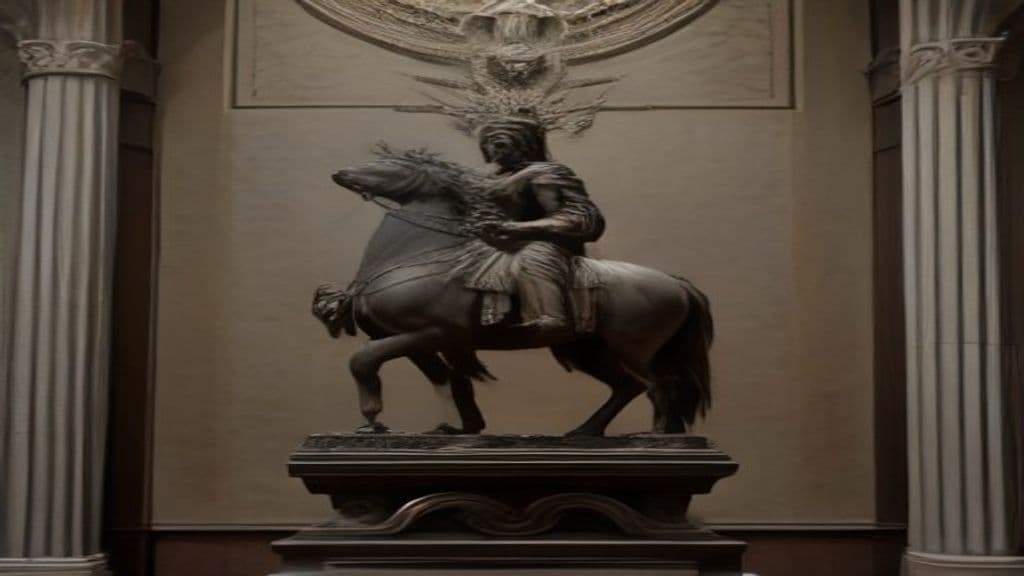
No native mythic origin narrative survives in the cited sources. Arduinna is known from epigraphic evidence and toponymy as the eponymous protective divinity of the Arduenna (wooded heights); her name derives from Gaulish arduo- 'height' and the Roman interpretatio identified her with Diana. Beyond this onomastic and cult-place association, the sources supply no indigenous origin legend.
Epigraphic attestations of the name (an altar at Düren and an inscribed relief at Rome) do not provide descriptive details. Modern scholarly and antiquarian literature commonly depicts Arduinna as a huntress riding a boar — based on two small Gallo-Roman bronze statuettes (one at Musée des Antiquités Nationales, St-Germain-en-Laye, and another formerly in Richard Payne Knight's collection now in the British Museum) showing a woman sidesaddle on a boar while holding a knife. However, one key statuette bears no inscription and nineteenth-century antiquarian identification is responsible for linking these bronzes to Arduinna; thus the boar-riding image is attested in later interpretation but the direct ancient labeling is uncertain.
Sources characterize Arduinna primarily as the tutelary or protective goddess of the Ardennes landscape, implying guardianship and association with woodland and, via interpretatio Romana, hunting. The cited material does not record a catalogue of miracles, mythic deeds, or specific supernatural powers beyond her regional protective role and the later comparison to Diana.
Weaknesses
- otherNo named native vulnerabilities in surviving sources; historically the cult image and local worship could be ended by Christian missionary action (late-6th-century account of Walfroy pulling down a statue, recorded by Gregory of Tours).
Wards
- ritualChristian preaching and statue-destruction (late-6th century, Walfroy as recorded by Gregory of Tours)
Acionna
Acionna is a local Gallo-Roman water goddess attested by a single votive inscription found at a spring in the Orléanais region. The inscription, discovered by Jollois in 1822 and datable by style to the 2nd century CE, dedicates a portico and ornaments "AUG(ustae) ACIONNAE" and was recovered from the Fontaine de l'Étuvée in Orléans; archaeological work in 2007 uncovered remains of a Gallo-Roman temple and a section of an aqueduct at the site.
Ambisagrus
Ambisagrus is a local Gaulish deity attested in Gallo‑Roman religion, worshipped at Aquileia in Cisalpine Gaul and identified there with Jupiter Optimus Maximus under Roman interpretatio. The name is tentatively analyzed from Proto‑Celtic elements *ambi‑ + *sagro‑.
Icaunis
Icaunis (Dea Icaunis) is the localized Gallo‑Roman goddess of the river Yonne (ancient Icauna), known from a single inscription found at Auxerre in Burgundy. She exemplifies the widespread Roman‑era practice in Gaul of venerating rivers and other natural features as female divine figures.
Loucetios
Gallic god associated with Mars, lightning, and war; worshipped in the Rhine-Moselle region. (Note: 1. Power tier: Primordial is unlikely, given the lack of information about his abilities or behaviors; a more plausible tier would be Greater (powerful regional). 2. Abilities: No direct information a)
Ritona
Ritona (also attested as Pritona) is a named local goddess of Roman‑period Gaul, chiefly attested among the Treveri of the Moselle valley. She is understood from inscriptions and temple remains as a divine patron of fords, river crossings, springs and associated sanctuary spaces, worshipped in formal civic cult contexts at sites such as Augusta Treverorum (Trier) and Contiomagus (Pachten).
Ardat-lilî
Ardat-lilî are a class of female phantom-spirits in Ancient Mesopotamian sources: the restless ghosts of young women who died without sexual fulfillment or marriage. Presented in exorcistic and medical texts from the Old Babylonian period onward, they are blamed for seductive attacks on young men and for illnesses variously described as the 'hand of ardat-lilî.' Ritual responses include incantations, exorcism, and a prescribed 'mock marriage' to placate the spirit.
Ardescus
Ardescus is presented as an instance of the class of ancient Greek river gods: personified deities tied to particular rivers, often integrated into local worship and genealogies and placed in Hesiodic theogony as offspring of Oceanus and Tethys.
Ardhanārīśvara
Ardhanārīśvara is an androgynous iconographic form in Hindu tradition combining Shiva and his consort Pārvatī into a single deity split vertically as male and female, symbolizing the inseparability and synthesis of masculine and feminine cosmic principles.
Ardina
Ardina is a Marvel Comics fictional cosmic/magical construct described in comic-book continuities as a female being formed from the Silver Surfer's energies (Power Cosmic) and appearing in storylines involving the Defenders, the Order, and related Marvel mythic figures.
Aredvi Sura Anahita
Aredvi Sura Anahita is the Avestan Yazata of waters and fertility in ancient Iranian religion and Zoroastrianism, praised in the Aban (Aban Yasht) as the mighty, undefiled river and invoked in liturgical offerings to waters.
Aregonis
Aregonis (Ancient Greek: Ἀρηγονίς) is a mythological maternal figure in Greek genealogies, named as the wife of the seer Ampyx and mother of the Argonautic seer Mopsus in the Orphic Argonautica. In other traditions the maternal role is given to a woman called Chloris, reflecting variant naming in transmission.
Areilycus (Archilycus)
Areilycus (Ancient Greek Ἀρηίλυκος; also attested Archilycus/Areilykos) is a personal name in Greek epic and later mythography. It appears in two distinct Homeric-era attestations: as a genealogical father of Boeotian leaders (Arcesilaus/Archesilaus and Prothoenor) and as a mortal warrior, son of Menoetius, wounded in the thigh by Patroclus in Iliad Book XVI.
Community Record
- [1]Arduinna (Wikipedia). Wikipedia contributors, 'Arduinna,' Wikipedia, The Free Encyclopedia.wiki
- [2]Arduinna (Wikidata). Wikidata entry Q655419 for Arduinna.wiki
- [3]Gregory of Tours (summary in Wikipedia). Summary of Gregory of Tours' account (as reported in the Wikipedia article on Arduinna) describing Walfroy's actions in the late 6th century.literary
- [4]Miraheze Arduinna Next Stage (archival snapshots). Archive snapshot of a Miraheze 'Arduinna Next Stage' wiki (included among provided sources; contained no additional extractable primary evidence in the supplied summaries).other