
In the classical mythic context recorded in the provided sources, Asterope is presented as one of the seven daughters of Atlas and Pleione — the Pleiades — a family of sisters who are personified as bright stars in the open cluster in Taurus. Mythic summaries associated with the Pleiades recount that the sisters were pursued by Orion and that Zeus transformed them into celestial birds or into stars to protect them from this pursuit; this metamorphosis is the core etiological motif linking the human/divine daughters to the visible star cluster. The sources also note that the name Asterope appears in variant genealogical lists as a Hesperid in other traditions, indicating that the name was reused in different mythic contexts rather than referring to a single, consistent individual across all sources.
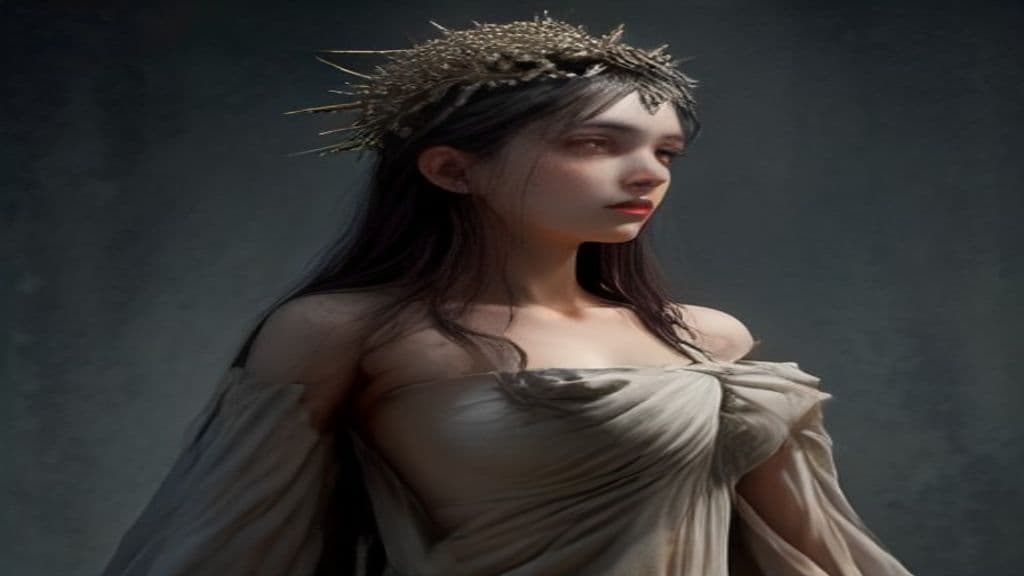
The provided material does not give a concrete anthropomorphic description of Asterope-as-person. Instead, Asterope's documented appearance is as one of the brighter members of the Pleiades star cluster in the constellation Taurus. Astronomical and poetic descriptions of the cluster (from the Spitzer archive) portray the sisters as bright young stars 'seem[ing] to float on a bed of feathers' surrounded by sweeping dust clouds that swaddle them in a cushiony veil; Asterope is one named member of that visibly clustered group. No specific clothing, age, or bodily features for a human-form Asterope are supplied in the sources.
The sources do not ascribe individual, ongoing powers, coercive behaviors, or cultic functions to Asterope. The primary mythic capability recorded is the transformation motif: the Pleiades as a group were said to have been transformed into celestial doves or into stars by Zeus in order to escape Orion's pursuit, a one-time divine metamorphosis that identifies the sisters with fixed stellar bodies. Beyond this etiological transformation and her status as a named star (and modern star-name bearers), the provided material contains no descriptions of active magical abilities, interventions in human affairs, or supernatural behaviors specific to Asterope.

Pleione
Pleione is a name applied to a figure in Greek myth (mother of the Pleiades), a star in the Pleiades cluster (Flamsteed 28 Tauri), and a genus of small orchids named after the mythic mother. Sources treat Pleione across mythic, astronomical, and botanical taxonomies rather than as a single active supernatural being.
Electra
Electra (Ancient Greek: Ἠλέκτρα, Ēléktrā) is a Mycenaean princess in Greek myth and drama, daughter of Agamemnon and Clytemnestra, whose primary role across Aeschylus, Sophocles, and Euripides is as an avenger of her father's murder and a focal figure for questions of filial duty, revenge, and ritual consequence.

Maia
Maia is a figure of ancient Greek myth: the eldest of the seven Pleiades, a mountain-nymph (oread) daughter of Atlas and Pleione traditionally associated with Mount Cyllene in Arcadia, and the mother of the god Hermes. She functions in myths as a maternal and nurturing foster-figure and as an aetiological link between terrestrial narratives and the Pleiades star-cluster.

Celaeno
Celaeno (Ancient Greek: Κελαινώ, 'the dark one') is a personal name applied to multiple distinct figures in Greek myth — notably one of the Pleiades (a named star in Taurus), one of the Harpies encountered in Vergil's Aeneid, and several mortal women (a Danaid, a Phocian princess, an Amazon, and various mothers in genealogical traditions). The name appears across astronomical, epic, and genealogical traditions rather than designating a single unified being.
Community Record
- [1]Asterope — Wikipedia. Wikipedia contributors. "Asterope." Wikipedia, The Free Encyclopedia.wiki
- [2]The Seven Sisters Pose for Spitzer (Spitzer Space Telescope Archive). Spitzer Science Center. "The Seven Sisters Pose for Spitzer." Spitzer archive image and description.other
- [3]Asterope — Wikidata. Wikidata entry for Asterope (Q2714434) listing modern usages (star name, asteroid, genus).other