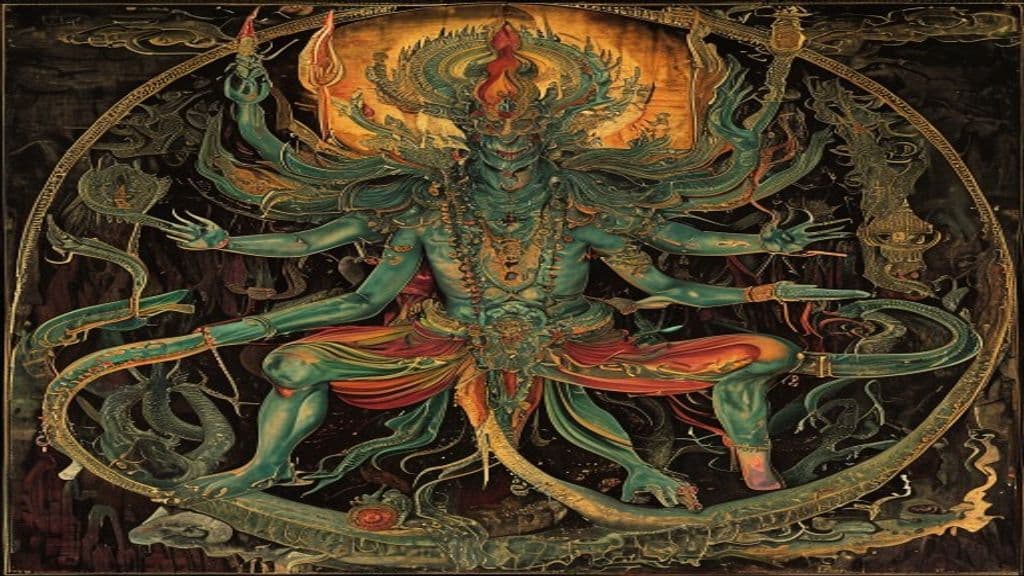
Sources report that Buddhist asura traditions derive from earlier Hindu asura material but develop distinct myths in Buddhist texts. A common narrative (Deva–Asura War) recounts that asuras formerly dwelt in Trāyastriṃśa on Mount Sumeru but, after drunkenness and defeat, were cast down to the Asura‑world at the base of Sumeru. Mahāyāna passages and later accounts also place many asuras in subterranean or oceanic zones beneath Mount Sumeru, and Tibetan iconography at the initiative of Je Tsongkhapa treats asuras as an explicit realm on the bhavacakra. Sources thus show variation among traditions concerning their original and current abode.
Descriptions vary by subtype and named leaders. General characterizations depict asuras as martial and formidable; some leaders (e.g., the Mahāyāna description of Rāhu) are given enormous, awe‑inspiring forms and fortresses, while other asuras are described as 'terrible‑faced' or bow‑wielding. The sources do not give a single uniform physical type for the class, instead offering diverse, often warlike portrayals for particular asurendra and sects.
Asuras are powerful non‑human beings prone to war, boasting, and arms‑bearing; they mount assaults on the devas and organize under named leaders (asurendra such as Vepacitti, Rāhu, Sambara, Bali and others). Cosmologically, rebirth as an asura is described as resulting from a mixture of karmic fruits—experiencing wholesome results while engaging in unwholesome actions—so their condition embodies both sensual pleasure and persistent unwholesome mental states (wrath, pride, envy, insincerity). Some high‑ranking asuras resemble major obstructive figures in Buddhism and occupy significant positions within the desire realm.
Weaknesses
- conditionaddiction to unwholesome passions (wrath, pride, envy, insincerity, boasting)
- conditionvulnerability to their own envy and internal torment when confronted with devas' superior status
Wards
None recorded.

Community Record
- [1]Asura (Buddhism) — Wikipedia. Wikipedia: 'An asura (Sanskrit and Pali: असुर) in Buddhism is a demigod or titan of the Kāmadhātu...' and related sections on character, cosmology, asurendra, and the Deva–Asura War.wiki
- [2]Wikidata entry: asura (Q1637262). Wikidata: classificatory note describing asuras as among the lower ranks of deities or demigods of the Kāmadhātu.other
- [3]Peacock King Duology [NES] — archive note (popular culture reference). Archive game blurb noting modern popular culture usage of 'Asura' as a character term; cited to indicate contemporary adaptations rather than traditional ritual content.other
- [4]Two archived sermons (contextual references). Archive: contextual material referencing Buddhist terms in modern religious discourse; cited for lack of ritual material in the supplied corpus.other
- [5]Archived service video: 'The Third Largest Religion' (contextual). Archive: contextual reference; included among supplied materials but not a primary source of doctrinal ritual concerning asuras.other