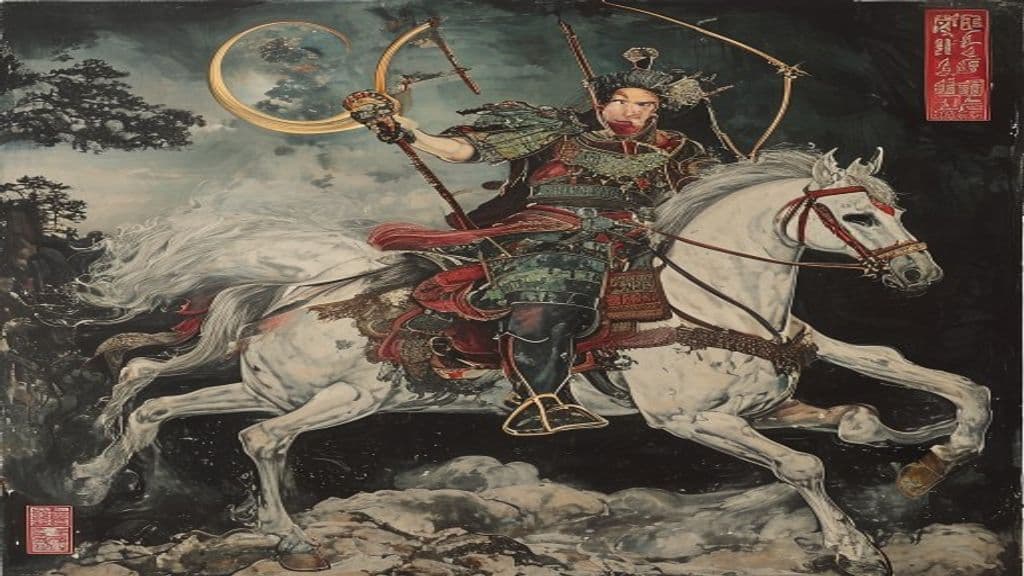
In traditional accounts tied to Mount Atago, the guardian figure emerges from Shugendō mountain religion and honji-suijaku syncretism: a local kami was identified as a provisional manifestation (gongen) of the Buddhist bodhisattva Jizō. Legendary narratives record a powerful tengu of the mountain named Tarōbō who was confronted by mountain sages (often named En no Gyōja and Taichō) and—after surrendering in those versions—was transformed into the mountain's protector, becoming incorporated into the Atago cult. Over time Atago Gongen was enshrined at Hakuun-ji on Mt. Atago and at many Atago shrines nationwide (around nine hundred sites).
Iconographically Atago Gongen is often shown mounted on a white horse and depicted carrying a ringed staff (shakujō) and a desire-cancelling jewel (cintamani). Some depictions emphasize a warrior aspect—a mounted Chinese-style warrior-figure—while folk imagery and legends additionally link the guardian with a wild boar as a messenger or support animal. In popular legend an associated figure, Tarōbō, is presented as a great tengu (daitengu) of Mount Atago prior to conversion.
Traditionally venerated as a protector against fire, theft, and other disasters, Atago Gongen functions as the guardian of Mount Atago and of Kyoto more broadly; communities and officials petition the deity for prevention of conflagration and for martial success (historical patronage by samurai frames Jizō in a victory/war-protector role, e.g., 'Shōgun Jizō'). Legendary material records the conversion of a dangerous mountain tengu into a protective spirit by ascetics, and folk tales describe wild boars or the mounted guardian charging to rout enemies—elements reflecting the cult's role as both protective and martial in tradition rather than claims of literal constant intervention.
Weaknesses
- otherNot recorded as a hostile being to be weakened; legendary conversion by ascetics (En no Gyōja, Taichō) is an origin motif rather than a vulnerability
Wards
- ritualEstablishment and veneration at Atago Shrines (Atago-jinja) and Hakuun-ji
- ritualShugendō ascetic intervention
Ajisukitakahikone
Ajisukitakahikone is a kami in Japanese mythic literature (Kojiki/Nihon Shoki). He appears in the transfer-of-rule cycle between heaven and earth, is described as a son of Ōkuninushi, associated with the Kamo cult (called Kamo no ōmikami in some modern museum/catalog entries), and features in narratives that explain landscape formation and meteorological genealogy.
Amaterasu Ōmikami
Amaterasu Ōmikami is the sun deity and a principal kami in Shinto tradition, presented in classical Japanese sources as ruler of Takamagahara (the High Celestial Plain) and the mythic ancestress of the Imperial House through her grandson Ninigi. She is central to shrine cult at Ise and to ritual nomenclature and practice within institutional Shinto.
Amatsumara
Amatsumara (天津麻羅), also called Amenomahitotsu, is a Shinto kami presented in sources as the divine smith of Takamagahara who is said to have aided in making the mirror used in the Amaterasu cave episode and who serves as a patron of earthly blacksmiths.
Ame-no-Koyane-no-mikoto
Ame-no-Koyane-no-mikoto is a male Amatsukami (heavenly kami) in classical Shinto myth, presented as the ritual-official ancestor of the Nakatomi clan and linked genealogically to the Fujiwara. He functions as a divine ritual specialist—performing divination and liturgical speech in foundational myths (notably the Ama-no-Iwato episode) and as guardian of the sacred mirror—and is venerated at major shrines such as Kasuga Taisha and Hiraoka Shrine.
Ame-no-Minakanushi
Ame-no-Minakanushi (天之御中主) is a primordial kami named in Japan's classical creation texts as one of the very first deities to come into being in Takamanohara (High Heaven). Presented in the Kojiki and Nihon Shoki as a solitary, hidden first god, he functions primarily as a mythic point of cosmic origin rather than an actively intervening deity in surviving narratives.
Ame-no-Tajikarao
Ame-no-Tajikarao is a kami in Japanese Shinto myth notable for exceptional physical strength. He appears in the Ama-no-Iwato narrative as the deity who pulls Amaterasu from the heavenly rock cave, and he is venerated at numerous shrines across Japan with associations to physical power and local lineage claims.
Ame-no-Tokotachi
Ame-no-Tokotachi is a primordial kami in classical Shinto cosmology attested in summaries of the Kojiki and Nihon Shoki tradition. Sources identify a very early solitary or among-the-first deity who manifests at the creation of heaven and earth; supplied materials also reference a closely related name, Ame-no-Minakanushi, in English summaries of those chronicles.
Ame-no-Uzume-no-Mikoto
Ame-no-Uzume-no-Mikoto is a Shinto kami of dawn, mirth, revelry and the performing arts whose comic and erotic dance at the entrance of Amano‑Iwato lures the sun goddess Amaterasu from hiding, restoring light; her action is cited as the mythic origin of kagura and of certain ritual/performance lineages.
Ame-no-hohi
Ame-no-hohi (also rendered Ame no Fuhi) is a male kami in Japanese mythology identified in sources as the second son of the sun goddess Amaterasu. He is principally attested as an ancestral figure: historical rulers of Izumo and the modern heads of Izumo Taisha and Izumo-taishakyo claim descent from him.
Ame-no-wakahiko
Ame-no-wakahiko is presented in the provided sources as a kami in Japanese mythology, described specifically as a god of grains and counted among the Amatsukami (heavenly deities). The sources identify him as a son of Amatsukunitama and note a medieval prose narrative, the Ame no Wakahiko Monogatari, exists about him.
Amenohoakari
Amenohoakari (天火明) is a Japanese kami associated with sunlight, heat, and the ripening of grain; he functions as an agricultural deity and a divine ancestor claimed by multiple clans and hereditary priestly lineages. Textual sources place him within heavenly genealogy (tensonzoku) while other records give alternate parentage, producing divergent traditions about his origins and relationships to other kami.
An (案)
An (案) is a small table, desk, or platform used in Shinto ceremonies to bear offerings. It is a liturgical furnishing and material mediator in shrine rites rather than a sentient supernatural being.
Community Record
- [1]Atago Gongen - Wikipedia. Wikipedia article 'Atago Gongen'wiki
- [2]Atago Shrine (Kyoto) - Wikipedia. Wikipedia article 'Atago Shrine (Kyoto)'wiki
- [3]Atago Gongen (Wikidata). Wikidata entry Q1101132wiki
- [4]Mt Atago pilgrimage - Green Shinto. Green Shinto blog 'Mt Atago pilgrimage'other
- [5]Atago ascent - Green Shinto. Green Shinto blog 'Atago ascent'other
- [6]Tengu overview - Onmarkproductions. Onmarkproductions 'Tengu' overviewother
- [7]WKD - Saijiki for Festivals and Ceremonies: Atago Shrines. WKD Saijiki 'Atago Shrine' entryother
- [8]Atago Shrine (Roppongi) - LIVE JAPAN. LIVE JAPAN 'Atago Shrine (Roppongi)'other
- [9]Heian Period Japan: Atago Gongen Legends. Blog 'Atago Gongen Legends' (Heian Period Japan)other
- [10]Gokuraku - Shogun Jizo (iconographic commentary). Gokuraku blog 'Shogun Jizo'other