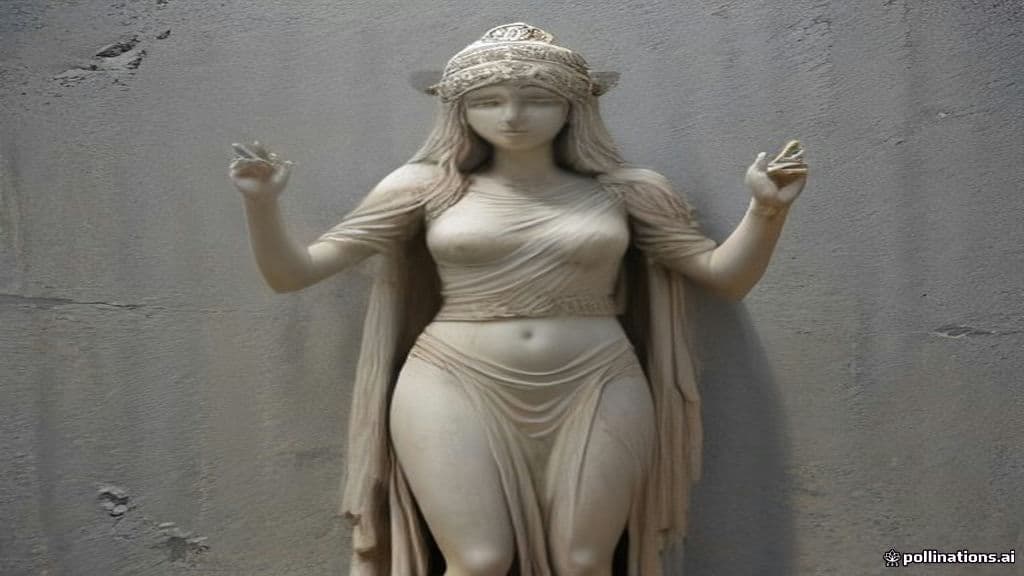
The material attests that Alea was originally a place-based local goddess of eastern Arcadia whose name and cult at towns such as Alea and Mantineia predated or stood apart from pan-Hellenic Athena. Over time local cult practice and political-religious processes produced a syncretism between the local Alea and the Olympian Athena, producing the composite cult figure Athena Alea. Literary references (for example those summarized from Pausanias and cited in modern scholarship) record that the local name persisted in sanctuary practice and a named festival (the Aleaia), and Herodotus and later inscriptions and coinage show the combined usage of Athena and Alea in the classical period. The sources emphasize this as a process of religious unification that nonetheless retained local distinctives rather than a simple replacement of a local goddess by Athena.
Direct textual descriptions of Alea’s iconography are not preserved in the supplied material. Pausanias (as cited in secondary material) records a sanctuary and an image of Athena Alea at Mantineia/Tegea; archaeological and numismatic evidence (Tegean coins of the fourth century BCE, the remains and reconstructions of the Temple of Athena Alea at Tegea, and scholarly studies of its columns and peristyle) attest to cult statuary and monumental architecture associated with the deity. From these attestations we can say with confidence that a cult statue/image and major temple architecture were central to Athena Alea’s worship, but the sources supplied do not specify consistent attributes, dress, or iconographic details for the statue.
The sources do not list supernatural feats or mythic narratives. From the civic prominence of the sanctuary at Tegea, the named festival Aleaia, and the assimilation with Athena, it is reasonable to infer functional roles: protective and civic functions related to local identity, temple-centered cult maintenance, and the kinds of city-protecting or martial/wisdom associations commonly projected onto Athena. The notes caution that such attributions are inferences from cult practice and syncretism rather than recorded miraculous acts; the primary evidence remains archaeological, numismatic and literary references to sanctuary, statue and festival rather than narratives of specific divine interventions.
Weaknesses
None recorded.
Wards
- ritualmaintenance of the sanctuary and performance of the Aleaia

Community Record
- [1]Athena Alea (Wikipedia). Wikipedia entry 'Athena Alea' summarizing classical sources (Herodotus, Pausanias) and modern scholarship (McInerney, Jost); notes temple and Aleaia festival.wiki
- [2]Temple of Athena Alea (Wikipedia). Wikipedia entry on the Temple of Athena Alea; archaeological and architectural information about the Tegean sanctuary.wiki
- [3]The Representations of the Goddess Athena - Main. Website essay citing Pausanias: 'They also worship Athena Alea, of whom they have a sanctuary and an image…' referencing Pausanias' testimony about statue and sanctuary.other
- [4]Le sanctuaire d'Aléa Athéna à Tégée au IVe siècle (archive). Scholarly/archival treatment of the sanctuary at Tegea and its fourth-century rebuilding; archaeological context for the Temple of Athena Alea.academic
- [5]Tegea, Temple of Athena Alea · Wilcox Classical Museum. Museum collection item documenting the Tegean temple and its material remains.other
- [6]Pausanias (as cited in summaries). Summary of Pausanias' observations (2nd century CE) reporting the local name Alea and the festival Aleaia; used in modern syntheses of the cult's continuity.literary