
Sources situate Atreus within the genealogical sequence that traces the 'House of Atreus' back to Tantalus and Pelops. The inherited misfortunes and curses associated with Tantalus and Pelops form the background context for the family's continuing cycle of crimes and retribution. Within that framework Atreus emerges as the son of Pelops and Hippodamia who becomes king of Mycenae; his reign and actions — including a contested claim to kingship determined by possession of a golden lamb, the adultery of his wife with his brother Thyestes, and his retaliatory murder and feeding of Thyestes' sons — provide the immediate etiological episodes that shape the later fate of his sons Agamemnon and Menelaus and the continuing family tragedy.
The sources give no consistent physical or iconographic description of Atreus. Ancient materials present him through his actions, legal and familial position, and the narrative consequences of his decisions rather than by stature, clothing, or facial features; no surviving portrayal in the supplied texts establishes a standard visual representation.
Atreus is represented as a mortal king whose capacities are political and volitional rather than supernatural. The narrative credits him with seizing and holding the throne of Mycenae, making and breaking vows (for example, a vow to sacrifice his best lamb to Artemis), and plotting calculated acts of revenge: he discovers a golden lamb, conceals it via his wife Aerope, contests kingship with Thyestes, and upon learning of Aerope's adultery he kills Thyestes' sons and tricks Thyestes into eating them. The sources also report episodes of divine intervention or prodigy that intersect with his career: Zeus is said to have sent Hermes to advise him in the struggle for the throne, and a reported prodigy in which the sun reversed its normal course is described as validating his claim. The record does not ascribe ongoing magical powers or immortality to Atreus—his influence is social, dynastic, and narrative.
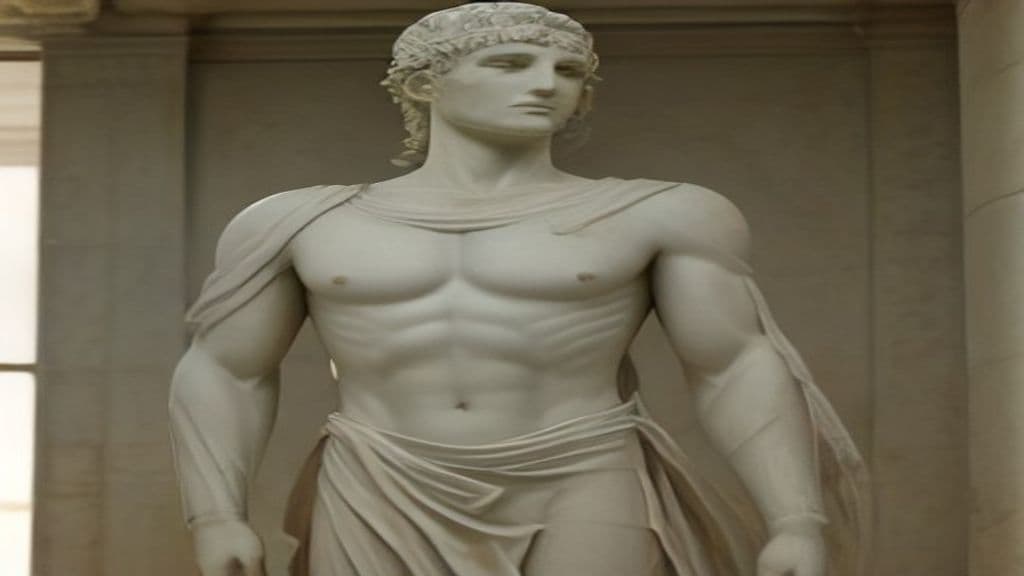
Pelops
Pelops is a mythic heroic-royal figure of ancient Greek tradition, an eponymous founder-ancestor of the Peloponnesus, ruler of Pisa/Olympia, and progenitor of dynasties (notably the House of Atreus). He is both a cult hero venerated at Olympia with chthonic libations and a narrative focal point whose deeds generate a long-lasting familial curse.

Tantalus
Tantalus is a figure of ancient Greek myth: a once-mortal king punished eternally in Hades/Tartarus as an exemplar of hubris and the consequences of violating divine law. His canonical image—standing in water beneath fruit that recedes or branches that elude him, or beneath a suspended rock—functions proverbially to signify unreachable gratification.

Agamemnon
Agamemnon is the legendary king of Mycenae (or Argos), head of the House of Atreus, and commander of the Achaean forces at Troy in Greek epic and tragedy. His story links dynastic guilt, ritual obligation, and political authority, culminating in the sacrifice-at-Aulis episode and his murder on return from Troy followed by juridical atonement in the Oresteia.

Menelaus
Menelaus is a mytho-historical king of Sparta in the Greek epic tradition, husband of Helen and a leader in the Trojan War cycle. He appears in Homeric epic (Iliad, Odyssey) and many later literary retellings and traditions; he is portrayed as a mortal royal figure whose fortunes are affected by divine intervention.

Aegisthus
Aegisthus (Greek Αἴγισθος, Aigisthos) is a mortal member of the House of Atreus in Greek myth who, born of incestuous circumstances and raised by shepherds and a goat, participates in dynastic murder and usurpation — notably the slaying of Atreus in some accounts and the conspiracy (with Clytemnestra) that results in Agamemnon's death — and is later killed by Orestes, an episode that figures in narratives about inherited guilt, vengeance, and the transition from private retribution to public justice.

Aerope
Aerope (Ancient Greek: Ἀερόπη) is a mythological mortal woman of Greek tradition, a Cretan princess connected to the royal house of Mycenae (the Atreidai). In surviving accounts she functions as a human agent whose sexual relationships and/or the transfer of a symbolic object (the "golden lamb") are narrated as catalysts in the dynastic feuds of Atreus and Thyestes; sources preserve variant and sometimes conflicting traditions about her fate and parentage.
Community Record
- [1]Atreus — Wikipedia. Wikipedia contributors, 'Atreus', Wikipedia, The Free Encyclopedia.wiki
- [2]Atreus — Wikidata. Wikidata entry Q192469, 'Atreus'.other