
The figure of Aulus Vibenna is preserved as part of an Etruscan aristocratic and military memory centered on the Vibenna brothers from Vulci. Archaeological evidence includes a bucchero chalice dedicated at the sanctuary near Veii bearing an Etruscan dedicatory inscription read as 'Aulus Vibenna dedicated me' and a red-figured cup inscribed 'Avles V(i)pinas naplan' ('cup of Aulus Vibenna'). Narrative iconography in the François Tomb at Vulci depicts Aulus and his brother Caelius among a band of companions and enemies in martial episodes; later Roman historiographical traditions (e.g., via Fabius Pictor as reported by Arnobius) link episodes involving Aulus, his relations with Mastarna/Servius Tullius, and conflicts with the Tarquins, though such literary links reflect later interpretive layers rather than contemporary documentary proof.
No contemporary textual personal description of Aulus survives; he is known through visual representation. In the François Tomb fresco he is depicted as an armed participant in battle and in scenes of capture and liberation alongside Caelius Vibenna, Mastarna and other named figures. He also appears by name on portable objects (a bucchero chalice, an Etruscan cup) and is represented in Etruscan mirrors and cinerary urn imagery associated with the Vibenna group. There is no single standardized portrait; instead he appears as a martial aristocrat within narrative compositions.
Sources present Aulus as a historical military leader and elite dedicant rather than a supernatural agent. He is associated with leadership in armed conflicts against rival lineages (figures identified with the Tarquins and other regional foes), with participation in dynastic and political struggles of the mid-1st millennium BCE, and with cultic benefaction as the named dedicator of a bucchero chalice at a sanctuary. The iconography emphasizes martial prowess, group leadership, and commemorative patronage.
Caelius Vibenna
Caelius Vibenna (Etruscan Caile Vipina) is presented in the supplied tradition as an Etruscan noble and legendary leader associated with a circle of companions; he appears in Etruscan tomb painting (notably the François Tomb at Vulci) and in later Roman antiquarian tradition as an ancestral or eponymous figure tied to the Caelian Hill of Rome. The corpus treats him as a human aristocratic/heroic figure rather than a supernatural being.
Feronia
Feronia is an ancient Italic goddess of central Italy associated with fertility, the wild/nature, and certain civic-economic functions such as trade. Originating with Sabine and Faliscan practice and later incorporated into Roman religious listings, she possessed sanctuaries and a visible cult presence in the archaic and Republican periods.
Hirpi Sorani
Infernal fire god in ancient Etruscan and Roman pantheon, associated with volcanic fires and solar forces. (Note: 1. Power tier should be Ancient (deity-level) instead of Primordial. 2. No physical description is provided in the source material; delete or rephrase "Appearance" section accordingly. 3. Since specif)
Tuchulcha
Tuchulcha is an underworld chthonic being from Etruscan funerary iconography, attested chiefly in a single Tomb of Orcus II fresco at Tarquinia where the figure attends Theseus and Peirithous in the realm of the dead (Aita). Modern scholarship interprets Tuchulcha as an attendant daemon of the netherworld with ambiguous gender and composite animal features.
Vanth
Vanth is an Etruscan chthonic female attendant depicted in funerary art as a benevolent psychopomp who escorts and assists the dead on their journey to the Underworld. She appears in tomb paintings, sarcophagi, and ash urns from the classical Etruscan period and is often shown with attributes such as a torch, key, and scroll.
Aufhocker
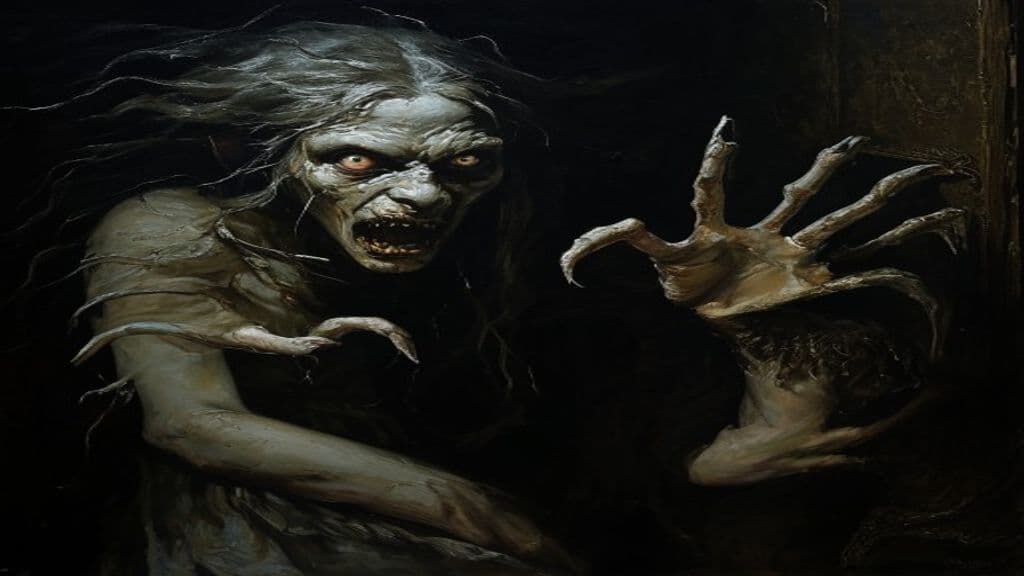
The Aufhocker is a German folkloric shapeshifting 'pressure' or 'perching' spirit that leaps upon the backs or shoulders of solitary travelers, weighing them down with each step until victims become exhausted, incapacitated, or—in some variants—killed. It is associated with liminal places (bridges, crossroads, hollow paths, cemeteries) and exists in multiple narrative roles including punitive agent, nightmare embodiment, and theriomorphic attacker.
Auge
Auge (Ancient Greek: Αὐγή, Augḗ, lit. "sunbeam, daylight, dawn") is an Arcadian princess and virgin priestess of Athena Alea in Greek myth, mother of the hero Telephus by Heracles. Her narrative (in multiple variant traditions) treats oracular fate, the sanctity and vulnerability of a priestess, exposure/abandonment motifs, and the foundation of cross-regional ties when she and Telephus come to Mysia and are received by King Teuthras.
Augeas
Augeas is a mythic king of Elis in the Greek Heracles cycle, famous for the Augean stables which housed an immense herd and had not been cleaned for decades; his contractual refusal to pay Heracles for cleaning the stables leads to his death and the transfer of kingship to his son Phyleus in the traditions summarized by the sources.
Aulanerk
Aulanerk is an Inuit sea spirit attested in several short ethnographic and reference summaries as a benevolent sea-being who lives in the ocean and is responsible for producing waves and surf; he is also described as helping hunters by working with other sea powers to lead them to seals.
Aulë
Aulë is a divine artisan in J. R. R. Tolkien’s legendarium, one of the Ainur who entered the created world (Arda) to give it material form. Counted among the Valar, he is the principal craftsman and smith whose office is the shaping and working of the world's substance.
Aun the Old
Aun (Old Norse: Aunn inn gamli; Latinized Auchun) is a legendary Swedish king of the Yngling dynasty attested in Old Norse sources (Ynglingatal, Ynglinga saga in Heimskringla, and Historia Norwegiae). He is portrayed as a mortal ruler who prolonged his life by performing human sacrifices to the god Odin until his community refused a final offering.
Aunt Em (Emily Gale)
Aunt Em (Emily "Em" Gale) is a fictional human character in L. Frank Baum’s Oz series, the married partner of Uncle Henry and the guardian/aunt of Dorothy Gale. Presented as an ordinary Kansas farmwife whose life is altered by Dorothy’s voyage to Oz, she later relocates to the Emerald City and is given a ceremonial civic occupation there.
Community Record
- [1]Aulus Vibenna (Wikipedia). Wikipedia contributors, 'Aulus Vibenna,' Wikipedia, The Free Encyclopedia.wiki
- [2]Aulus Vibenna (Wikidata). Wikidata entry Q2871794 for Aulus Vibenna.wiki
- [3]Caelius Vibenna (Wikipedia). Wikipedia contributors, 'Caelius Vibenna,' Wikipedia, The Free Encyclopedia.wiki
- [4]The brothers Vibenna - Ancient World Magazine. Article 'The brothers Vibenna' in Ancient World Magazine discussing the archaeological and iconographic evidence for the Vibenna cycle.other
- [5]CAPITOLINE JUPITER AND THE HISTORIOGRAPHY OF ROMAN WORLD RULE*. Scholarly article addressing Roman historiographical traditions that reference Aulus Vibenna and related pseudo-etymologies (e.g., caput Oli).academic
- [6]The Story in Paintings: genocide and an Etruscan tomb – The Eclectic Light Company. Blog discussion of the François Tomb fresco cycle depicting the Vibenna scenes.other
- [7]The Francois Tomb enters the Italian heritage – The Observatorial. Overview of the François Tomb and its iconography relating to the Vibenna group.other
- [8]Two Of The Seven Hills Of Rome Were Said To Have Been Named After Twin Etruscan Chieftains - The Historian's Hut. Popular treatment of traditions linking Vibenna brothers to Roman topographical legends.other