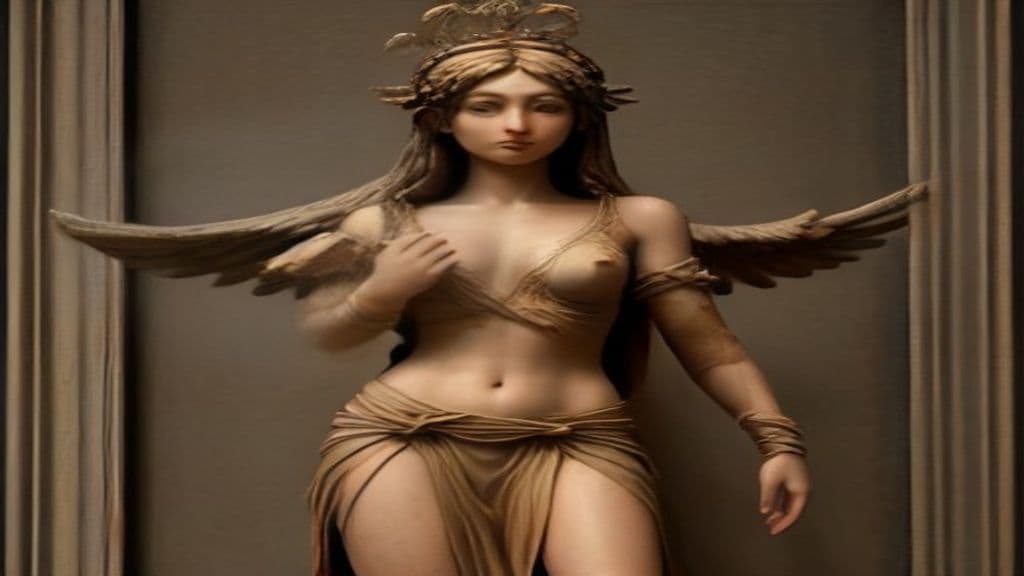
Vanth is attested primarily through Etruscan visual and limited inscriptional evidence rather than extant narrative myths. She appears in funerary contexts from around c. 400 BC onward as part of an ensemble of underworld figures; no surviving Etruscan literary birth-myth or cosmogonic origin for her is recorded in the cited sources. The name is attested in the Etruscan form vanθ, including one depiction where that name is written on a scroll, but the sources provide no secure etymological breakdown beyond the attested proper name.
In Etruscan art Vanth is depicted as a female figure, often youthful and winged, frequently bare-chested with cross-straps across the breast, wearing a short rolled chiton, fur boots, and sometimes unfixed sleeves; one scholar likened aspects of her dress to a huntress costume. She is shown singly or in groups, and commonly appears alongside other underworld figures such as the more menacing Charun. Common accoutrements in the iconography include a torch, a key, a scroll (in one instance bearing the inscription vanθ), and occasionally a sword. Examples of her depiction occur on tomb paintings, sarcophagi, and ash urns (for instance an ash urn from Chiusi showing her rising from the ground) and in scenes drawn from narrative cycles such as Trojan-myth subjects.
Iconography and interpretation in the sources present Vanth primarily as a guide and escort for the deceased: she meets the dying, accompanies and protects travelers to the Underworld (on foot, on horseback, wagon, or chariot), and appears in both instant-of-death scenes and postmortem journey scenes. She is sometimes shown enacting protective behavior (one urn painting depicts her shielding Odysseus from rocks thrown by Polyphemus). The torch, key, and scroll are read as markers of her duties—lighting a path to the Underworld, unlocking access, and conveying or recording destiny—though scholarship treats such readings as interpretive possibilities rather than settled facts; the view that she may function as a goddess of fate is explicitly presented in the sources as an interpretation tied to the scroll imagery rather than definitive proof. She operates within a populated Etruscan underworld alongside figures like Charun, Calu, Phersipnai, Turms, Aita, and Culsu.
Aulus Vibenna
Aulus Vibenna (Etruscan Avile Vipina) is a remembered historical and legendary Etruscan aristocrat and military leader from Vulci, attested in mid-1st millennium BCE inscriptions and tomb painting. He appears in votive dedications (a bucchero chalice) and in the François Tomb fresco cycle alongside his brother Caelius and companions such as Mastarna (identified with Servius Tullius in later tradition).
Caelius Vibenna
Caelius Vibenna (Etruscan Caile Vipina) is presented in the supplied tradition as an Etruscan noble and legendary leader associated with a circle of companions; he appears in Etruscan tomb painting (notably the François Tomb at Vulci) and in later Roman antiquarian tradition as an ancestral or eponymous figure tied to the Caelian Hill of Rome. The corpus treats him as a human aristocratic/heroic figure rather than a supernatural being.
Feronia
Feronia is an ancient Italic goddess of central Italy associated with fertility, the wild/nature, and certain civic-economic functions such as trade. Originating with Sabine and Faliscan practice and later incorporated into Roman religious listings, she possessed sanctuaries and a visible cult presence in the archaic and Republican periods.
Hirpi Sorani
Infernal fire god in ancient Etruscan and Roman pantheon, associated with volcanic fires and solar forces. (Note: 1. Power tier should be Ancient (deity-level) instead of Primordial. 2. No physical description is provided in the source material; delete or rephrase "Appearance" section accordingly. 3. Since specif)
Tuchulcha
Tuchulcha is an underworld chthonic being from Etruscan funerary iconography, attested chiefly in a single Tomb of Orcus II fresco at Tarquinia where the figure attends Theseus and Peirithous in the realm of the dead (Aita). Modern scholarship interprets Tuchulcha as an attendant daemon of the netherworld with ambiguous gender and composite animal features.
Vampire (tradition)
A class of revenant beings in southeastern and eastern European folk belief that subsist by feeding on the vital essence (generally blood) of the living. Recorded chiefly in early modern to modern oral traditions, these vampires are typically described as reanimated corpses whose presence explains unexplained illness, death, and post-mortem disturbances in their communities.
Vanatühi (Vanapagan)
Vanatühi, also called Vanapagan, is a figure from Estonian folk tradition described in available sources as a giant farmer and characterized as a devil or god of the underworld who is portrayed as more foolish than malevolent. The character appears in Estonian folk tales rather than in documented organized religious practice.
Vanemuine
Vanemuine is an Estonian cultural institution — originally the Vanemuine Society (Vanemuise Selts) founded in Tartu in 1865 — that gave rise to the first Estonian-language theatre and later a multi-genre theatre company and concert organization. It played a foundational role in staging Estonian-language drama, organising song festivals, and training theatre practitioners during the late 19th and 20th centuries.
Vanishing Hitchhiker
A widespread modern folk-narrative type in which a traveler (often a motorist) gives a ride or shelter to a passenger who later disappears without mundane explanation; subsequent corroboration often reveals the passenger had died earlier or leaves a token such as a garment on a grave.
Vapula
Vapula is a named goetic spirit represented in Western grimoire-derived and modern occult literature as a high-ranking Duke/Prince who teaches crafts and sciences and commands numerous legions. In contemporary occult commentary he is frequently characterized as a patron of technical knowledge and 'Prince of Technology'.
Varatantu
A sage in Hinduism associated with the Vāratantavīya philosophy, embodying spiritual and intellectual authority. (Note: 1. Power tier: Downgrade to Ancient (deity-level) as the sources only mention his association with a school of thought, but do not indicate cosmic powers. 2. Abilities: More specific description of hi)
Varda / Elbereth
Varda, often called Elbereth in secondary references, is identified in the provided sources as one of the Valar — the mightiest Ainur who chose to enter the created world (Arda) in J. R. R. Tolkien’s legendarium. The Valar are described in the sources as the 'Powers of the World' who shape and govern Arda after its form is determined by the Music of the Ainur.
Community Record
- [1]Vanth — Wikipedia. Wikipedia contributors, 'Vanth', Wikipedia, The Free Encyclopediawiki
- [2]Vanth — Wikidata. Wikidata entry Q603083wiki
- [3]Vanth Database (MacDonald) - The Digital Classicist Wiki. Digital Classicist Wiki, 'Vanth Database (MacDonald)'other