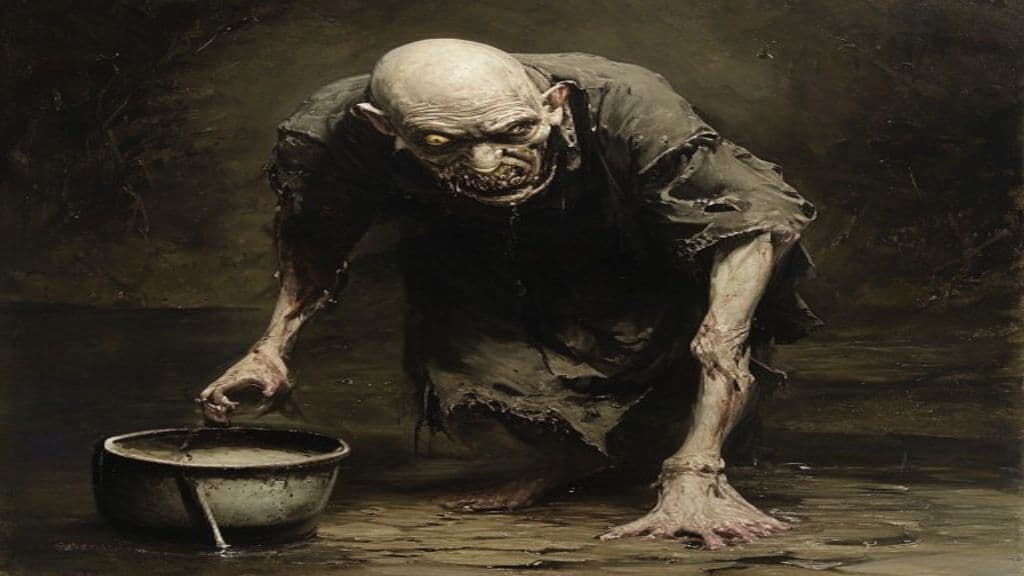
Azukiarai is not presented in the sources as a single authored origin myth but as a folkloric explanation for an uncanny domestic sound heard at the water's edge. The naming — literally 'azuki bean washing' or 'azuki bean grinding' — frames the phenomenon as a personified sound tied to everyday domestic activity heard in liminal watery places. Variants in modern compendia and popular media treat Azukiarai as a yokai character, while some local or skeptical accounts attribute the sound to ordinary animals (notably tanuki or weasels), showing how the motif functions both as a supernatural warning and as a folkloric category applied to unexplained noises.
Sources stress that the azukiarai is 'seldom seen' and primarily known by its sound, but when described it often appears as a grotesque, short-statured humanoid: a bent figure with a large balding head, crooked teeth, a thin moustache, bulging yellow eyes, ragged clothes, and stooped over a pail washing azuki beans. Alternative attributions in some tellings give the visible agent as common trickster animals (tanuki or weasel) rather than a humanoid, indicating regional or interpretive variation between an anthropomorphic yokai and an animal cause.
Legendary behavior centers on producing the unmistakable sound of azuki beans being washed or ground beside rivers, ponds, or other bodies of water. Some tellings include a taunting refrain — reported as 'azuki togou ka, hito totte kuou ka? shoki shoki' ('Will I grind my azuki beans, or will I get a person to eat? shoki shoki') — suggesting deliberation between domestic task and harm. Folklore says those who approach the sound risk falling into the water; sources phrase this as legend or story rather than empirical fact. Because accounts vary, the agent may be a malicious yokai, a mischievous trickster animal, or a natural sound given supernatural meaning.
Weaknesses
- otherNo documented weaknesses in supplied sources; traditions do not record specific vulnerabilities
Wards
- otherNo documented wards in supplied sources; narratives imply avoidance of approaching the sound but give no formal ritual protections
Abumi-guchi
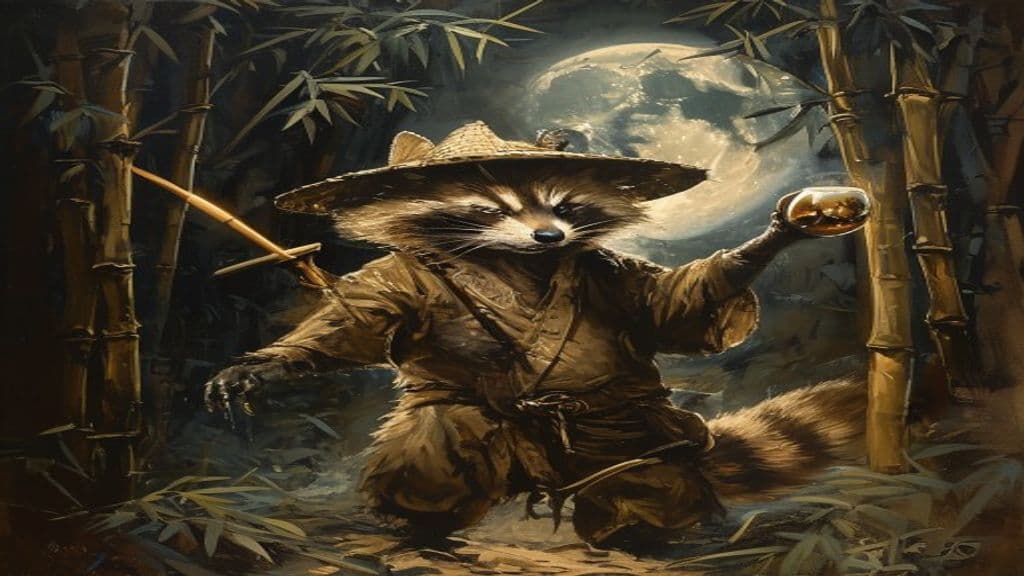
A Japanese yōkai classed as a tsukumogami: an animated stirrup (abumi) depicted in Sekien Toriyama's Gazu Hyakki Tsurezure Bukuro. Traditional accounts say it is formed from a stirrup that belonged to a soldier who fell in battle and that it waits where the stirrup lies for its dead owner to return.
Abura-sumashi
A yōkai spirit from the Amakusa region of Kumamoto Prefecture, Japan, said to inhabit mountain passes. Traditionally explained as the ghost of a person who stole oil, it appears to surprise travelers and is represented in modern media with a straw-coat body and a potato- or stone-like head.
Akaname
Akaname is a Japanese yōkai associated with baths, bathtubs, toilets, and other places where scum and filth accumulate. Traditionally depicted as a child-like creature that licks grime, it functions in folklore as a cautionary figure tied to cleanliness; a few narrative variants cast it as dangerously predatory.
Akateko
Akateko (赤手児, lit. 'red child's hand') is a yōkai from Japanese folklore commonly told as a small, red, disembodied child's hand that appears from trees—especially the Japanese honey locust—and startles travelers; in some regional variants it is accompanied by a specter of a young woman or manifests as paired foot- or leg-like apparitions. Accounts vary between mostly harmless trickster apparition and a violent variant that attacks humans.
Akubōzu
Akubōzu (灰坊主, Akubōzu) is a household yōkai from parts of Akita and Iwate Prefectures in northern Japan said to live in the ashes of the hearth. Sources say they appear when people (notably children) play with or dig in hearth/furnace ash; the figure is cited as part of a broader Tōhoku motif warning against disturbing ash.
Akuma
Akuma (悪魔/あくま) in Japanese sources is an evil spirit, devil, or demon associated with misfortune and mental disturbance. The term appears in Buddhist texts and Heian-period literature and was later used to translate the Christian figure of Satan, as well as the Buddhist Mara.
Akurojin-no-hi
Akurojin-no-hi (悪路神の火, "fire of the god of the bad road") is a flamelike ghost from the folklore of Mie Prefecture, Japan. It is reported to appear on rainy nights; those who encounter it and do not run away are said to become gravely ill. The phenomenon is sparsely documented and is usually compared to will-o'-the-wisp type ghost-lights.
Amabie
Amabie is a mid-19th-century Japanese yogenjū-type wondrous creature attested in kawaraban and related pamphlet culture that emerges from the sea (in canonical accounts) to prophesy about harvests and epidemics and prescribes that its image be drawn and shown to the sick as a protective measure.
Amanojaku
Amanojaku (天邪鬼 / あまのじゃく) is a Japanese yōkai-type being portrayed as a contrarian, heart-reading trickster. Treated in different contexts as a small ogre (ko-oni), a wicked demon (jaki) in Buddhist iconography, and a folkloric spirit that provokes human vice, it appears across regional tales with variable roles from malicious kidnapper to household oddity.
Amefurikozō
Amefurikozō (雨降小僧 or 雨降り小僧) is an Edo-period yōkai figure depicted in classical illustrated and popular print culture as a youthful attendant associated with rain. Classical sources (notably Sekien Toriyama's Konjaku Gazu Zoku Hyakki) present it as a kozō-type servant linked by captional wordplay to a rain deity; later popular literature elaborates its rain-producing role and playful mischief on rainy nights.
Ameonna
Ameonna (雨女, "rain woman") is a figure in Japanese folklore treated as a yōkai associated with rain. Sources depict her both as a rain-calling supernatural being (sometimes helpful in drought) and as a folk label for an unlucky person whom rain seems to follow; a key pictorial source is Toriyama Sekien's Konjaku Hyakki Shūi.
Amorōnagu
Amorōnagu (Amorōnagu / 天降女子) is a tennyo or celestial maiden figure in the folklore of Amami Ōshima (Kagoshima Prefecture, Japan). Attested sources describe her as a heavenly woman who bathes in pools and waterfalls in ravines on the island.
Community Record
- [1]Azukiarai. Wikipedia: Azukiaraiwiki
- [2]Azukiarai. Wikidata entry for Azukiaraiwiki
- [3]Azukiarai | Wikizilla, the kaiju encyclopedia. Wikizilla: Azukiaraiwiki
- [4]Azukiarai | Yo-kai Watch Wiki. Yo-kai Watch fandom: Azukiarai (popular-culture adaptation reference)other
- [5]Azukiarai | Villains Wiki. Villains Wiki: Azukiarai (popular-culture / fandom summary)other
- [6]Azukiarai | The Dream That Time Dreams. Eidolicdreamer blog: discussion of Azukiarai motifother
- [7]Haiku and Happiness: azuki arai. Haiku and Happiness blog post on azuki araiother
- [8]BOO-GLEECH: tokuyoukai. Bogleech: tokuyoukai page referencing Azukiaraiother
- [9]The Great Yokai War. Wikipedia: The Great Yokai War (films that include yokai such as Azukiarai in adaptations)wiki