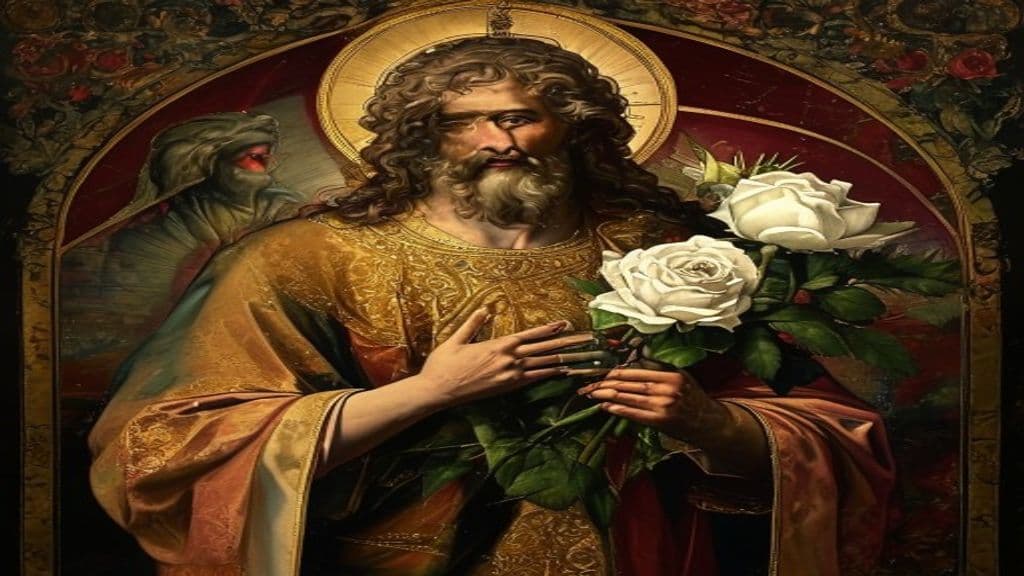
In Jewish mystical literature (as summarized from the Third Book of Enoch) Barachiel is listed among the Princes of the Host and is appointed over the second heaven; that source reports he is attended by a vast retinue of ministering angels described in the summary as '496,000 myriads of Ministering Angels.' In later Christian devotional reception (Byzantine Catholic and Eastern Orthodox) he is incorporated into the angelic hierarchy and venerated as an archangel and patronal intercessor for family, marriage, converts, and those popularly thought to be under his special care (for example, those born on Saturday).
Primary mystical texts preserved in the cited material do not supply a flesh-and-blood corporeal description; instead the available sources describe Christian iconographic attributes. In icons and devotional art Barachiel is sometimes depicted holding a white rose against his chest or with rose petals scattered on his clothing (the rose/ petals symbolize 'God's sweet blessings showering down on people'), and is also shown holding a bread basket or a staff, both interpreted as symbols of parental/child blessings and provision. These attributes are presented as common iconographic motifs rather than universal, singular descriptions.
Barachiel is described as the archangel associated with blessings and as chief of the guardian angels; devotees may pray to him for the benefits expected from one's guardian angel. Mystical association links him to the sephirah Chesed (kindness/mercy) and to planetary/zodiacal correspondences in later attributions (commonly Jupiter; some sources connect him to specific signs/months in folk or occult pairings). His appointed heavenly station is the second heaven, and the Third Book of Enoch (as summarized) emphasizes his command of a very large host of ministering angels. Across the supplied materials he is consistently framed as a beneficent intercessory figure rather than a harmful being.
Weaknesses
- otherNo weaknesses given in sources — Barachiel is consistently presented as a beneficent/intercessory angel; the provided materials give no hostile characterization or methods to weaken him.
Wards
- otherNo wards provided in sources — the traditions cited do not present rituals to ward against Barachiel; instead they describe devotional invocation and veneration.

Gabriel
A principal heavenly messenger in Jewish, Christian, and Islamic literatures, Gabriel is portrayed as an archangel who reveals and explains divine messages, announces births and divine intent, and executes certain divine judgments in apocalyptic texts.
Michael
Michael is presented in the supplied sources as a masculine given name and disambiguation headword applied to people, historical rulers, cultural works, places, and other uses; the provided material treats it as an onomastic item rather than as a single supernatural being.
Ariel
Ariel is named in the provided materials as an angel appearing primarily in Jewish and Christian mysticism and apocrypha. The supplied sources give the Hebrew form אֲרִיאֵל (romanized ʾÁrīʾēl) and identify Ariel as an angelic figure but do not provide further doctrinal, narrative, or ritual detail.
Binah (בינה)
Binah (Hebrew: בִּינָה Bīnā, "understanding") is the third sephirah on the Kabbalistic Tree of Life, a non-personal divine attribute that receives, contains and structures the undifferentiated creative impulse (Chokmah). It functions as an intellectual/metaphysical principle in Kabbalistic cosmology and psychology rather than as an independent, anthropomorphic spirit.
Chokmah
Chokmah (חָכְמָה, 'wisdom') is the second sefirah on the Kabbalistic Tree of Life, described in classical kabbalistic texts as the primordial point of divine wisdom that emerges from Keter and precedes differentiation by Binah. It functions as an abstract metaphysical principle and cognitive archetype rather than a personified spirit in the provided sources.
Ein Sof Aur
A Kabbalistic metaphysical formulation linking Ein Sof (the Infinite) with ʾOr (divine 'light'), used to discuss divine emanation and the manifestation of revealed divine names (e.g., YHWH Elohim) rather than a personified folkloric being.
Gevurah
Gevurah (Hebrew: גְּבוּרָה, Găḇūrā) is the fifth sephirah on the Kabbalistic Tree of Life, an emanation representing the divine principles of judgment, limitation, and disciplined strength. It functions as a structural attribute within Jewish mystical cosmology rather than an individual personal spirit.
Jegudiel
Jegudiel (Hebrew: יַחְדִּיאֵל Yaḥdīʾēl) is presented in Eastern Christian tradition as one of the seven Archangels. He is associated with praise of God, bears iconographic attributes of a crown and a three‑thonged whip (or rod/staff), and functions as a patron and advisor for those who labor and for leaders such as kings and judges.
Keter
Keter (Hebrew: כֶּתֶר, "crown") is the highest of the ten sefirot in Jewish Kabbalistic cosmology, the first emanation from the Ein Sof that functions as the primal divine will or initial impulse toward creation. It is described as utterly concealed — "the most hidden of all hidden things" — and as the origin point from which subsequent sefirot emerge.
Ohr
Ohr (Hebrew: אור, ʾor, 'Light') is a central technical term in Kabbalah denoting divine light or emanation. It functions as a metaphysical model for how divine influence flows into and relates to the created world, rather than a personified being.
Saint George
An early Christian martyr and soldier-saint traditionally said to have died in 303 CE, venerated across many Christian traditions and later portrayed in popular legend as the dragon‑slayer and protector of communities.
Sandalphon
Sandalphon is a highly elevated angelic figure in later Jewish and Christian mystical literature (rabbinic, midrashic, and Kabbalistic), often ranked among the chief angels. He functions as an intermediary who gathers human prayers and transmits them to God, is associated with heavenly song, and is placed in Kabbalah as representing the sephirah Malkuth and as chief of the Seventh Heaven.
Sefirot
The sefirot are the ten divine emanations or creative attributes in Kabbalah through which the infinite Ein Sof reveals and continually creates the cosmos and structures the human soul. They function as dynamic, relational channels (often arranged as the Tree of Life) rather than separate gods or independent beings.
Theli (Dragon)
A celestial being described as a dragon in Jewish mystical tradition, placed above the universe, with an ambiguous role within the mystical framework. (Note: 1. Remove "The purpose and powers of Theli within the universe might be multifaceted but not clearly defined in Jewish mysticism." since it's an assumption and not supported by the source. 2. Clarify )
Community Record
- [1]Barachiel — Wikipedia. Wikipedia entry 'Barachiel' (summary referencing Third Book of Enoch, iconography, and devotional roles)wiki
- [2]Barachiel — Wikidata. Wikidata item Q1321987 (classification as Archangel)other
- [3]Stories for my Children: The Angels and the Sacraments — archive table of contents. Archive.org listing (contains 'The Story of St. Barachiel and the Toadstool' in table of contents; text not supplied in source materials)literary
- [4]Pixelated Audio 143 - Splice with Dain Saint (track listing). Archive.org track listing that includes a musical track titled 'Barachiel' (modern cultural reference)other
- [5]True Flying Saucer 1 9 — archive mention. Archive.org (marginal polemical text naming 'Barachiel or Arakiel' in anti-theistic invective; noted as non-traditional and isolated)other