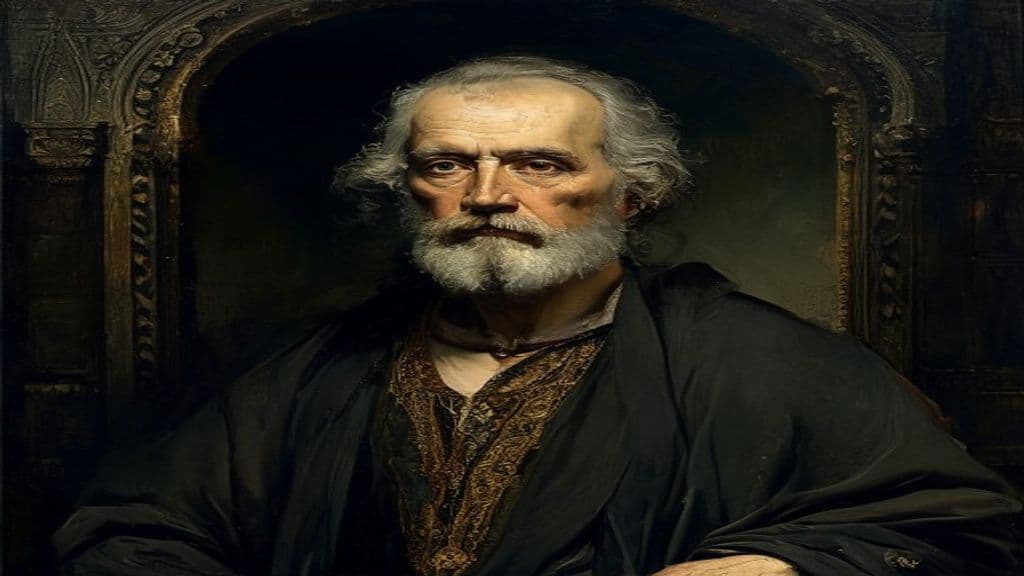
The provided sources do not supply a mythological or etymological origin for the name within the excerpted material. In the supplied corpus 'Michael' appears as a headword on a disambiguation page and as a Wikidata label classified as a male given name; no origin narrative or root-language analysis is given in these sources.
No single physical appearance is attributed to 'Michael' in the supplied materials. Instances in the sources are the name borne by many distinct historical and contemporary individuals and by titles of works, places, and events rather than a description of one entity's appearance.
The sources do not ascribe supernatural abilities or behaviors to 'Michael.' Activities mentioned in the corpus relate to actions of persons or works that carry the name (e.g., rulers, artists, films, songs) and not to powers of a singular being.
Metsänpeitto
A lesser spirit in Finnish folklore that conceals people and animals within the forest, making them invisible to those searching for them. (Note: - Change Power tier: Minor Spirit -> Lesser (According to the provided power tier classification, Lesser corresponds with a local spirit, which seems more fitting given Metsänpeitto's role in conceali)
Metsänväki
A Finnish term attested in fragmentary sources referring either to the animate power of the forest or to forest-dwelling spirits/creatures; sources supplied are brief and inconsistent about whether it denotes an impersonal force or a class of beings.
Mettekoe
Mettekoe is a contemporary processional giant created in Petit-Enghien, Belgium in 2022 that functions as a civic mascot for a charitable association concerned with orangutan conservation and as a participant in gatherings of giants and contemporary art events.
Metztli
Metztli (Nahuatl: Mētztli) is the Nahuatl term for the Moon and in the supplied sources is described as a god or goddess associated with the moon, the night, and farmers in Aztec/Nahuatl cultural context. The available material treats Metztli both as the celestial Moon and as a lunar deity, but supplies no detailed myths, iconography, or ritual corpus.
Mezzetino
Mezzetino is a commedia dell'arte stock character from 16th‑century Italian popular theatre, a member of the Zanni servant class known as a scheming, often musically inclined servant and flirt. The role circulated into French and English stages and appears in visual arts (notably Watteau) and decorative arts.
Miasma (Ancient Greek)
In ancient Greek religion, a miasma is a malevolent force arising from human wrongdoing that can cause catastrophe and has an independent life. (Note: - The draft states that a miasma causes catastrophe, disease, famine, or war, which is not supported by the source material. - Power tier: Primordial (not Ancient), since it's described as having an ")
Michigan Dogman
A regional cryptid and folkloric beast from Michigan popularized in late 20th-century media and oral reports, described as a bipedal, canine-headed figure reported in rural and wooded areas. The figure functions in local legend and contemporary folklore rather than in documented scientific or premodern ethnographic sources.
Mictlāntēcutli
Mictlāntēcutli (Mictlantecuhtli) is the Aztec lord and ruler of Mictlan, the lowest northern region of the dead. He functions as a principal underworld authority who receives the deceased, figures in myths about the bones of former humans, and appears widely in Aztec calendrical and ritual iconography.
Mictēcacihuātl
Mictēcacihuātl is an Aztec death deity, consort of Mictlāntēcutli, who is described in the sources as watching over the bones of the dead and presiding over the ancient festivals of the dead; modern accounts link her figure to the evolution of those festivals into the contemporary Day of the Dead.
Mideia (Midea)
Mideia (Ancient Greek Μιδεία / Μιδέα) is a name appearing in ancient Greek tradition applied to several mytho-geographic and genealogical figures: notably a nymph described as mother of Aspledon by Poseidon and multiple eponymous or mortal women whose names are attached to towns or genealogies. The name also denotes ancient place-names in Boeotia and Argolis preserved in Homeric and later geographical accounts.
Midnight Beauty
Attested in the supplied corpus only as a terse label — a single-line Wikidata entry calling 'Midnight Beauty' a "temptress ghost of Brazil." No supporting folkloric narratives, rituals, or detailed descriptions are present in the provided materials.
Mielikki
Mielikki is a Finnish forest-personification variously described as the Mistress of the Forest (Metsän emäntä) and a metsänhaltija whose favour is sought by hunters and shepherds. She is portrayed in runic songs and the Kalevala as a giver of game, a healer of animals, and a localized spirit who inhabits particular trees such as spruces.
Community Record
- [1]Michael - Wikipedia (disambiguation). Wikipedia contributors. "Michael." Wikipedia, The Free Encyclopedia. https://en.wikipedia.org/wiki/Michaelwiki
- [2]Michael (Wikidata Q4927524). Wikidata. Q4927524 — Michael. http://www.wikidata.org/entity/Q4927524wiki
- [3]Archive: Obama being played like a violin by dictators 8/8/14. Archive.org audio item featuring individuals named Michael in broadcast content. https://archive.org/details/soundcloud-162319036other
- [4]Archive: What drives insurance companies crazy about their outside counsel? (Ep. 2). Archive.org audio item featuring individuals named Michael in broadcast content. https://archive.org/details/gfvjwpe5o5zv1yrts0eekk4bhwctmapgqqtnsytmother
- [5]Archive: 1-17-2020 Loving Liberty with Bryan Hyde pt 1. Archive.org audio item featuring individuals named Michael in broadcast content. https://archive.org/details/qkuzarky0zrrv9tfni07yh2miy4d0fkv252ciz04other