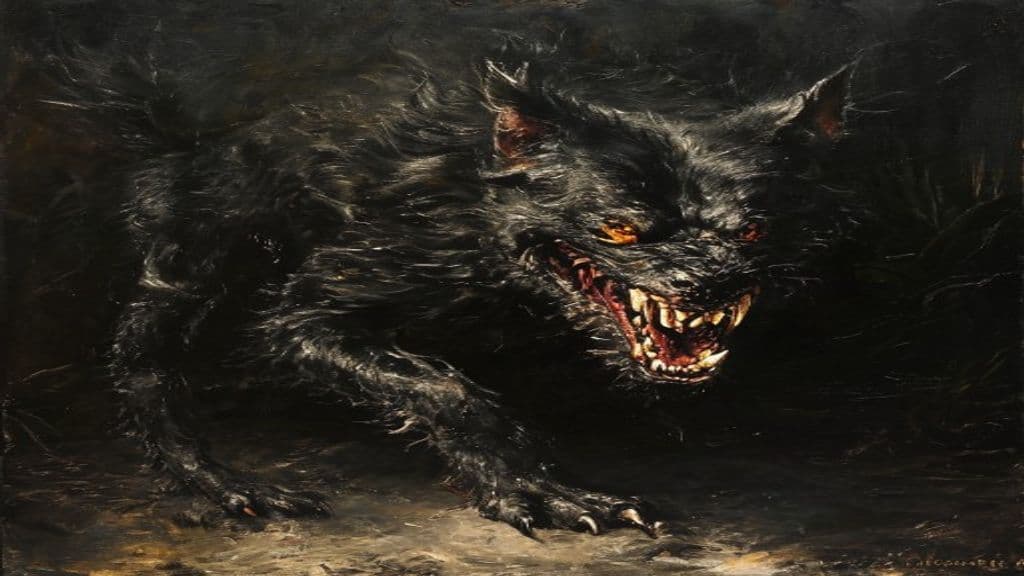
The sources do not supply a single creation myth for the Barghest; instead the name appears in Northern English lore with multiple proposed etymologies and a range of local associations. Antiquarian and popular accounts have suggested various linguistic origins (e.g., burh-ghest ‘town-ghost’; Germanic proposals such as Berg-geist ‘mountain ghost’, Bär-geist ‘bear-ghost’, or Bahr-Geist ‘spirit of the funeral bier’), reflecting attempts to explain a locally salient term. In practice the label has been used across locales from Troller’s Gill in the Yorkshire Dales to urban Snickelways in York and to sites in Durham and Northumberland, sometimes signifying a monstrous black dog and in other places denoting a ghost or household elf (for example, applied to figures like the Cauld Lad of Hylton). The multiplicity of forms and the range of etymological proposals indicate the Barghest functions as a flexible folk category rather than a single origin story attested in the supplied materials.
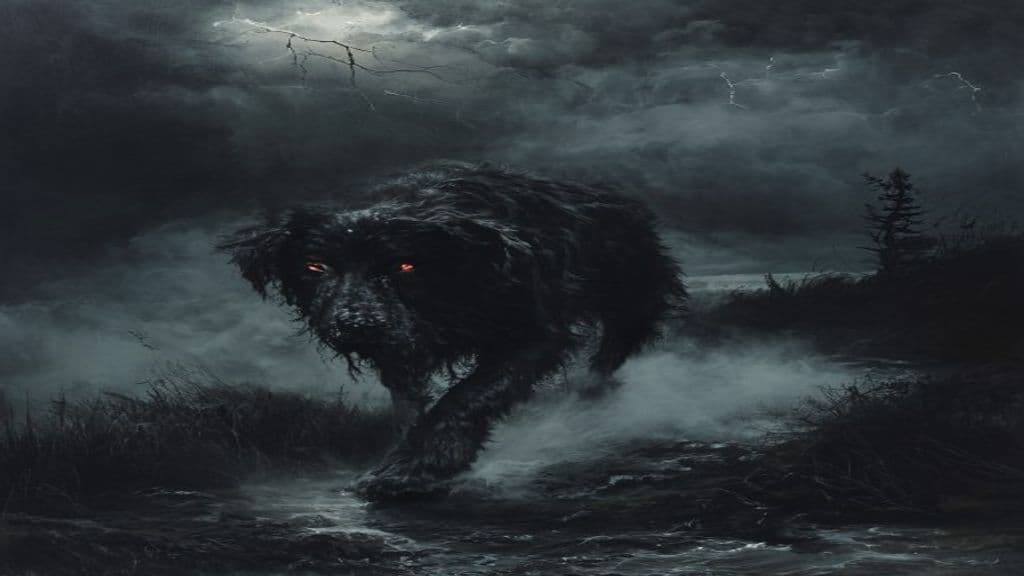
Most commonly described as a large black dog with fiery eyes, oversized teeth and claws; many accounts identify it explicitly as a 'mythical monstrous black dog.' Variant local traditions report alternative or non-canine manifestations: invisible visitations accompanied by the sound of rattling chains, and shapeshifting forms recorded in Durham traditions (e.g., a headless man who vanishes in flames, a headless lady, a white cat, a rabbit, a dog, or a black dog). When appearing as a death-omen it is sometimes described as being followed by other local dogs in a howling procession.
In the cited folklore the Barghest primarily functions as an omen-bearing uncanny presence. It is frequently alleged to herald death—appearing at or before the passing of a person and sometimes being 'followed by all the other dogs of the local area in a kind of funeral procession'—and in some accounts it 'may foretell the death of an individual by lying across the threshold of his or her house.' Variant reports attribute other capacities in some traditions: the creature may become invisible (reportedly walking with rattling chains), may shapeshift into non-canine forms in specific local narratives, and is said in some stories to strike with a paw to leave a wound that never heals. Folkloric comparison also notes a boundary restriction in some tellings: like continental vampire motifs, the Barghest is described as unable to cross rivers.
Weaknesses
- conditionunable to cross rivers
Wards
- conditionriver as a boundary (folkloric limitation attested in sources)
Barbary lion
The Barbary lion was a historical North African population of Panthera leo (also called the North African, Atlas, or Egyptian lion) that inhabited the Maghreb and Atlas Mountains. Treated in sources as a zoological and conservation subject rather than a supernatural being, it is extinct in the wild and survives only in captive lineages claimed to descend from historic North African animals.
Barbas
The corpus contains no folkloric or mythological entity named Barbas. The term appears only as a modern surname, a French commune name, occasional Spanish common noun usage (barbas = beards), and as the name of a video-game nonplayer character in player forum discussions; no traditional origin, appearance, powers, or rituals are attested in the provided sources.
Barbatos
Barbatos is a named spirit in European grimoire tradition, listed among the Seventy-Two spirits of The Lesser Key of Solomon and also appearing in the Grand Grimoire. He is given a ducal rank, commands legions of spirits, and is invoked in ceremonial contexts for knowledge, revelation of hidden things, and reconciliation.
Barbette Spaeth
American academic and associate professor at College of William and Mary, specializing in Roman mythology. (Note: 1. Add "None" to Power tier since Barbette Spaeth's abilities as a human academic are accurately described. 2. Remove "origin story" section, as it is unnecessary for a non-mythological figure like Ba)
Barbēlō
Barbēlō is a primary divine emanation (aeon) in several Gnostic theogonies, presented as the first thought and generative principle within the pleroma. She functions as an originating mediating principle through which subsequent divine manifestations arise and is central to certain Sethian and related Gnostic systems.
Bard the Bowman
A fictional human hero from J. R. R. Tolkien's The Hobbit: an archer and captain of Lake-town who kills the dragon Smaug with the family heirloom "Black Arrow," claims descent from the lords of Dale, and becomes king of the rebuilt Dale.
Barliman Butterbur
Barliman Butterbur is a human resident of Bree in J. R. R. Tolkien's Middle-earth. Source material classifies him simply as a man in Tolkien's legendarium and situates him within Bree-land, the village region where Hobbits and Men live side by side.
Barmanou
A bipedal, humanoid primate-like being reported in the mountainous regions of northern Pakistan (notably Chitral and the Karakoram). Described in local reports and modern cryptozoological literature as a 'wild man' comparable to the Yeti, Almas, or Bigfoot; accounts present it as a corporeal unknown hominid rather than a spirit.
Barnabas
Barnabas is an early Christian disciple and apostolic figure known from the New Testament book of Acts and later Christian tradition. Presented as an encourager, mediator, and missionary companion of Paul, he is associated with the Jerusalem and Antioch churches, missionary journeys in the eastern Mediterranean, and later traditions tying him to writings and martyrdom in Cyprus.
Barnell Bohusk
Barnell Bohusk is a fictional character listed in the Marvel Comics universe. The available source identifies the name as a Marvel Comics character but provides no further in-universe details.
Barney Barton
Charles Bernard "Barney" Barton is a fictional human character from Marvel Comics, introduced in The Avengers #64 (May 1969). He is Clint Barton's (Hawkeye) older brother whose life arc spans orphanage and carnival work, military and FBI service, criminal racketeering, and costumed villainy (notably adopting the Trickshot identity and serving briefly with Norman Osborn's Dark Avengers).
Barnstokkr
A named hall-tree from the Völsunga saga (Old Norse legendary-material) standing in the centre of King Völsung’s hall; it functions as a ritual-symbolic focal object in a wedding-feast episode where a sword is thrust into its trunk and later drawn by Sigmund. Scholarship situates it among Germanic 'guardian' or household trees associated with family luck, childbirth, and marriage symbolism.
Community Record
- [1]Barghest (Wikipedia). Wikipedia entry 'Barghest' (excerpts supplied in research notes)wiki
- [2]Barghest (Wikidata). Wikidata classification entry for 'Barghest' (referenced in research notes)wiki
- [3]The Legend of the Troller's Gill (summary in William Hone's Everyday Book, 1830 as cited). Summarized ballad account referenced in source material (Troller's Gill narrative summarized in supplied notes)literary
- [4]Archive items noting modern uses of the name 'Barghest'. Recorded setlists and object listings showing modern cultural use of the name; these items attest contemporary naming but do not add folkloric detail (referenced in research notes)other