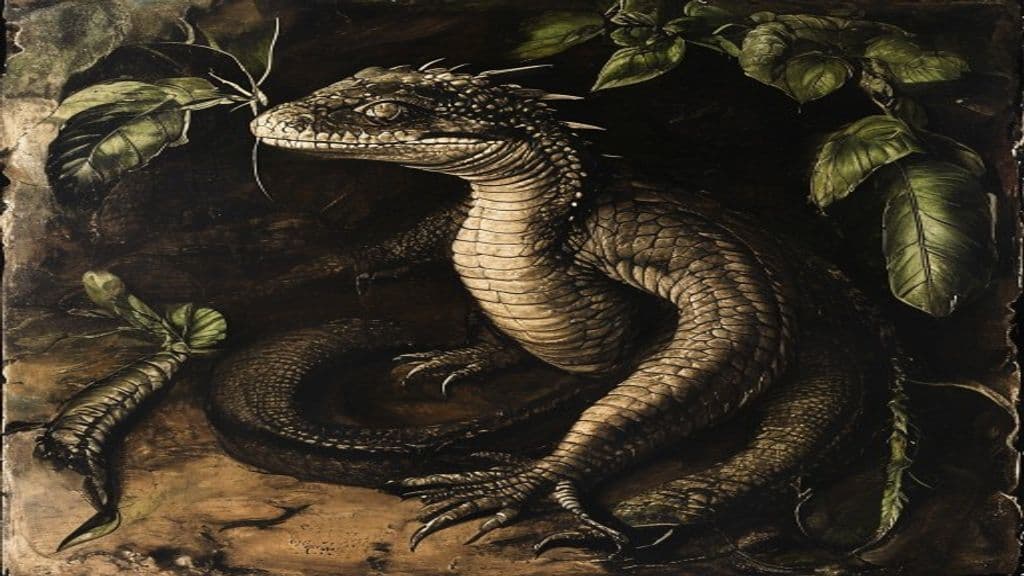
Classical authority (Pliny) reports the basilisk as a creature produced in the province of Cyrene; medieval traditions develop divergent birth-legends. Several medieval authors assert basilisks spring from extraordinary eggs—often an egg laid by a serpent or toad and incubated by a rooster—while learned commentators such as Albertus Magnus dispute or problematize the rooster-incubation story. Alexander Neckam and Pietro d'Abano reframe some lethal effects as atmospheric corruption rather than purely ocular power. Thus the tradition preserves multiple, sometimes contradictory accounts: a localized natural-origin claim (Cyrene) alongside folkloric egg-hatching variants and learned rebuttals within medieval natural-philosophical discourse.
Pliny describes the basilisk as a small serpent "not more than twelve fingers in length" bearing a white spot on the head "strongly resembling a sort of a diadem," an attribute that underlies its epithet as a "little king." Medieval retellings often hybridize its form, sometimes conflating it with the cockatrice and depicting rooster-like or composite features (rooster body, serpent tail, distinctive crest or crowned headmark). Size and form vary across accounts from a relatively small venomous snake in classical sources to larger, more hybridized monsters in later legend.
Classical and medieval sources attribute extreme lethality to the basilisk. Pliny reports it destroys vegetation by contact and by breathing upon it, scorches grass, and is so noxious that it can even "break the stones" in his phrasing; he also describes potent venom transmissible by contact and via weapons used against it. Other medieval writers emphasize a killing gaze or a corrupting exhalation ("air corruption") as the fatal agent; later legends add variants such as killing by voice or breathing fire. The creature's parts (ashes, blood) are recorded in alchemical and artisanal recipes (e.g., Theophilus, Albertus Magnus) rather than purely as medical cures.
Weaknesses
- substanceweasel effluvium
- conditionown-reflection (mirror exposure)
- conditionrooster crow
Wards
- substanceweasel (thrown into its hole)
- symbolmirror (to force the basilisk to see itself)
- conditionrooster presence or crow

Catoblepas
A legendary Greco‑Roman monstrous beast reported from Ethiopia: a mid‑sized, sluggish quadruped with a heavy head habitually pointed toward the ground and described in sources as possessing lethal properties expressed either as a deadly gaze or poisonous breath.
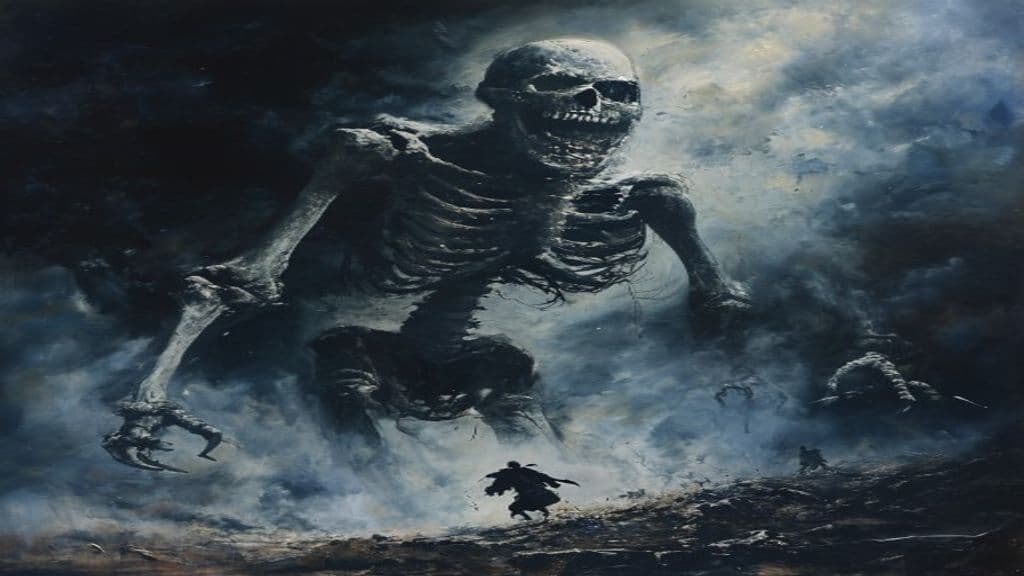
Gashadokuro
A fifteen-times-human-height skeletal yokai formed from the bones of those who starved to death or died on battlefields, their unburied remains fused together into a hungry colossus.
Community Record
- [1]Basilisk — Wikipedia. Wikipedia contributors, 'Basilisk', Wikipedia, The Free Encyclopediawiki
- [2]Natural History (Pliny) — excerpts cited in research notes. Pliny the Elder, Natural History (excerpted in research notes)literary
- [3]Theophilus Presbyter — Schedula diversarum artium (recipe references). Theophilus Presbyter, Schedula diversarum artium (recipe using powdered basilisk blood) — referenced in research notesliterary
- [4]Albertus Magnus and medieval commentators (references in research notes). Albertus Magnus; Alexander Neckam; Pietro d'Abano — medieval natural-philosophical commentary referenced in research notesacademic