
The catoblepas appears in Greco‑Roman natural history and bestiary traditions as one of the exotic marvels of the world's margins, reported from Ethiopia in the accounts of classical compilers. Classical authors such as Pliny and Aelian treat it as a physical animal to be catalogued alongside other wondrous creatures; Renaissance and medieval bestiaries and commentators (echoed in notes by figures like Leonardo da Vinci) preserved and transmitted those descriptions. Over time medieval compilers and later literary or gaming authors adapted its features (shifting emphasis between gaze and breath, adding hog‑ or gorgon‑like features), but the creature's origin in the literature is as a peripheral, zoological marvel within Greco‑Roman compilatory cosmologies.
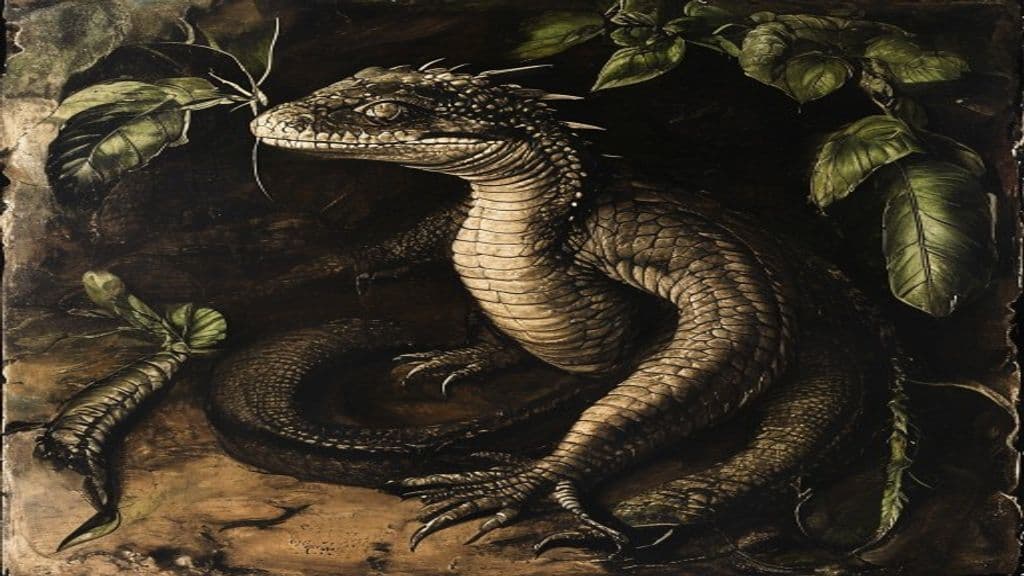
Classical descriptions converge on a mid‑sized quadruped about the size of a domestic bull or cape buffalo, sluggish in movement, with a disproportionately heavy head that droops and is habitually turned toward the ground (Pliny; Leonardo da Vinci's notes). Aelian adds details found in some accounts: a heavy mane, narrow bloodshot eyes, a scaly back, and shaggy eyebrows. Later medieval and modern literary adaptations sometimes layer on non‑classical features—hog‑ or boar‑like heads, black coloration, or gorgon‑style serpent hair—but those are later elaborations rather than unanimous ancient attestations.
Classical sources record two variant lethal attributions that coexist in the tradition. Pliny likens the catoblepas' gaze to that of the basilisk and explicitly claims its look is lethal, while Aelian denies a fatal stare and instead explains that the animal's breath is poisonous because it feeds on poisonous plants; other later authors (Timotheus of Gaza; Constantine Manasses) describe harmful fire or breath‑like emissions. The creature is otherwise described as sluggish and passive rather than an active predator (Pomponius Mela), so its danger is framed as an environmental hazard rather than an aggressive, intelligent menace. Later popular and gaming traditions adapt both gaze and breath motifs into mechanics, but those are derivative of the classical variants.
Weaknesses
- conditionhead posture (drooping head limits its lethal gaze)
- othersluggish temperament and passivity (implying avoidance/distance as practical defense)
Wards
- conditionavoidance / keeping distance
- otherdo not meet its gaze (classical concern about lethal look) — practical precaution rather than ritual
Community Record
- [1]Catoblepas — Wikipedia. Wikipedia: Catoblepas (summary of Pliny, Aelian, Leonardo da Vinci, Pomponius Mela, and later sources)wiki
- [2]Catoblepas — Wikidata. Wikidata entry for Catoblepaswiki
- [3]Catoblepas — Medieval Bestiary. Medieval Bestiary compilation drawing on classical sourcesother
- [4]Catoblepas — NetHack Wiki. NetHack Wiki (modern game adaptation noting lethal gaze mechanics)other
- [5]Nekrozon / Catoblepas (derivative bestiary entry). Nekrozon 'Catoblepas' (later derivative description; swamp ecology noted)other
- [6]Catoblepas | Cairn resources. Cairn RPG bestiary (modern adaptation referencing classical motif)other
- [7]Archive video: Monsters of Roman Folklore. Archive: compilation discussing Roman monstrous fauna including the catoblepasother
- [8]Leonardo da Vinci note (quoted in Wikipedia). Leonardo da Vinci's note as cited in Wikipedia: description of location near the source Nigricapo and drooping headliterary