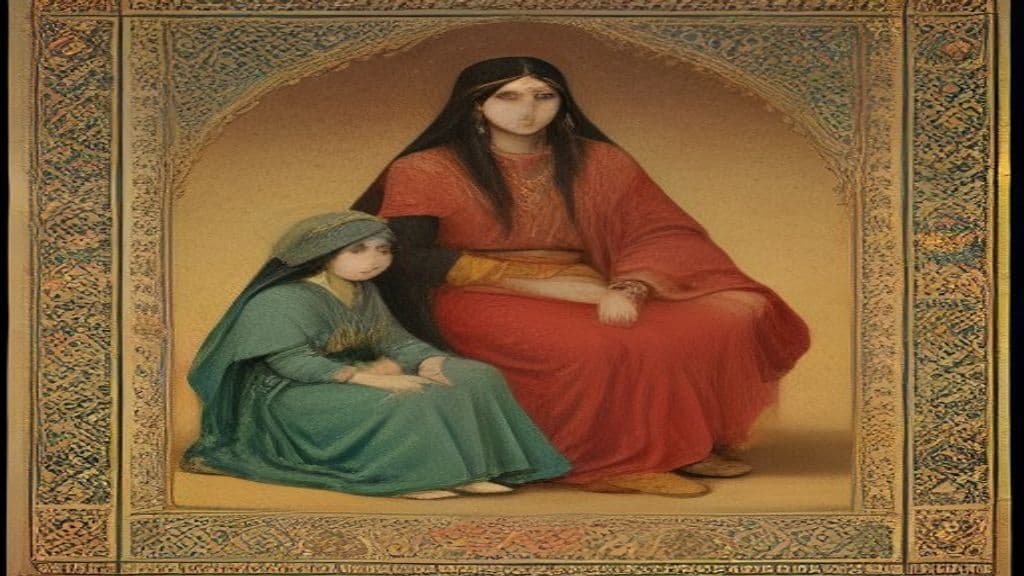
In the historical and historiographic sources summarized in the provided material, Bāzrangī is attested as the family name of a local dynasty of petty rulers in southwestern Iran near the end of the Arsacid period. Tabari (as summarized in secondary sources) is cited for a genealogical claim that Sasan took a wife from a family called Bazrangi (the woman called Rambehesht), who is described as mother of Papak; Papak and his descendants figure in narratives about the rise of the Sasanian house. Scholarly commentary in the sources treats the term's relationship to place-names and later folktale usage as uncertain; one speculative etymology (S. Wikander) proposes a title meaning "holding a mace" or "possessing miraculous power," a suggestion explicitly marked unproven by R. N. Frye in the cited material.
The supplied sources do not describe Bazrangi as a corporeal or supernatural appearance. Rather, the name appears attached to historical individuals (for example Rambehesht, a 3rd-century noblewoman described as from the Bazrangi family) and to living toponyms (notably villages called Upper Bāzrang and Lower Bāzrang in the Behbahan district of Khuzestan and a district in the Boyer-Ahmad mountains). No physical, anthropomorphic, or otherworldly attributes are recorded in the provided texts; the term's "appearance" in the record is on genealogical lists, place-name registers, and lexical notes in folktales.
The sources do not attribute supernatural powers, behaviors, or functions to Bazrangi. Actions associated with the name in the documents are political and genealogical: members of the Bazrangi family are named in accounts of marriage and descent (e.g., Rambehesht as mother of Papak) and the family is described as a local ruling house in Persis at the end of the Arsacid era. The speculative etymology proposing a meaning of "possessing miraculous power" is noted in the sources as an unproven scholarly suggestion and is not presented as an attested cultural belief about agency or abilities.
Bauk (Slavic mythology)
A mythical creature from Serbian mythology that inhabits dark places, waiting to grab and devour its victims. (Note: 1. Power tier should be Lesser (local spirit), as it's described as hiding in dark places, not possessing deity-level powers. 2. The appearance description matches the source material, but note that ")
Bawang Merah dan Bawang Putih
A widely told Malay/Indonesian folktale about two eponymous human stepsisters — Bawang Putih (the humble, patient sister) and Bawang Merah (the vain, cruel sister). The story uses small supernatural motifs (magic pumpkins, a talking fish, a gift-bearing old woman) set in rural liminal spaces to reward virtue and punish vice; it functions as a didactic children's tale rather than an account of a discrete spirit being.
Bayard (Ros Balatum)
Bayard, called Ros Balatum in some modern French sources, is a singular magical bay horse from the medieval chansons de geste, most famously associated with the cycle around The Four Sons of Aymon. The creature is presented in the literary tradition as an intelligent and powerful enchanted steed with the supernatural ability to change size to accommodate its riders.
Bayon
A Theravada Buddhist temple and monument in Angkor, Cambodia, embodying the principles of Mahayana Buddhism. (Note: 1. Power tier: The draft article assigns Bayon to the Primordial power tier, but given that it's a temple with no mentioned ability to affect reality on a cosmic scale, this should be adjusted to Anci)
Bayonetta
Bayonetta is the titular witch protagonist of a contemporary urban-fantasy action‑adventure video‑game franchise created by PlatinumGames and published by Sega/Nintendo. Presented as a stylized, humanlike witch, she wields firearms and hair‑based magic to battle angelic and godlike foes across modern and mythic settings.
Bazi
Bazi (cuneiform 𒀭𒁀𒍣, dBa-zi) is a figure in Mesopotamian king-list and literary traditions associated with Mari and the western lands; in the Tell Leilan recension of the Sumerian King List he appears as a legendary 'king of Mari', while an Old Babylonian composition, the Song of Bazi, treats him as a deity linked to exorcistic practice and ascribed filial relation to the god Ea.
Baš Čelik
Baš Čelik is the supernatural antagonist of a Serbian folktale recorded in Vuk Karadžić’s tradition. In the tale he is an imprisoned, other‑worldly being whose life is hidden outside his body; he is temporarily weakened by denying him water but can only be permanently defeated by locating and destroying his external life‑locus.
Bašmu
An ancient Mesopotamian monstrous serpent (literally 'Venomous Snake') appearing in mythic lists of primeval foes of the gods and as the Akkadian name of a Babylonian constellation (MUL.DINGIR.MUŠ, equated with the Greek Hydra). It is portrayed in fragmentary texts and art as a huge, horned, venomous snake defeated by divine champions.
Baʿal Hammon
Baʿal Hammon is the chief male deity of the Punic (Carthaginian) pantheon, associated principally with vegetation fertility, communal prosperity, and kingly supremacy. He is syncretized with North African/Egyptian Ammon (Amun) and, in Greco‑Roman interpretatio, with Cronus/Saturn. Classical authors accuse his cult of child sacrifice, a claim debated by modern scholars and archaeologists.
Baʿal Zephon
An epithet/localized form of the Canaanite storm god Baʿal (Hadad) associated with Mount Zaphon (Jebel Aqra) and with the north; worship of Baʿal Zephon served protective and maritime functions and was widely syncretized in neighboring cultures.
Ba‑Pef
Ba‑Pef is an obscure, malevolent underworld deity attested in Old Kingdom Egyptian sources and referenced in later summaries; the name literally means "that Ba". The priesthood of Ba‑Pef was held by queens in the Old and Middle Kingdoms, and the deity appears in at least one funerary inscriptional context naming a priestess.
Beaduhild (Böðvildr)
Beaduhild (Old Norse Böðvildr; Old English Beaduhild/Beadohild; also Bodil, Badhild) is a legendary human princess in Germanic heroic tradition whose life is entangled with the smith Wayland (Weland/Vǫlundr). In earlier sources she appears as a tragic victim in the Weland cycle; in later Scandinavian recensions she is recast as Wayland's wife and the mother of a heroic descendant (Viðga).
Community Record
- [1]Bazrangi. Wikipedia: Bazrangi (entry summarizing family name, toponyms, folkloric usage, and scholarly notes including mention of S. Wikander and R. N. Frye)wiki
- [2]Rambehesht. Wikipedia: Rambehesht (identifies Rambehesht as a 3rd-century Sasanian noblewoman from the Bazrangi family and wife of Sasan)wiki
- [3]Bazrangi (Wikidata). Wikidata entry for Bazrangi (dates and entity data: 2nd/3rd-century dynasty in southwestern Iran)other
- [4]Istakhr (regional context). ROOTSHUNT: contextual material on Istakhr and the wider Persis region referenced in source notes about Bazrangi's geographic contextother