The phrase appears in Hebrew scriptural contexts (notably Genesis 6:2,4 and Job 1:6; 2:1) and in later Jewish interpretive traditions. In the Hebrew Bible it functions as a designation for beings who belong to the divine sphere—members of a heavenly assembly who "present themselves" before God (Job) or who figure in the antediluvian narrative (Genesis 6). Comparative evidence from Ugaritic and Phoenician texts shows close parallels for terms denoting a council of gods, and later Jewish angelological systems (Kabbalah and medieval hierarchies) incorporated bene elohim as part of ordered angelic ranks. Some interpretive traditions, however, read the phrase as referring to human groups (e.g., descendants of Seth or human judges) rather than nonhuman heavenly beings.
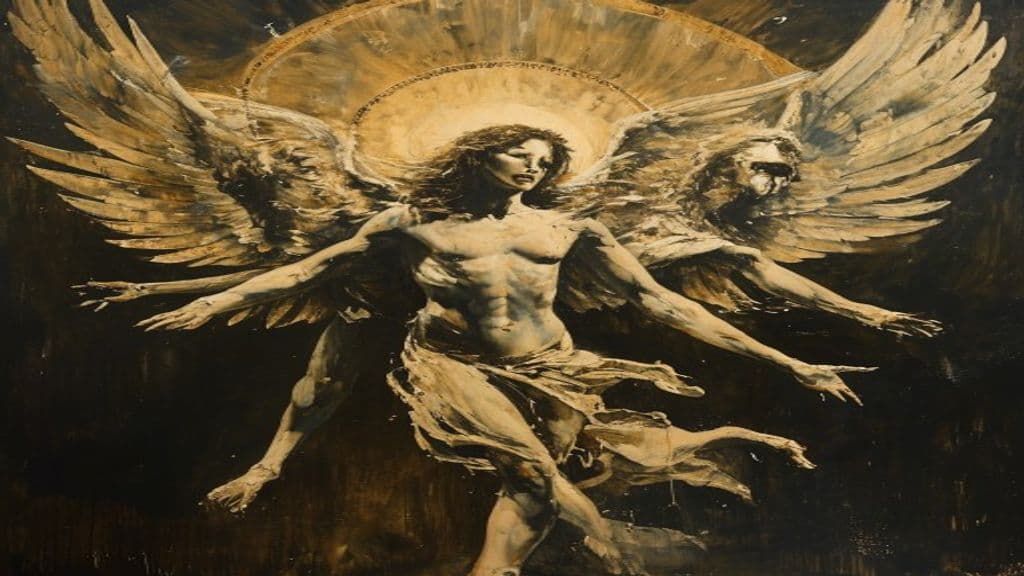
The supplied sources do not provide a consistent or scripturally attested physical description of bene elohim. While later artistic conventions for angels commonly show human-shaped, winged, or radiant figures, those conventions are general to angel imagery and are not attested in the provided materials as specific to the phrase bene elohim. Scriptural usages treat the term as a social/ontological category rather than describing bodily features.
Sources describe bene elohim primarily in social and functional terms: as members of a heavenly council who assemble or "present themselves" before God (Job 1–2), and, in some readings of Genesis 6, as beings who interacted with human women (an interpretation that leads in some traditions to the identification of their offspring as Nefilim). They are thus portrayed as participants in divine governance, intermediaries or agents of divine will, and as occupants of the divine sphere. Interpretive disagreement exists over whether Genesis 6 describes downward interaction between heavenly bene elohim and humans or whether the phrase there denotes particular human groups.
Community Record
- [1]Sons of God. Wikipedia, entry 'Sons of God' (summary on bene elohim and later angelology)wiki
- [2]Bene-elohim - Biblical Cyclopedia. Biblical Cyclopedia, entry 'Bene-elohim'other
- [3]Elohim - Alchetron. Alchetron, 'Elohim' (notes parallels with Ugaritic/Phoenician council-language)other
- [4]¿Quiénes fueron los Nefilim? Respuestas En Jubilees En Espanol Parte14. Archive.org video discussing Genesis 6 traditions and the Book of Jubilees treatment of 'sons of God' (documents the interpretive debate)other
- [5]Who were the "sons of God" (bene elohim) in Genesis 6:2?. Hermeneutics StackExchange discussion (surveys interpretive positions: heavenly beings vs. human groups)other
- [6]Does the equivalent of bene ha elohim in Gen. 6:2,4; Job 2:1 ever refer to Believers in the NT?. Hermeneutics StackExchange (discusses usage and referential range of bene ha-elohim across texts)other
- [7]What do the Nephilim represent?. Judaism StackExchange (notes divergent Jewish readings including Sethite/human and heavenly readings and relation to Nefilim)other