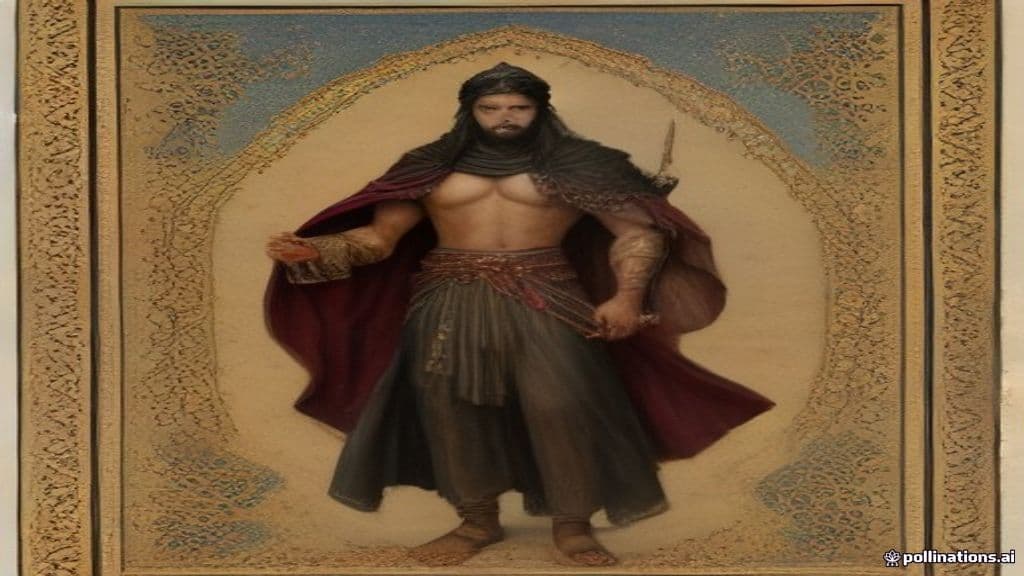
Biderafsh appears in the legendary-historical episode surrounding King Goshtasp's conversion to Zoroastrianism and the hostile response of Arjasp, king of Turan. In the narrative attested in the Shahnameh and in earlier sources (Middle Persian Ayadegar-e Zariran, and Islamic-era historians/epic compilers such as Tabari, Bal'ami, and Ebn Balkhi) Arjasp sends a threatening letter to Goshtasp; Biderafsh is named among the Turanian envoys and champions involved in this confrontation. The episode situates him within the mythic chronology of Goshtasp's reign and the Iran–Turan wars that dramatize political and religious conflict in the epic tradition (sources: Shahnameh; Ayadegar-e Zariran; Tabari; Bal'ami; Ebn Balkhi).
The provided sources do not supply a physical description of Biderafsh. He is presented as a Turanian hero and envoy within epic narrative; beyond his martial status and role as an envoy and combatant, no details of clothing, bodily features, age, or supernatural attributes are recorded in the cited texts. The name itself—given in Middle Persian as Wīdrafš and reconstructed Old Iranian *wi-drafša—evokes the image of one associated with an unfurled banner, but this linguistic meaning is recorded independently of any descriptive passage in the narratives (sources: Shahnameh; Ayadegar-e Zariran; linguistic reconstruction noted in secondary etymological discussion as cited in the source corpus).
In the literary sources Biderafsh's capacities are those of a mortal martial leader and envoy rather than supernatural powers. He functions as an envoy (Biderafsh and Nāmkhāst are sent to Iran bearing Arjasp's letter), fights in Arjasp's army against the Iranians, kills Zarir (Goshtasp's brother), and is subsequently killed by the Iranian hero Esfandiar. The etymology of his name (Middle Persian Wīdrafš; Old Iranian *wi-drafša, 'with unfurled banner') places him within the heraldic/martial idiom of epic warfare, suggesting a public role as a bearer or emblematic figure on the battlefield. No supernatural abilities or magical feats are attributed to him in the cited Shahnameh, Ayadegar-e Zariran, Tabari, Bal'ami, or Ebn Balkhi passages.
Community Record
- [1]Biderafsh — Wikipedia. Wikipedia, article 'Biderafsh' (accessed via provided research notes)wiki
- [2]Shahnameh (national epic of Greater Iran) — episodes concerning Goshtasp and Arjasp. Shahnameh: narrative sections treating the Goshtasp–Arjasp episode in which Biderafsh appears (as cited in research notes)literary
- [3]Ayadegar-e Zariran (Middle Persian epic). Ayadegar-e Zariran: Middle Persian epic attesting the figure (as cited in research notes)literary
- [4]Tabari — historical/epic accounts. Tabari: Islamic-era historiographical references to the episode and figures (as cited in research notes)literary
- [5]Bal'ami and Ebn Balkhi — historiographical/epic compilations. Bal'ami and Ebn Balkhi: later compilations citing the same epic-historical material in which Biderafsh is named (as cited in research notes)literary