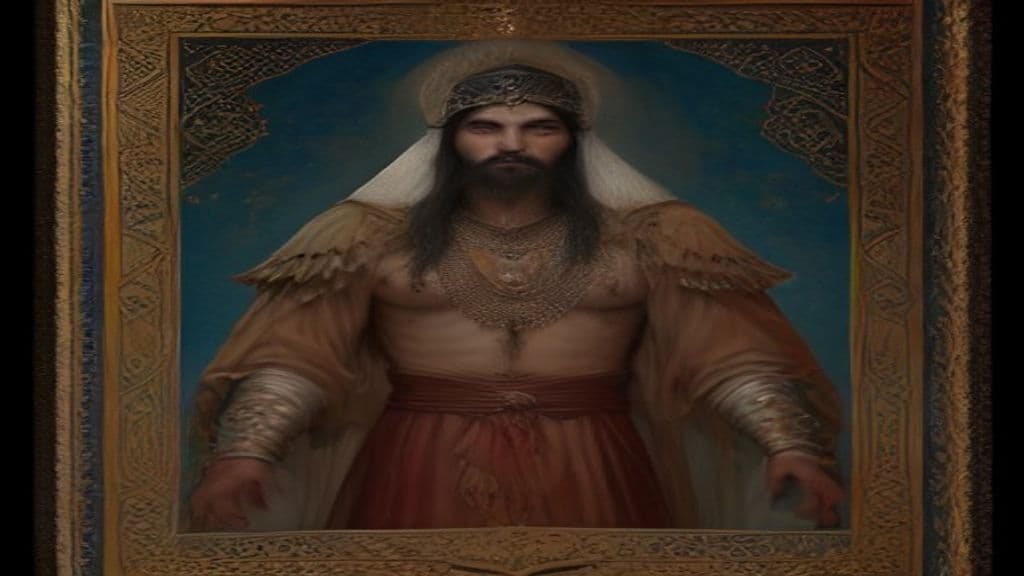
In the Avestan hymns Arәĵaṭ.aspa (Arjāsp) is attested as leader of the Xyaona (Hyaona) tribe hostile to the newly promulgated Zoroastrian faith and its princely patron Vishtaspa/Goshtasp (see Aban Yasht Yt. 5.109; Gosh Yasht Yt. 9.30; Ard Yasht Yt. 17.50). In Middle Persian summaries (e.g., Bundahishn and later historiographical traditions) the opposition to Goshtasp is historicized into a decisive conflict located at places such as Mad-Frayād between Padešxwārgar and Kumish, and in the Shahnameh cycle the figure is incorporated into Turanian dynastic genealogy (made a son of Shavāsp and brother of Afrasiab) and presented as a king leading campaigns against Ērān.
Primary textual sources do not provide a sustained physical description of Arjasp. The Avestan and Middle Persian accounts present him as a human tribal leader or king. Later Shahnameh manuscripts and Persian miniature traditions portray him visually as a royal/warrior figure within fortifications during the episode in which Esfandiyar storms his castle, but these illustrations are pictorial traditions rather than detailed textual physiognomies.
Narratively, Arjasp's capacities are political and military: he commands the Xyaona/Turanian forces, leads sieges (notably the siege of Balkh in the Shahnameh), captures members of the Iranian royal household (Goshtasp's daughters Homāy and Behāfrīd in the Shahnameh), and fights pitched battles against Iranian princes. Middle Persian accounts attribute the slaying of figures such as Lohrāsp and Zarēr to his campaigns in some versions, and a Middle Persian text (Yadegar-e Zariran) records that he was captured and mutilated before being released. He is ultimately defeated and killed by the hero Esfandiyar in the epic tradition.
Weaknesses
- conditiondefeat by Zoroastrian-aligned military/heroic force
- conditionpolitical/religious consolidation under Goshtasp/Vishtaspa (conversion to Zoroastrianism as counterforce)
Wards
- conditionalignment with Zoroastrian religion and martial defense

Aghrirat
Aghrirat is a named Turanian noble and peacemaker in the Shahnameh and Iranian mythic tradition, presented as a son of Pashang and brother of Afrasiab and Garsivaz. He is notable for his kind and gentle character and for attempting, largely unsuccessfully, to end the hostilities between Iran and Turan.
Akvan Div
Akvan Div is a named div (دیو) from the Persian epic Shahnameh who confronts the hero Rostam during the era of Kay Khosrow. In the tale Akvan appears among onager herds, can vanish or assume forms such as a brilliant onager, wind, or storm, and is ultimately snared with a lasso and beheaded by Rostam.
Andariman
Andariman is a named antagonist in the Shahnameh cycle of Greater Iran, depicted in manuscript illustrations and genealogical lists as an enemy combatant—described in a manuscript caption as "one of the Turkman host"—who fights the Iranian hero Gorgin (Gurgin) and is shown slain in illustrated episodes.
Arzhang Div
Arzhang Div (Aržang Dēw; ارژنگ دیو) is presented in Shahnameh manuscript tradition as the chief or commander of the divs of mythic Mazandaran and an antagonist defeated by the hero Rustam during the episode commonly called Rustam's Sixth Feat (part of the Seven Labours). His defeat is treated by commentators as emblematic of the collapse of a demonic ruling order in the epic.
Bârmân (بارمان)
Bârmân is a Turanian hero and commander in Ferdowsi’s Shahnameh who fights in the Great War of Iran and Turan during the reign of Nowzar. In the epic he kills the Iranian Qobád and is later slain by the Iranian warrior Qaran; he is represented in Safavid illustrated Shahnameh folios as a recognizable martial figure.
Div (Dīv)
Div (Persian: دیو dēw / dīv) are monstrous, often sorcerous antagonists in Persian epic and folkloric tradition, best known from the Shahnameh where they oppose heroes such as Rustam. Scholarly sources trace their cultural history to a re‑interpretation and demonization of older Indo‑Iranian divine figures (devas).
Esfandiyār
Esfandiyār is a legendary human prince and warrior in the Iranian epic tradition (the Shahnameh). Presented as a Kayanian crown prince and a divinely supported champion who aids the cause of Zarathustra, his career includes seven labors, receipt of heavenly armor and a binding chain, and a fatal duel with the hero Rostam that functions as a moral and providential pivot in the epic.
Eskandar (Alexander the Great) — Shahnameh tradition
In Ferdowsi’s Shahnameh Eskandar (Sikandar/Alexander) is a legendary royal-hero integrated into the Iranian royal sequence: a world-conquering monarch who also undertakes spiritual journeys and erects a barrier against apocalyptic forces. The episodes function as a narrative and cosmological bridge from the poem’s mythic Kayanian age to a more historical time-frame.
Farangis
Farangis is a human literary character in the Persian epic the Shahnameh: the eldest daughter of Afrasiab of Turan, the second and favourite wife of the Iranian prince Siyâvash, and the mother of the hero and later king Kai Khosrow. Her role in the epic is genealogical and political, marked by loyalty, mourning, and participation in dynastic succession.
Farud
Farud (also Firoud, Forud) is a human princely figure in the Persian epic Shahnameh, presented as the son of Siavash and ruler of Kelat. His encounter with the army of his brother Kai Khosrow—marked by misrecognition, restrained tactics, and tragic wounding—functions as a moral episode about kinship, counsel, and the ethics of warfare.
Garsivaz
Garsivaz is a human courtier in the Persian epic tradition, presented in Ferdowsi's Shahnameh as a brother of Afrasiab of Turan whose counsel leads to the killing of Siyâvash; later illustrated manuscript traditions expand his role in reception to include capture and disclosure of Afrasiab's location.
Giv (Gev)
Giv (Persian: گیو), also rendered Gev, is a legendary Iranian knight and one of the main human heroes in the New Persian epic Shahnameh. He is presented as a noble paladin of the House of Goudarz, father of Bizhan, brother of Roham, and a loyal companion of kings such as Key Khosrow.
Community Record
- [1]Arjasp - Wikipedia. Wikipedia entry 'Arjasp' (summarizes Avesta, Middle Persian, and Shahnameh treatments)wiki
- [2]Arjasp (Wikidata). Wikidata item Q5860111 for Arjaspother
- [3]Aban Yasht; Gosh Yasht; Ard Yasht (Avestan references). Avestan hymns cited in summaries: Aban Yasht (Yt. 5.109), Gosh Yasht (Yt. 9.30), Ard Yasht (Yt. 17.50) — attest Arәĵaṭ.aspa as leader of the Xyaonaliterary
- [4]Yadegar-e Zariran (Ayadgar-i Zariran). Middle Persian text referenced in summaries (accounts of capture/mutilation of Arjasp)literary
- [5]Bundahishn (summaries cited). Middle Persian tradition summarized in secondary sources locating decisive conflict at Mad-Frayād between Padešxwārgar and Kumishliterary
- [6]Shahnameh (Ferdowsi) — Isfandiyar episode. Shahnameh narrative describing Arjasp's siege of Balkh, capture of Goshtasp's daughters, and fatal encounter with Esfandiyarliterary
- [7]Isfandiyar slays Arjasp — Cleveland Museum (archival image). Manuscript/illustration tradition showing the Shahnameh episode; pictorial evidence of Arjasp as royal/warrior figureother
- [8]Isfandiyar Kills Arjasp (Walters Art Museum). Walters manuscript miniature depicting the Shahnameh sceneother
- [9]Shahnameh folio — Fitzwilliam Museum reference. Fitzwilliam Museum object page for a miniature of Esfandiyar slaying Arjaspother