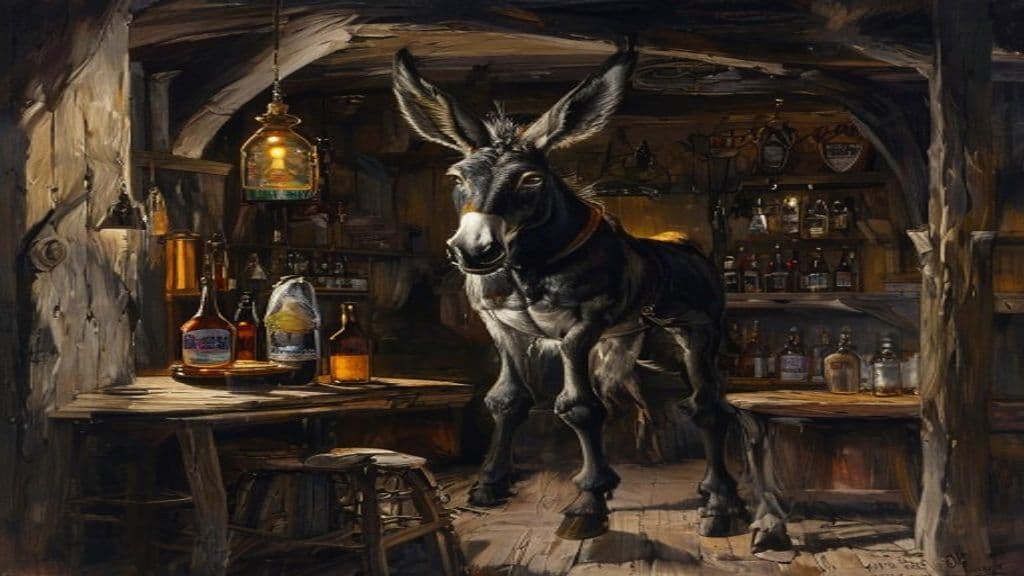
No cosmogonic origin story is recorded in the provided sources. The name is a German compound of Bier ("beer") + Esel ("donkey") attested in print as an insult in 1597 (Bürgel) and discussed in a 1705 work (Johann Georg Schmidt's Die gestriegelte Rockenphilosophie), and has been used in folklore scholarship to denote a beer‑house kobold or house spirit associated with beerplaces.
Descriptions vary regionally. Common motifs describe a spirit with donkey legs, sometimes only three (a three‑legged donkey form) or donkey‑headed and hooved; several Thuringian accounts emphasize the three‑ or four‑legged donkey imagery. Other localized accounts include a Bohemian witness who described a horned gray ox with a thick red human head; some traditions focus more on behavior and occupations than on fixed monstrous detail.
In occupational and household contexts the Bieresel is recorded doing chores in breweries, inns and cellars—cleaning bottles, steins, casks and kegs, bringing beer into houses and performing other household tasks—in return for payment in the form of a nightly portion of beer. If not given its beer or otherwise offended, it is said to retaliate by breaking or hiding vessels and equipment, throwing people out of bed, creating disturbances, and in some Bohemian tales behaving as a noisy poltergeist with allegedly harmful or deadly encounters. In some Thuringian accounts the Bieresel practices aufhocken—leaping upon the backs of drunkards or late tavern visitors and forcing them to carry the spirit home; in Vogtland it is reported to mingle harmlessly among pub crowds.
Weaknesses
- substancenightly portion of beer (appeasement)
- conditionconfrontation/driving out by force (anecdotal instance: bear and handler drove it away at Katzenmühle)
Wards
- ritualnightly beer offering
- conditionavoid late drunken wandering
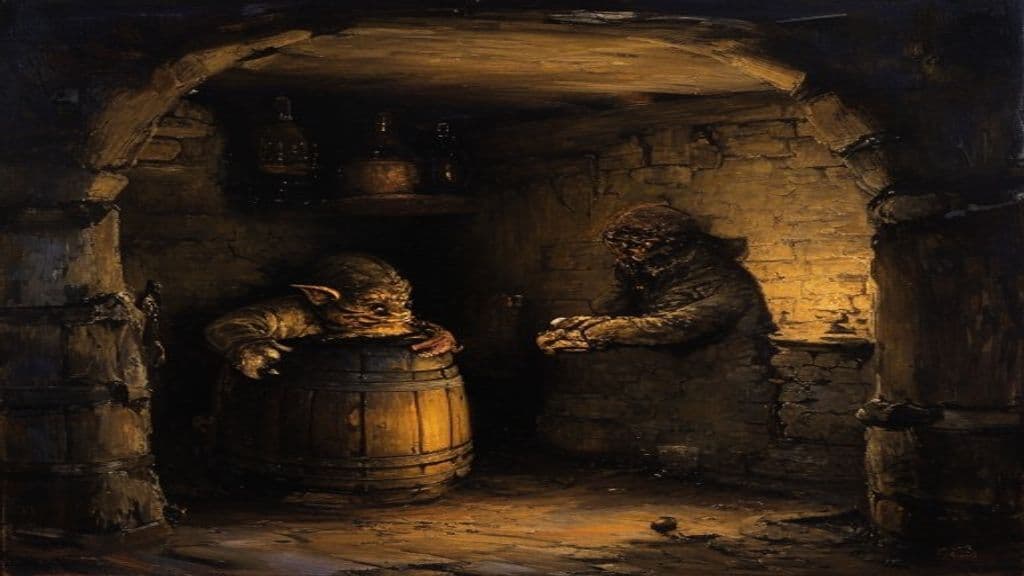
Kobold
The German household and mine spirit — a mischievous but potentially helpful small being who attaches to a household, bringing luck or disaster depending on how it is treated.

Clurichaun
A solitary Irish fairy-like household and cellar spirit associated with drinking places (breweries, pubs, wine cellars). He is a heavy drinker and smoker, a mischievous trickster who can also act as a protective domestic spirit for a household that tolerates him; accounts are primarily from 19th-century collectors and later summaries.
Abraun
Abraun is an attested name in German-language plant-legend scholarship (Der abraun, ein beitrag zur pflanzensagenkunde, 1916) and a short database entry (Wikidata) labels it as a spirit from German mythology. Surviving accessible documentation is extremely limited: the principal academic treatment is a 1916 contribution to pflanzensagenkunde (plant-saga studies), but the excerpts available here contain only bibliographic metadata and do not record tales, descriptions, or rituals.
Alp
A German-speaking folkloric figure associated with nocturnal disturbance of sleepers. Historically tied to the broader Germanic family of 'elves' and treated variously as an eerie nature-being in medieval glosses and as a male nocturnal spirit in later folk accounts that sits on sleepers' chests and causes nightmares (Alptraum) and 'elf-pressure' (Alpdruck).
Aufhocker
The Aufhocker is a German folkloric shapeshifting 'pressure' or 'perching' spirit that leaps upon the backs or shoulders of solitary travelers, weighing them down with each step until victims become exhausted, incapacitated, or—in some variants—killed. It is associated with liminal places (bridges, crossroads, hollow paths, cemeteries) and exists in multiple narrative roles including punitive agent, nightmare embodiment, and theriomorphic attacker.
Bergmönch
A German mountain spirit associated with pits and mines; described as a hooded, giant figure who aids favored miners and punishes those who offend him or violate mining-community mores. He appears in mining locales and may manifest as a monk-like giant, a miner, a horse, or become invisible.
Buschgroßmutter
A female wood/forest spirit of German folklore, especially attested in Thuringia, Saxony, German Silesia and parts of Bohemia and Transylvanian Saxon tradition. She is an ancient, ambivalent grandmotherly figure of the underwood who may reward respectful helpers or punish mockery and transgression of forest norms.
Drak
The Drak is a household spirit in German folklore, attested under several regional names and frequently identified with the kobold or the devil (Teufel). Surviving references are brief and primarily classificatory, indicating a household-associated supernatural figure with variable local naming and associations.
Elwetritsch
A regional legendary chimera reported in southwestern Germany (especially the Palatinate): a bird‑like, chicken‑sized imaginary creature assembled from parts of different animals and embedded in local mock‑hunts and folk identity. One scholarly interpretation traces the modern motif to a linguistic and cultural miniaturization of older night‑pressure spirits (Albdrude/Albdruck), though this continuity is presented in sources as an interpretation rather than uncontested fact.
Erdhenne
The Erdhenne (German: 'Earth Hen') is a German house spirit from Alpine, Upper Palatinate, and Bavarian folk tradition that usually remains unseen but communicates by loud clucking to warn households of danger. When it becomes visible it is regarded as an omen of death—tradition records death within a year, often of the person it shows itself to.
Ewiger Jäger
A spectral huntsman from German, Belgian and Pennsylvania Dutch folklore condemned to an unending hunt. Usually portrayed as a formerly human hunter bound by oath, curse, sacrilege, or a dying injunction to pursue quarry ceaselessly, the figure is a local variant of the European wild hunt motif.
Feldgeister
Feldgeister are a class of German agricultural spirits or 'field spirits' associated with cereal crops, harvest processes and weather. The category groups many named local types (animal, human, and hybrid forms) implicated both in fertility of fields and in hazards such as child-stealing, illness, spoilage and storm phenomena.
Feuermann
A German-language folkloric luminous apparition described as a "fire man" or "fiery ghost," known in regional dialects by several synonymous names that emphasize burning, glowing, or flickering qualities. The Feuermann is presented in the supplied sources primarily as a named class of luminous phenomenon rather than through detailed narratives, rituals, or functions.
Klabautermann
A ship-bound household/ship spirit from North Sea and Baltic coastal folklore (Frisian, German, Dutch) that aids sailors and fishermen in work and warns of a ship's doom; normally unseen and helpful, its visible appearance is traditionally an ill omen.
Community Record
- [1]Bieresel (Wikipedia). Wikipedia contributors. 'Bieresel.' Wikipedia, The Free Encyclopedia.wiki
- [2]German folklore (Wikipedia). Wikipedia contributors. 'German folklore.' Wikipedia, The Free Encyclopedia.wiki
- [3]Der Pummpälzweg — English page. Der Pummpälzweg (English). pummpaelz.de.other