
Folklorists trace the modern Bigfoot/Sasquatch phenomenon to a synthesis of older 'wild man' motifs, North American indigenous stories of hairy wild people (e.g., Sts'ailes sasq'ets narratives), and mid-20th-century media events and hoaxes. The anglicized term 'Sasquatch' is recorded from Halq'emeylem sasq'ets ('roughly "hairy man"'), while the English name 'Bigfoot' was coined in 1958 after large footprints were found in Humboldt County, California and publicized in local press. Subsequent revelations of some engineered footprints and other hoaxes are part of the tradition's modern history.
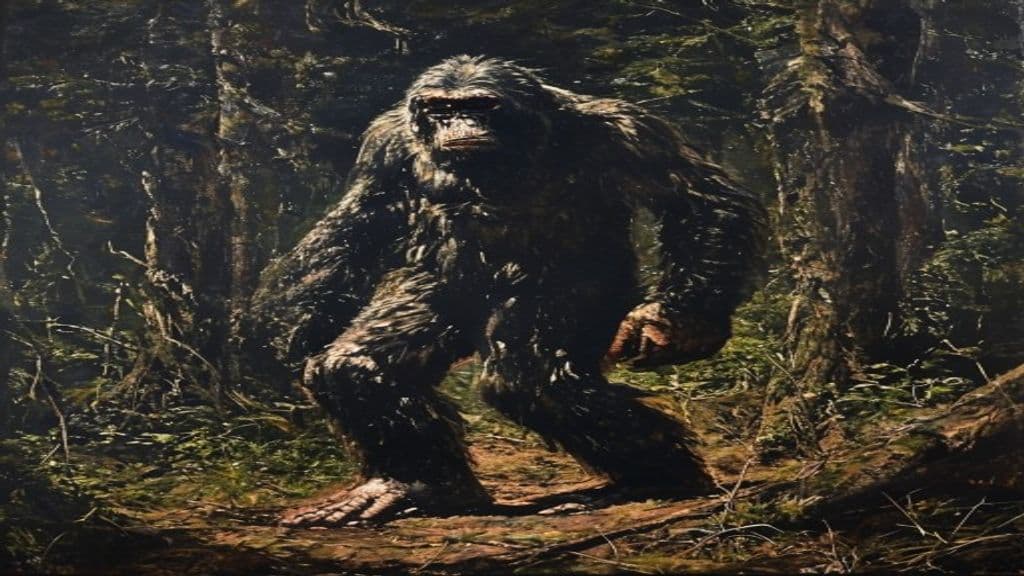
Accounts describe a large, muscular, bipedal humanoid covered in dark hair (black, dark brown, or dark reddish), commonly estimated at roughly 6–9 ft (1.8–2.7 m) in height; larger heights (10–15 ft) appear as anecdotal outliers in some reports. Reported features include broad shoulders, long arms, sometimes a minimal or obscured neck, and a face variously described as more human than animal. Nighttime reports sometimes include claimed eyeshine (yellow or red), which sources note conflicts with known ape/human physiology and may reflect misperception or misattribution to other animals.
The tradition attributes large footprints (plaster casts and track photographs feature prominently in accounts) and strong physicality in anecdotal testimonies; some witnesses claim unusual strength or that objects were moved, and a small body of photographs, video, audio recordings, hair samples, and footprint casts are offered by enthusiasts as evidence. Scholarly and scientific treatments in the supplied sources characterize this material as folklore, misidentification, or hoax and dismiss Bigfoot as not an established biological species. Specific exceptional feats reported in anecdotes are unverified in the sources.

Yeti
A Himalayan legendary apelike humanoid—large, hairy, bipedal—embedded in pre‑Buddhist and local Himalayan folklore and later incorporated into Tibetan Buddhist classificatory schemes; it is variably described in local terms as a 'man‑bear' or 'wild man' and has been reinterpreted in modern popular culture as the 'Abominable Snowman.'
Yowie
Yowie is an Australian folkloric entity—recorded in some Aboriginal lexical records as a nocturnally roaming spirit and in colonial and modern accounts as a large, bipedal, hairy creature. The figure appears across eastern Australian traditions under many regional names and has been reinterpreted in settler literature and modern cryptozoology.
Community Record
- [1]Bigfoot - Wikipedia. Wikipedia contributors. "Bigfoot." Wikipedia, The Free Encyclopedia. https://en.wikipedia.org/wiki/Bigfootwiki
- [2]Bigfoot - Wikidata. Wikidata entry Q56356273 for Bigfoot. http://www.wikidata.org/entity/Q56356273wiki
- [3]LIVE from Fight Laugh Feast: Bigfoot and The Yeti from Bigfoot Revival Podcast (archive). Archive.org. "LIVE from Fight Laugh Feast: Bigfoot and The Yeti from Bigfoot Revival Podcast." https://archive.org/details/indsvywpckmmtnlkbhenl9m7ibvnqczcfix0bdyxother
- [4]Cinema Beef Podcast #147 : Seasoned Heroes (archive). Archive.org. "Cinema Beef Podcast #147 : Seasoned Heroes." https://archive.org/details/hi6vwaj1buvjbwsvrk5ecagreaoo43qwz95aahipother
- [5]TMBS ReAir: 91 Wonkery Won't Save Us & Green Imperialism ft. Brandon Sutton (archive). Archive.org. "TMBS ReAir: 91 Wonkery Won't Save Us & Green Imperialism ft. Brandon Sutton." https://archive.org/details/xokrlratososgaipnlnawdcqt9nuutz9dd53ij4cother