The term was recorded in a Gamilaraay lexical entry by Rev. William Ridley (1875) as "Yō-wī," described there as "a spirit that roams the earth at night," indicating an original lexical and oral-tradition framing as a nocturnal roaming spirit. Across eastern Australia numerous regional names (including the Queensland Quinkin/joogabinna and many New South Wales names such as Gulaga and Thoolagal) show a distributed set of local traditions rather than a single uniform origin. Nineteenth- and twentieth‑century settler writings and later popular accounts layered European "wild man" and "Yahoo" motifs onto these Indigenous reports and, together with public interest in captive great apes, helped produce the modern hominid/cryptid framing; sources note the precise path by which the English label "Yowie" came to be used for hominid legends is explicitly uncertain.
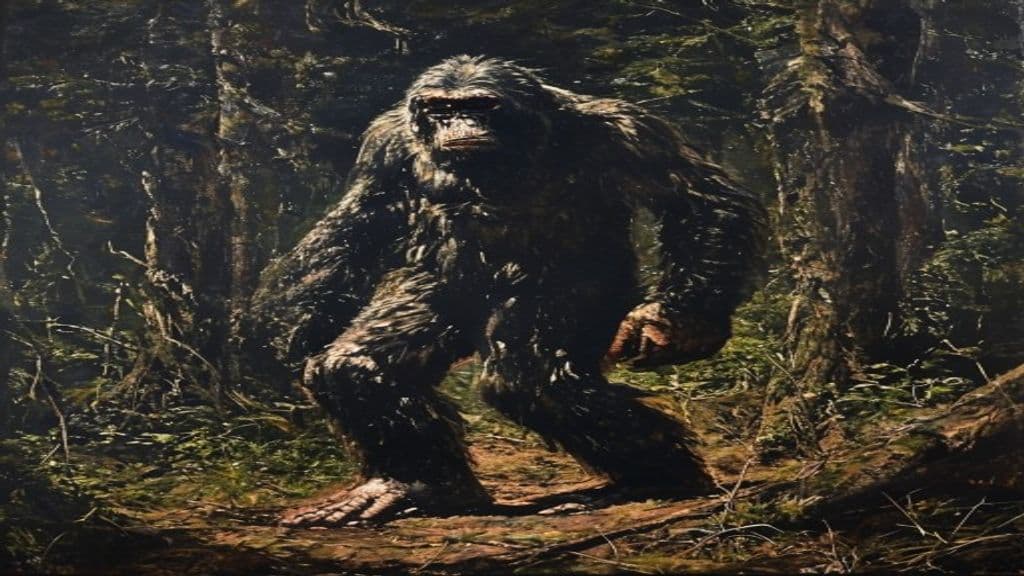
Colonial and modern descriptions commonly portray the Yowie as a bipedal, hairy, ape-like being. Summaries report heights most often given between about 2.1 m and 3.6 m in popular accounts, a wide flat nose, and footprints much larger than a human's; the footprint evidence is inconsistent in shape and toe number across reports. A specific nineteenth‑century eyewitness (Henry James McCooey, 1882) described a tailless being covered in long black hair with reddish fur around the throat and chest, small restless eyes partially obscured by matted hair, and estimated it at nearly five feet tall in that account. These physical details vary across sources and reports.
In the ethnolinguistic record the entity is characterized as a nocturnally roaming spirit; later colonial and modern accounts attribute a range of behaviors. Reported actions include roaming the landscape, leaving large footprints, and producing unexplained vocalizations (including night screams reported in 1977). Accounts vary on temperament: some describe timid, reclusive behavior while others present it as potentially violent or aggressive. Modern investigators and cryptozoologists have at times suggested it could be responsible for animal injuries or mutilations, but such attributions are presented as claims rather than confirmed facts in the sources.
Community Record
- [1]Yowie — Wikipedia. Wikipedia contributors, 'Yowie', Wikipedia, The Free Encyclopedia.wiki
- [2]Kámilarói and Other Australian Languages (entry recorded by William Ridley, 1875). Ridley, W. (1875). Kámilarói and Other Australian Languages (lexical record noting 'Yō-wī' described as 'a spirit that roams the earth at night').folk
- [3]Skeptoid #762: On the Trail of the Yowie. Skeptoid episode #762, 'On the Trail of the Yowie' (archival audio/transcript discussing folkloric and cryptozoological aspects).other
- [4]Encyclopedia of Strange and Unexplained Physical Phenomena (archival compilation). Archival encyclopedia entry compiling anomalous hairy biped reports (includes references to Yowie accounts).other
- [5]Tongue & Groove Radio Show - Vol. 1 (Archive). Archive recording including discussion material mentioning Yowie in popular culture contexts.other