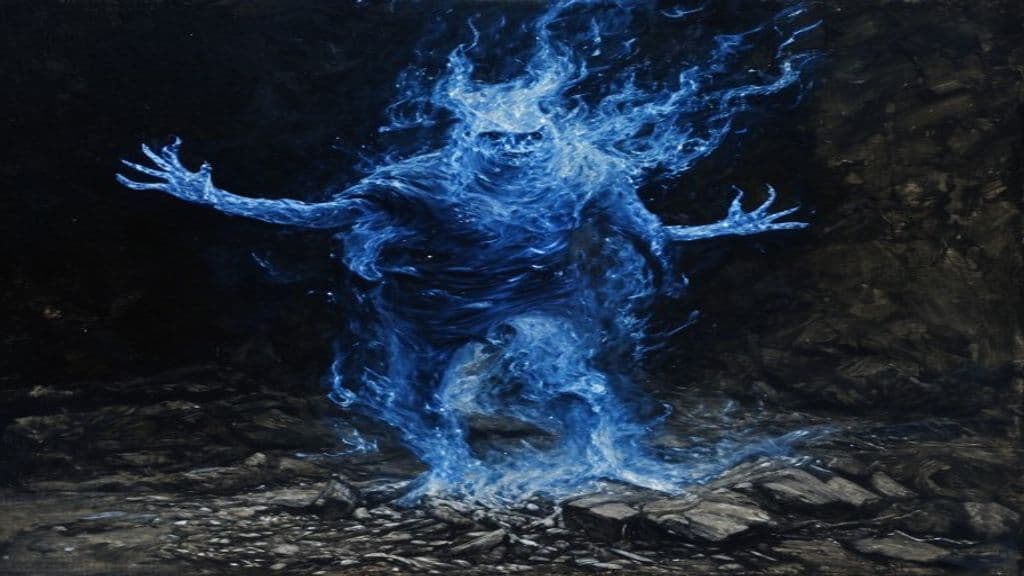
No single mythic origin narrative is recorded in the supplied sources. Instead the Bluecap is attested as part of an occupational and local cosmology among mining communities of the Anglo-Scottish border and North East England. Within that context Bluecaps form a class of place-bound subterranean agents comparable to knockers, coblynau and (by analogy) Germanic kobolds. Their existence and behaviours are narrated as integrated with daily mining labour: they are imagined as resident in particular pits, linked to mineral wealth, and incorporated into workplace customs (notably the ritualized leaving of wages). The tradition frames Bluecaps less as world-originating deities and more as localized, practical presences whose roles and rights are negotiated by miners through customary reciprocity.
Sources consistently describe Bluecaps as appearing as a small blue flame. No humanoid or anthropomorphic physical form is recorded in the supplied materials; the tradition presents them as flame-like beings of small size. Accounts include behaviour such as a ‘‘flickering bluecap’’ settling on a full tub of coal and transporting it, suggesting a visible flame that interacts physically with mining tubs.
Bluecaps are credited with practical, localised abilities tied to mining: they lead miners to rich deposits of minerals and can forewarn of cave-ins. They are described as hard workers who physically assist with tasks (for example, settling on and helping to move tubs of coal). Crucially, they are said to expect remuneration: miners left payment equal to ‘‘a working man's wages, equal to those of an average putter,’’ placed in a solitary corner of the mine, and the Bluecap ‘‘would not accept any more or less than they were owed.’’ This contractual reciprocity is central to their behaviour and relations with miners.
Weaknesses
- otherNo specific weaknesses recorded in sources
Wards
- ritualleaving putter's wages (placatory custom)
Kobold
The German household and mine spirit — a mischievous but potentially helpful small being who attaches to a household, bringing luck or disaster depending on how it is treated.

Coblynau
Coblynau (singular coblyn) are small gnome-like mine and quarry spirits from Welsh folklore. They are reported in folkloric summaries as haunting underground workings, making knocking sounds, and—according to some miners' tales—occasionally indicating locations of ore or riches.
Blue Men of the Minch
A localized class of Scottish sea‑spirits said to inhabit the Minch between the northern Outer Hebrides and the mainland; humanoid, blue‑coloured beings who interact with sailors — sometimes playfully, sometimes by raising storms, demanding tribute, or attempting to capsize vessels. Traditional tales record a verbal poetic challenge by which mariners may avert disaster.
Blue Nile patas monkey
The Blue Nile patas monkey (Erythrocebus poliophaeus), also called Heuglin's patas monkey, is an Old World monkey species native to the Blue Nile river valley of Ethiopia and Sudan and possibly South Sudan. Described in 1862, it was long treated as conspecific with other patas monkeys until re-elevation to species status in 2017; its distribution, ecology, and population status remain poorly known.
Blue Snowman
The Blue Snowman is a fictional comic-book supervillain in the DC Comics universe who acts as a recurring adversary of Wonder Woman. Portrayed as Byrna Brilyant, the character employs genius-level inventiveness and specialized cold/cryogenic technology—most notably devices that generate "blue snow"—while wearing a distinctive snowman-themed blue costume or exo-suit. The Blue Snowman has no innate supernatural powers; threats are technological and resolved by heroic intervention.
Blue Stone (Russia)
A type of sacred stone in Slavic tradition, held significant spiritual significance and venerated through simple rituals. (Note: - Power tier should be Lesser (since they don't have major hallows and are venerated in a simpler way). - Abilities: "Venerated through simple rituals" is vague; clarify that these rituals include pou)
Blue Trinity
Blue Trinity (Russian: Голубая Троица, Golubaya Troitsa) is a fictional team of three Soviet-engineered superhuman operatives in DC Comics, created by Soviet scientists as state-controlled assets in a Cold War narrative; they are described in sources as abnormally strong, emotionally unstable, and raised for loyalty to the Soviet Union.
Bluebeard
Bluebeard (French: Barbe bleue) is a literary folktale character best known from Charles Perrault's 1697 version: a wealthy, powerful nobleman who marries repeatedly and secretly murders his wives, hiding their bodies in a locked chamber. He functions as a cultural archetype and cautionary exemplar about secrecy, patriarchal power, and the dangers facing women in marriage rather than as a supernatural being.
Blunderbore
Blunderbore is a stock giant of English and Cornish folklore, appearing as a corporeal monstrous antagonist in tales such as Jack the Giant Killer and regional variants like Tom the Tinkeard. He is depicted through his actions—kidnapping, highway obstruction, and violent strength—and is typically overcome by a human folk-hero who frees captives and reasserts social order.
Blóðughófi
Blóðughófi (variant Blóðhófr) is a named mythic horse in Old Norse poetic tradition attested in þulur (name-lists) as the steed associated with the god Freyr, glossed literally as "Bloody Hoof." The attestations are primarily catalogic rather than narrative, and no extended mythic episodes or independent powers are directly ascribed to this horse in the surviving cited materials.
Bo Le
Legendary horse tamer and judge from the Taoist tradition, renowned for his expertise in evaluating horses during the Spring and Autumn period. (Note: 1. Power tier should be Ancient, as Bo Le is described as "legendary" and the source material doesn't provide a basis for limiting him to a regional power level. 2. Appearance description should state)
Boann
Boann (also Boand) is a figure of early Irish tradition associated with the River Boyne (Bóinn) and the Well of Segais. Presented in the Dindsenchas and other medieval sources as a member of the Tuatha Dé Danann, she functions as a mythic landscape-progenitor, mother of the god Aengus, and a woman whose transgressive actions at a sacred well bring the river into being.
Boar
The boar principally denotes the species Sus scrofa (wild boar) in natural-history contexts and a recurring mythic motif in which monstrous or divine boars ravage lands or act as avatars of deities. Appears across Greek heroic myths (Calydonian, Erymanthian), Indic theistic narrative (a divine boar-form assumed by the Lord), and modern fiction (horror film, comics).
Boars in Heraldry
The boar (including the wild boar and the boar's head) is a recurring emblematic animal charge within European heraldry and related civic and family identity systems. Treated as a conventional heraldic device rather than a supernatural being, the boar functions as a visual signifier of lineage, allegiance, martial reputation and canting (name-play) across antiquity, the medieval period and into the early modern era.
Community Record
- [1]Bluecap - Wikipedia. Wikipedia contributors. "Bluecap." Wikipedia, The Free Encyclopedia.wiki
- [2]Bluecap - Wikidata. Wikidata entry Q4930278, Bluecap.wiki
- [3]Bluecap (pandius). Pandius: Bluecap (interpretive/fan page noting naturalistic suggestion).other
- [4]The Faery Folklorist: Knockers of the North. Faery Folklorist blog post, May 2011, discussing regional miner spirits including Bluecaps.folk