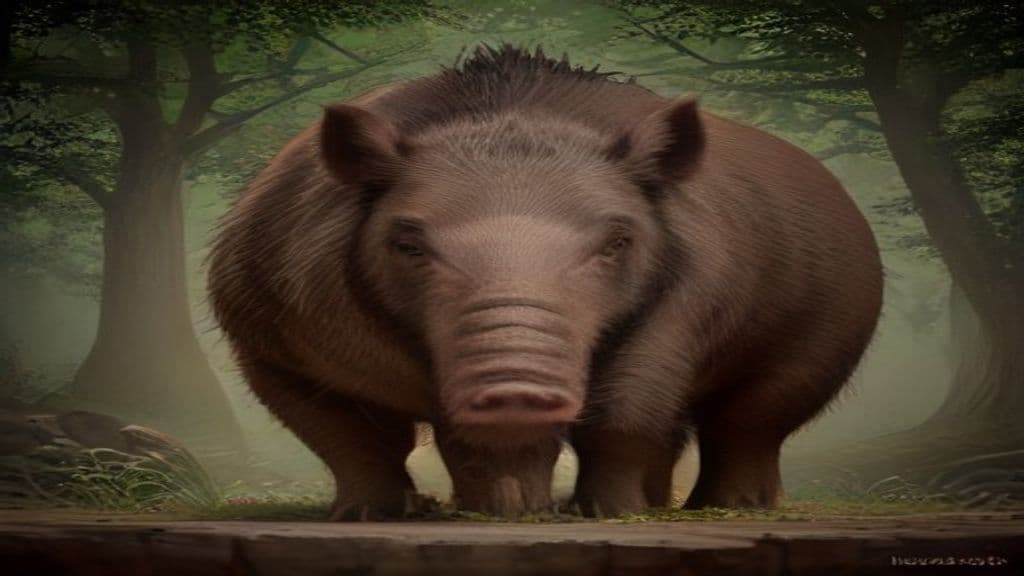
Biologically, Sus scrofa is treated in scientific sources as the wild boar species native to much of Eurasia and North Africa (with introductions elsewhere). In the Indic theistic excerpts cited, a theological account describes the Supreme Lord assuming a boar-form to slay the demon Hiraṇyākṣa and thereby upholding the world; the transcript also refers to the Lord as "the origin of the boar species" in a devotional narrative sense. Greek heroic narratives do not offer a single origin for the species but present particular monstrous boars (Calydonian, Erymanthian) as extraordinary creatures whose appearance precipitates heroic labors.
As an animal, the boar is a suid — a pig-like mammal (Sus scrofa) with the usual morphology of wild swine (sources identify species but do not elaborate morphology beyond taxonomic identity). Mythic portrayals depict monstrous boars that ravage countryside, killing people and livestock and tearing up crops. Modern fiction varies: a 2017 Australian horror film features a giant, bloodthirsty wild boar; a comic iteration describes a character "The Boar" who can transform into a massive porcine humanoid (superhumanly large porcine form) (sources specify these portrayals).
In nature the species is an adaptable omnivore with broad habitat tolerance and large range (assessed as least concern in conservation contexts). In myth and fiction, boars are depicted as highly destructive: Greek monstrous boars ravage lands and are dangerous enough to be the focus of heroic hunts. Indic theistic texts (as quoted in class transcripts) describe a boar-form assumed by the Supreme Lord that slays a formidable demon and functions to maintain the world—here the boar-form serves as a divine agent of cosmic maintenance. Contemporary narratives portray oversized strength and predatory behavior (film) and transformational superhuman strength/endurance (comic).
Weaknesses
- othernone recorded
Wards
- othernone recorded
Abas
Abas (Ancient Greek: Ἄβας, gen.: Ἄβαντος) is not a single mythic being but a recurring personal name borne by multiple mortals and minor mythic figures in Greek epic and genealogical traditions — kings, founders, seers, warriors, attendants, a centaur, and a youth transformed by a goddess. The name is glossed in the sources as 'guileless' or 'good-hearted' and appears across Argive, Theban, Trojan, Euboean, and other local cycles.
Acheilus
Acheilus (also spelled Akheilos/Achilleus in some sources) is a minor figure of Greek myth described as a mortal son of Zeus who was transformed into a shark and thereafter called a 'shark-formed sea daimon.' Surviving summaries frame his story as a hubris metamorphosis: boasting about his beauty led a goddess to change him into a marine monster.
Achelois
Achelois (Ancient Greek: Ἀχελωίς, 'she who drives away pain') is an attributive name or epithet used in ancient Greek mythic contexts rather than a single, consistently characterized being. The term appears applied to several different figures — a surname of the Sirens, a general name for certain water-nymphs (Acheloides), and as the name of a daughter of Pierus — and functions within Greek naming practice as a descriptive label rather than a fixed ontological office.
Achilles (son of Zeus)
A minor figure in Greek myth named Akhilleus (Ancient Greek: Ἀχιλλεύς), presented in some traditions as a son of Zeus and the Lamia who was famed for irresistible beauty, won a beauty contest judged by Pan, and was transformed into ugliness by Aphrodite. This Akhilleus is distinct from the Homeric hero of the Trojan War.
Achiroe
Achiroe (variants Anchirrhoë, Anchinoë/Ankhinoe) is a minor Greek mythological figure: a Naiad associated with the river Nile, daughter of the river-god Nilus, who becomes the wife of the Egyptian king Belus and mother of mythic progenitors such as Aegyptus and Danaus (with some accounts also naming Cepheus and Phineus). She functions primarily as a genealogical link between river-divinity and royal lineages rather than as an active agent in surviving myths.
Acontes
Acontes (Ancient Greek: Ἀκόντην) is an Arcadian prince in Greek mythology, counted among the fifty sons of the impious King Lycaon. He appears in the Lycaon narrative as a participant in a sacrilegious meal prepared for Zeus (disguised as a peasant) and is destroyed by the god's lightning as punishment.
Actaea
Actaea is a named sea‑nymph in Greek mythic lists, identified in the provided sources as the personification or eponym of the seashore. She appears primarily in onomastic and catalogue contexts (lists of nymphs/Nereids) and has no surviving independent narrative or cultic rites attested in the cited material.
Acte (Akte)
Acte (Ancient Greek Akte, sometimes rendered Acme) is a divine personification in Greek myth: one of the Horae who embodies a particular hour of the day — specifically the hour of eating and pleasure, a designated afternoon work-hour — and functions chiefly as a temporal marker rather than an active mythic agent.
Adonia
The Adonia festival is a ritual mourning celebration for Adonis, the consort of Aphrodite in ancient Greek mythology. (Note: 1. The draft claims that the article is about a "ritual mourning celebration", but the source only mentions the festival as a mourning celebration. 2. Power tier should be Primordial or Ancient since )
Aega
Aega is attested in modern reference works as a mythological name from the Greek tradition; the string 'Aega' is used for more than one minor figure or entry in Greek mythic catalogs. Surviving provided sources give no coherent myth, iconography, or rituals tied to a single, identifiable deity or spirit named Aega.
Aegaeus
Aegaeus (Ancient Greek: Αἰγαῖος) appears in Greek myth as (1) a local river-god associated with the island called Scheria (traditionally associated with Corfu) and father of the nymphs Aigaiides and of Melite (who in some sources bore Heracles a son, Hyllus), and (2) as a toponymic surname/epithet of the sea-god Poseidon derived from the town of Aegae in Euboea.
Aegesta
Aegesta is an ancient place-name and eponym recorded in Greek and Roman sources as an alternate form of Segesta, an Elymian city in northwestern Sicily, and as a mythic personal name (Aegestus/Aegesta) tied to Trojan foundation legends rather than a supernatural being.
Community Record
- [1]Wild boar - Wikipedia. "The wild boar, also known as the wild swine, common wild pig, Eurasian wild pig, or simply wild pig, is a suid native to much of Eurasia and North Africa..."wiki
- [2]Sus scrofa - Wikidata. Wikidata entry for Sus scrofaother
- [3]Vidagdha Madhava Prabhu — January 4, 2017 (Śrīmad-Bhāgavatam transcript excerpt). "After thus killing the most formidable demon Hiraṇyākṣa, the Supreme Lord Hari, the origin of the boar species, returned to His own abode, where there is always an uninterrupted festival..."literary
- [4]Girigovardhana Prabhu — January 3, 2017 (Śrīmad-Bhāgavatam transcript excerpt). "You have assumed the form of a boar, in pure goodness, for the purpose of maintaining the world. Fortunately for us, this demon, who was a torment to the worlds, has been slain by You"literary
- [5]Erymanthian Boar (Hercules' labors) - marvunapp. Descriptions identify the Erymanthian Boar as a monstrous boar that made its home around Mount Erymanthos and ravaged the land of Psophis.literary
- [6]Erymanthian Boar | A Book of Creatures. The Erymanthian Boar was a monstrous boar that made its home around Mount Erymanthos in Arcadia. It ravaged the land of Psophis, killing people and livestock and tearing up crops.literary
- [7]Calydonian Boar - Biblical Cyclopedia. Entry identifying the Calydonian Boar as the monstrous boar of Calydon (used in summary of Greek mythic material).literary
- [8]Boar (film) - Wikipedia. "Boar is a 2017 Australian horror film... being hunted by a giant, bloodthirsty wild boar."wiki
- [9]Boar (Beta Ray Bill/Spider-Man foe) - Marvunapp. "The Boar can transform into a massive porcine humanoid with superhuman strength and endurance."literary