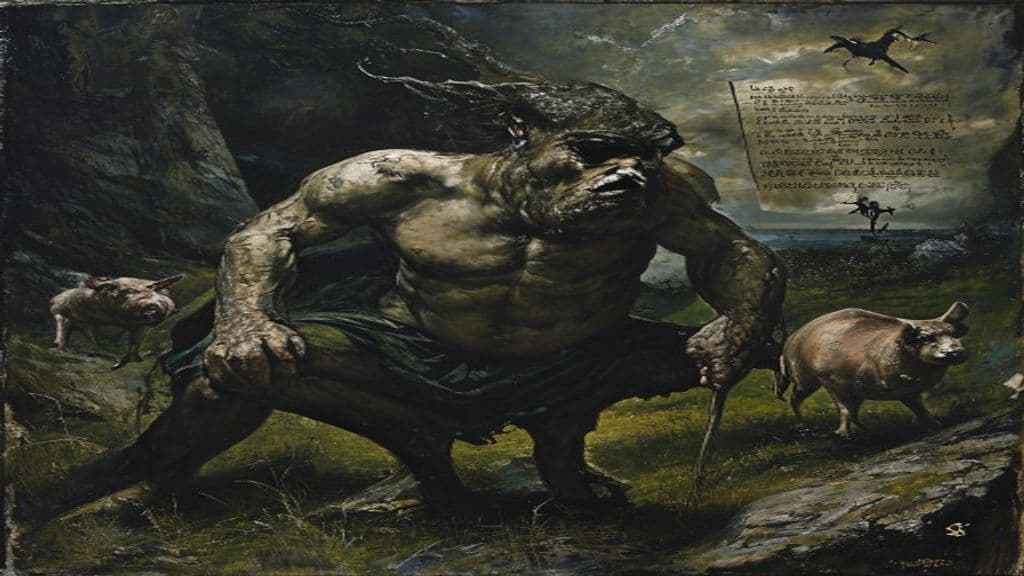
In the tale Oidheadh Chlainne Tuireann (The Tragedy of the Sons of Tuireann), Brian is presented as one of the three Sons of Tuireann (with Iuchar and Iucharba). The three set out to kill their father's enemy Cian. Cian is the father of Lugh of the Tuatha Dé Danann; after Cian is killed, dismembered, and the crime concealed, Lugh imposes a recompense: the brothers must go on a quest fetching magical weapons. Their journey takes them "all around the known world" to obtain the items demanded by Lugh, a narrative arc that functions as a reparative obligation for kinslaying.
The examined manuscript and summary sources provide no physical description of Brian/Uar. The tale records actions and transformations (Cian into a pig; the brothers into dogs) but does not supply a direct bodily description of Brian in the cited material.
The narrative includes a shapeshifting episode in which Cian disguises himself as a pig and the three brothers take the form of dogs to pursue him; the tale thus records the brothers engaging in shapeshifting in that episode. Brian participates with his brothers in killing and dismembering Cian, in undertaking the long quest to fetch magical weapons for Lugh, and in returning badly wounded and pleading with Lugh for healing. In at least one version Brian is portrayed as the clever and subtle brother while his siblings are more easily overawed by him. Beyond these narrative actions—shapeshifting in the episode and success in procuring magical items—the sources do not attribute independent supernatural powers or invulnerability to him.
Weaknesses
- conditionmortality and susceptibility to severe wounds (the tale reports the brothers return badly wounded and that Lugh refuses to heal them)
Wards
None recorded.

Beira / Cailleach
A Gaelic seasonal figure: an old-woman 'hag' who personifies winter, storms, and the shaping of landscape. Known across Ireland, Scotland, and the Isle of Man, she appears in contrast to younger spring/summer goddesses such as Brìgde.
Clíodhna
Clíodhna is a female otherworld figure from Irish myth and Munster folk tradition, portrayed in medieval narrative as a member of the tuatha dé Danann and later as the queen of the sióga/banshees of South Munster (Desmond). She is associated with healing birds, enchanted gifts (notably three birds and an emerald cup in the Book of Lismore), place‑names in County Cork, and a range of narratives in which she aids, loves, and sometimes harms mortals.
Elatha
Elatha is a figure in Irish medieval myth portrayed as a king of the Fomorians who also fathers several leading members of the Tuatha Dé Danann. He is depicted as a noble, luminous maritime prince associated with gold and light imagery and appears in narratives such as the Second Battle of Mag Tuired and genealogical accounts explaining the ancestry of figures like Bres, the Dagda, Ogma, and Lir.
Ethniu
Ethniu (also Ethne, Ethliu, Eithne, Ethnea, etc.) is a figure of Irish myth, presented as the daughter of the Fomorian leader Balor and the mother of the hero Lugh. Her story centers on imprisonment to avert a prophecy and the clandestine conception and rescue of her child, motifs that link her to dynastic and prophetic conflicts in the mythic cycles.
Tuatha Dé Danann
The Tuatha Dé Danann (earlier name: Tuath Dé) are a named supernatural race in Irish mythology. In modern summaries they are widely treated as representing the deities of pre‑Christian Gaelic Ireland and function as a mythic otherworldly people within Gaelic mythic history.
Áillen (Aillen)
Áillen is an otherworldly incendiary figure in Irish tradition who annually harasses the royal site of Tara at Samhain by lulling inhabitants to sleep with harp or timpán music and burning the place with fiery breath; his cycle is broken in the story-cycle when the hero Fionn mac Cumhaill resists the soporific music and kills him.
Bres
Bres (also Bress, Eochaid/Eochu Bres, Bres mac Elathan) is a contested royal figure in Irish myth who, born of Fomorian and Tuatha Dé Danann parentage, ruled as king of the Tuatha Dé Danann before being deposed; his reign and fate appear in accounts of the First and Second Battles of Magh Tuiredh and related dindsenchas poetry.
Breton Mythology
A collection of explanatory and heroic tales forming part of the Celtic mythos, rooted in ancient Celtic tradition. (Note: 1. Power tier: Primordial is incorrect; it should be Ancient (deity-level) as Breton mythology is rooted in ancient Celtic tradition but doesn't match the primordial level of cosmic entities. 2. Origi)
Brettia
Brettia (Ancient Greek: Βρεττίας in the surviving lexicon entry) is an eponymous nymph credited in Greek ethnographic/place-name handbooks as the name-source of the district Abrettene in Mysia. She is attested only in lexicographical/ethnic compendia and is presented as a local, place-personifying divine figure rather than a figure with recorded myths, cult practice, or narrated deeds.
Brian Braddock
Brian Braddock is a fictional human champion created within modern comic-book mythmaking, empowered by Arthurian figures to serve as the protector of the British Isles and a defender of Earth-616 within Marvel Comics' multiversal framework. First appearing in 1976, he has borne titles including Captain Britain and later adopts the name Captain Avalon after narrative developments.
Briareus
Briareus is one of the Hecatoncheires (Hundred‑Handers) in Greek mythology: a primordial giant, offspring of Uranus (Sky) and Gaia (Earth), traditionally described with fifty heads and one hundred arms and credited with helping Zeus and the Olympians overthrow the Titans in the Titanomachy.
Bride of Christ
A theological and biblical metaphor in Christianity describing the church or collective community of believers as the espoused partner of Jesus Christ, emphasizing covenantal intimacy, sanctification, and eschatological union rather than an independent supernatural being.
Community Record
- [1]Brian (mythology) — Wikipedia (excerpt). Wikipedia, entry 'Brian (mythology)' (excerpted material provided in research notes)wiki