
No cosmogonic or origin narrative for Bukavac is recorded in the supplied sources. The primary attestation in the provided material is a short descriptive entry (Wikipedia and a corresponding Wikidata item) noting that belief in Bukavac existed in Syrmia. Beyond this regional attestation, the sources do not offer an origin myth, creation story, or genealogical placement within a larger pantheon or spirit taxonomy; Bukavac instead appears in the material as a named dangerous creature within local popular belief.
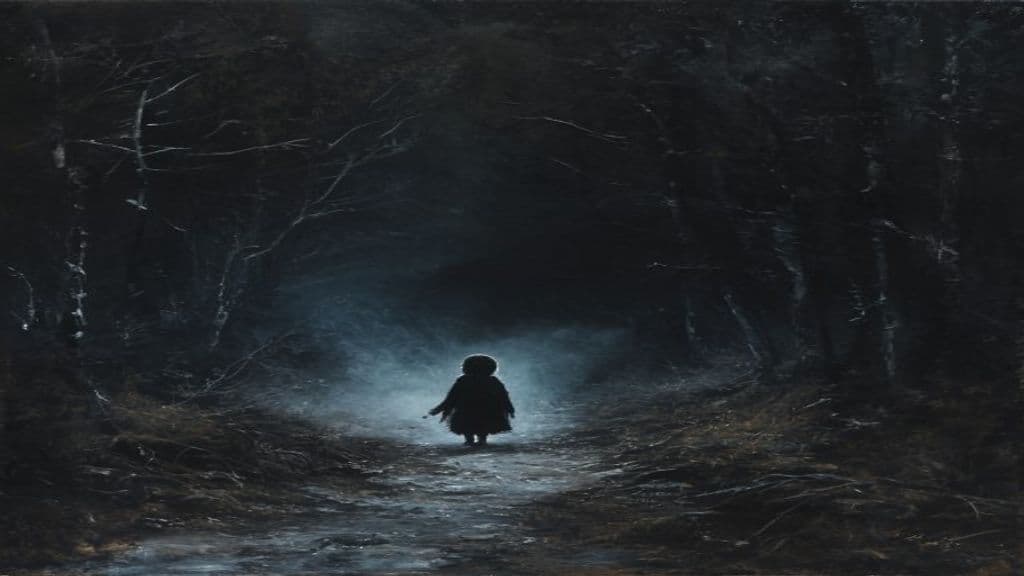
According to the cited descriptions, Bukavac was sometimes imagined as a six‑legged monster with gnarled horns and bright blue eyes. The sources emphasize these specific features and also that the creature is associated with aquatic habitats (lakes and pools). The provided material does not describe its overall size, body coloration or texture beyond the blue eyes, nor does it provide further anatomical detail; those attributes are therefore not recorded in the cited sources.
The sources state that Bukavac lives in lakes and pools and comes out of the water during the night to make a loud noise—an attribute linked etymologically to its name (buka = "noise"). According to the attested Syrmian folk belief recorded in the sources, Bukavac would jump onto people and animals and strangle them. No additional supernatural powers, magical formulas, or extraordinary feats are described in the provided material; the creature's recorded menace consists of its nocturnal aquatic emergence, loud noise-making, and physical attacks that strangle victims.
Weaknesses
- otherNone recorded in the cited sources
Wards
- otherNo wards recorded in the cited sources

Drekavac
A South Slavic night-haunting revenant-like creature whose name means "the screamer"; traditionally linked to the restless souls of improperly buried or unbaptised dead (including sinful adults and unbaptised children) and reported in many regional variants that foretell death or disease and frighten the living.
Myling
The ghost of an unbaptized or abandoned infant in Scandinavian tradition, doomed to haunt the place of its death until it receives a proper Christian burial.
Bug-Eyed Bandit
A nom-de-crime used by two DC Comics supervillains and later media adaptations for insect-themed criminal inventors who employ robotic or biologically inspired insect devices to commit theft, extortion, and assaults on technology-rich targets. The identity has appeared as Bertram Larvan (original comics), an unnamed son (later comics), and as a female reinterpretation Brie Larvan in Arrowverse television.
Bug-eyed monster (BEM)
A stock figure and visual trope of early- to mid-20th-century speculative fiction and related fan cultures, characterised by oversized, bulging or compound eyes and used as a conventionalised nonhuman antagonist signalling sexualized danger, abduction or general menace.
Buga
Buga (BUGA) is identified in the consulted sources as an Evenki (Evenk) sky or heaven god, rendered in brief tertiary references as the Evenki 'god of the heaven' and labelled by one popular summary as the 'Evenki Supreme God.' Available documentation in the provided set is fragmentary and supplies no detailed myths, rituals, or iconography for Buga.
Bugbear
A folkloric scare-figure historically invoked to frighten disobedient children, classed among boogeyman-type beings. Medieval descriptions in English sources portray it as a creepy, bear-like lurker in woods; modern popular culture and gaming have reimagined it as a large goblinoid monster.
Buggane
A large, malevolent supernatural being from Isle of Man folklore, described in tales as ogre- or giant-like and sometimes a shapeshifter. Buggane stories depict it damaging buildings and livestock, attacking people, and appearing in coastal and farm contexts; some tales limit it by sacred or liminal boundaries such as water and hallowed ground.
Bugul Noz
A nocturnal spirit of Breton folklore (particularly Morbihan) whose name is glossed as 'Night Shepherd' or 'child of the night.' Accounts vary: some present the Bugul Noz as a small goblin-like nocturnal being that menaces shepherds and people who linger outdoors after dark; other informants describe a tall, foreboding twilight figure. It functions in local culture as a cautionary night-being that enforces avoidance of unsafe nighttime activity.
Bukki
Bukki (Hebrew: בֻּקִּי, Buqqī) is attested in biblical and related traditions as a personal name borne by at least two distinct human figures: a Danite prince named in Numbers 34:22 and a member of the Aaronid priestly genealogy recorded in 1 Chronicles (and echoed in Ezra-related lists). The name appears in variant forms across textual traditions (e.g., Boccas, Borith) and in modern secular usages unrelated to the ancient individuals.
Bulgae (Korean Fire Dog)
A mythical Korean fire dog said to cause eclipses by biting the Sun and Moon. (Note: * The power tier is incorrect; according to the source, Bulgae cause eclipses by biting both the Sun and Moon, but there's no indication that they're on a primordial level. It should be at least Ancie)
Bulgasari (iron-eating monster)
Bulgasari (불가사리, also romanized Bulgasali) is a kaiju-style iron-eating monster originating in mid-20th-century Korean cinema. The creature is best known from the lost 1962 South Korean film Bulgasari, in which a martial artist (Nam Hyeong) is resurrected as the iron-eating monster to enact revenge on his murderers; a distinct later North Korean film titled Pulgasari (1985) is related in film-history discussions but is a separate production.
Bulis
No folkloric supernatural entity named 'Bulis' is attested in the provided sources. The string 'Bulis' appears in the materials as (a) the Latinized genus name for a jewel beetle species (Bulis bivittata) and (b) as a Hungarian adjectival form 'bulis' (from buli 'party') in an archive excerpt; there is no evidence in the supplied documents of a mythic being by this name.
Bull (mythology)
A recurring sacred animal in multiple mythologies, the bull often functions as a divine sign, an emblem of kingship and fertility, and a bridge between celestial and terrestrial order. In the Cretan tradition a bull appears from the sea to Minos as a sign tied to his claim to rule and an obligation of sacrifice; in broader comparative accounts bulls are associated with major deities and celestial symbolism.
Bull Demon King
A powerful literary spirit-king from the 16th-century Chinese novel Journey to the West; a sentient bull-form ruler who commands a grotto-domain, maintains a household (including consorts and a son), and fights both mortal and celestial opponents within the novel’s cosmology.
Community Record
- [1]Bukavac (Wikipedia). Wikipedia contributors, "Bukavac," Wikipedia, The Free Encyclopedia, https://en.wikipedia.org/wiki/Bukavac (accessed date as in research notes).wiki
- [2]Bukavac (Wikidata). Wikidata entry Q2927806, "Bukavac," http://www.wikidata.org/entity/Q2927806 (accessed date as in research notes).wiki
- [3]Archive items using the name 'Bukavac' (art and media uploads). Archive.org uploads titled 'Bukavac' (art/media), included in research notes as creative uses of the name without folkloric detail.other