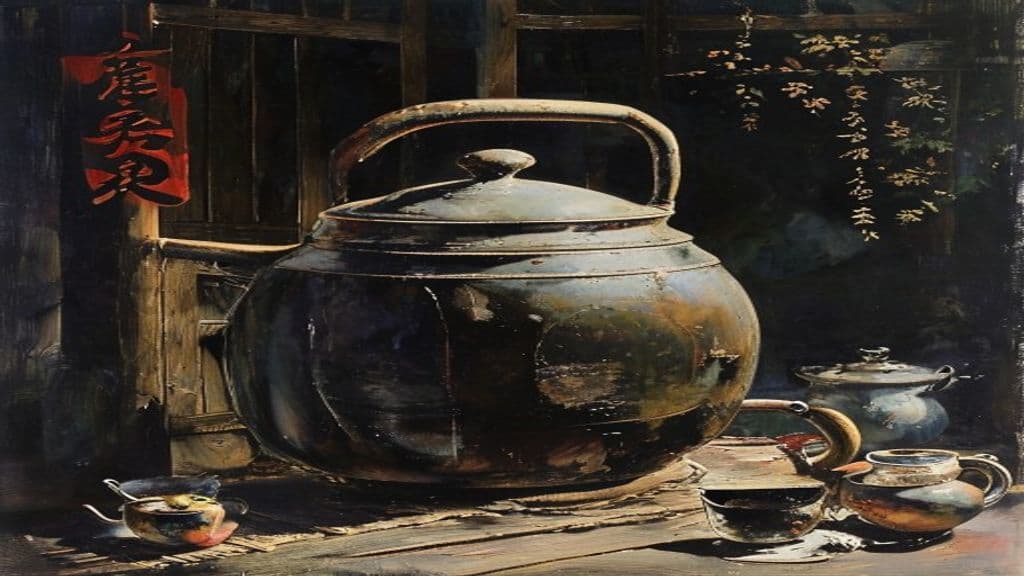
In the engi associated with Morin-ji temple the kettle called Bunbuku Chagama is tied to a priest named Shukaku (守鶴) who local legend says was an ancient mujina (a raccoon dog). The origin framing places a chagama used in the temple hearth at the center of the story: when set on the fire the vessel reveals its animate nature. Scholarly treatments also present a fairy-tale version in which a rescued animal (tanuki or in some variants a fox) becomes the kettle and later is exhibited by a peddler as an attraction, bringing wealth to its human rescuer before the tale concludes (some variants end with the animal returning to the wild). The compound name bunbuku/chagama carries layered readings—onomatopoeic, references to fortune (分福 “sharing fortune”), or alternative character glosses—reflected in different commentaries on the tale.
In tale summaries the Bunbuku chagama alternates between an ordinary tea-kettle (chagama) and a hybrid form in which the kettle 'sprouts' animal features such as a head, tail, or legs; older English renderings sometimes call the animal a 'badger' while Japanese sources identify it as a tanuki (raccoon dog), and some variants substitute a fox. The narrative image is therefore of a domestic metal kettle that can move and, at times, visibly combine object and animal anatomy. Local legend claims a kettle associated with the tale is on view at Morin-ji temple.
The central supernatural ability is shapeshifting between inanimate kettle form and an animate animal or hybrid half-kettle/half-animal. In the story the creature performs acrobatics—notably walking a tightrope and dancing to music—to entertain and draw paying viewers. Its agency functions socially: through performance it enables a human (a peddler or rescuer) to profit, and the tale highlights negotiated terms of treatment (the human agrees not to put it over a hot flame, not to stow it in a stuffy box, and to share food). Some folktale variants record that after being sold or exhibited the creature ultimately flees to the mountains.
Weaknesses
- conditionhumane-treatment bargain (do not place over a hot flame; do not stow in a stuffy box; share food)
Wards
None recorded.
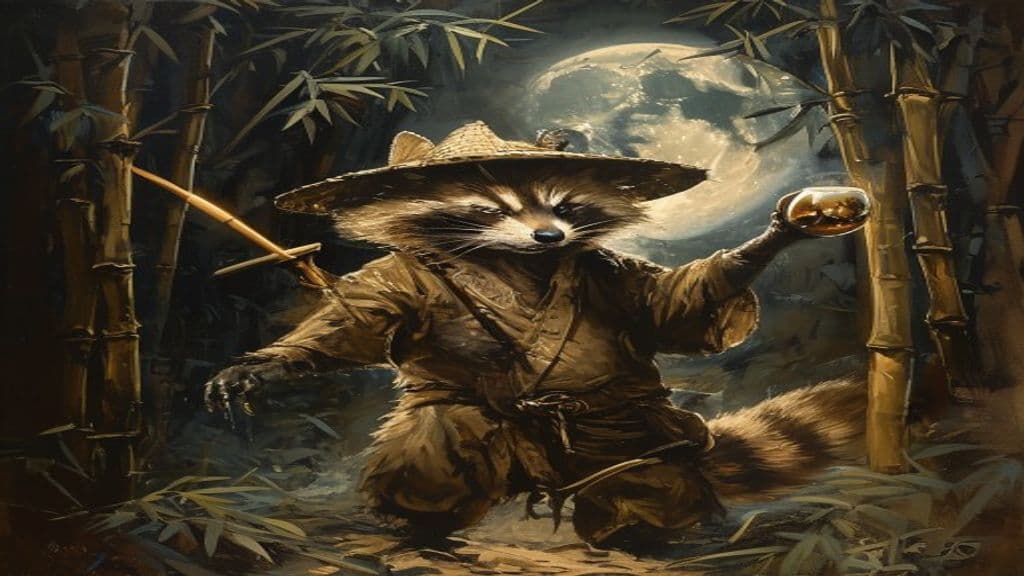
Tanuki
The raccoon-dog spirit of Japanese folklore — a cheerful trickster and master of shape-shifting, less dangerous than the kitsune but far more mischievous. Famous for leaves transformed into money.
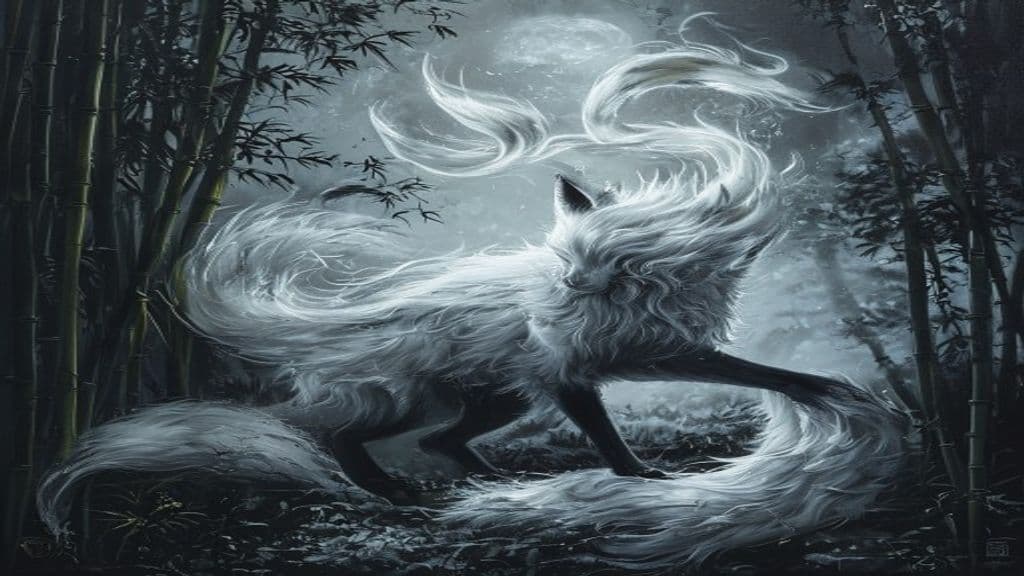
Kitsune
Fox spirits of Japanese mythology — intelligent, long-lived beings who gain additional tails (up to nine) as they age and grow in power. They serve as messengers of the god Inari and as powerful tricksters.

Mujina (貉)
A Japanese folkloric shapeshifting creature associated with badger-like and tanuki-like animals; classed among yōkai, mujina perform transformations, illusions, and pranks, and in some tales repay kindness or enact retribution when harmed.
Issun-bōshi
Issun-bōshi (一寸法師, "One-sun Boy") is the protagonist of a Japanese folktale: a human child born the size of one sun (about 3 cm) who travels to the capital, serves in a noble household, defeats an oni by bravery and craft, and— in some variants—acquires a magic mallet that enlarges him. The figure is principally a miraculous or abnormal human hero in premodern tale cycles, later sometimes mentioned in Edo-period popular culture as a label for very small people or as a yōkai-type motif.
Bull (mythology)
A recurring sacred animal in multiple mythologies, the bull often functions as a divine sign, an emblem of kingship and fertility, and a bridge between celestial and terrestrial order. In the Cretan tradition a bull appears from the sea to Minos as a sign tied to his claim to rule and an obligation of sacrifice; in broader comparative accounts bulls are associated with major deities and celestial symbolism.
Bull Demon King
A powerful literary spirit-king from the 16th-century Chinese novel Journey to the West; a sentient bull-form ruler who commands a grotto-domain, maintains a household (including consorts and a son), and fights both mortal and celestial opponents within the novel’s cosmology.
Bull of Heaven
A colossal mythic bull in ancient Mesopotamian literature, released by the goddess Inanna/Ishtar as an instrument of divine wrath and identified with the constellation Taurus. It appears in epic narratives (notably the Epic of Gilgamesh) as a world‑ravaging beast whose slaying carries grave divine consequences.
Bullaun
A natural feature in Celtic tradition, often imbued with spiritual significance. (Note: - Power tier should be Primordial=cosmic, given its association with natural features and spiritual significance. - Origin story missing entirely; add from source material (if available) or consult ex)
Bulleteer
Bulleteer is a fictional human-based superheroine from DC Comics (debut: Seven Soldiers: The Bulleteer #1, 2005). Alix (civilian name Alix Harrower; also appears as Rose Mendes in the Injustice continuity) is transformed when an experimental 'smartskin' bonds to her, rendering her tissues indestructibly hard and granting superhuman strength; she subsequently adopts the costumed identity Bulleteer and operates as a mid-tier hero within shared-universe team narratives.
Bulletman and Bulletgirl
Golden Age American comic-book heroes created for Fawcett Comics: Jim Barr (Bulletman), a ballistics expert/inventor who developed a chemical "crime cure" and a bullet-shaped Gravity Regulator Helmet, and Susan Kent (Bulletgirl), who received a second helmet and the same enhancements. Human inventors/experimenters rather than supernatural beings, they act as engineered, helmet-enabled crimefighters in wartime-era and later shared-universe stories.
Bune
Bune is a ducal spirit in European grimoire tradition, listed in works such as the Lesser Key of Solomon, Pseudomonarchia Daemonum, Dictionnaire Infernal, and the Livre des Esperitz. Described as commanding many legions and able to move the dead, confer wealth, and grant eloquence and wisdom, Bune functions as a summonable operant office within early modern ceremonial magic.
Bunene
Bunene is an attendant deity (sukkal) of the Mesopotamian sun-god Šamaš (Utu), described as the charioteer who conveyed the sun from the eastern horizon to the western doorway of heaven and as a cultic intercessor included in offerings and temple inventories, especially at Sippar.
Bungisngis
The Bungisngis is a one-eyed giant from Philippine folklore, described as humanoid, always laughing, and possessing great strength but easily outwitted. Tales place it in specific Philippine localities and often portray it as a comic yet dangerous antagonist defeated by clever protagonists.
Bunny Man
The Bunny Man is an American urban-legend figure that grew out of two late-1970 criminal incidents in Fairfax County, Virginia (October 19 and October 31, 1970). Reported as a man associated with a rabbit costume who threatened or attacked people with a hatchet/axe, the story expanded through newspapers, school rumor, folkloristic research, and the early internet into dozens of highly variant retellings, some supernaturalized.
Bunyip
A class of Aboriginal Australian water-being from southeastern Australia associated with swamps, billabongs, creeks, riverbeds and waterholes. Bunyip stories warn people away from dangerous waters and in some traditions enforce resource-use norms and child safety.
Community Record
- [1]Bunbuku Chagama (Wikipedia). Wikipedia contributors, 'Bunbuku Chagama,' Wikipedia, The Free Encyclopedia.wiki
- [2]Wikidata: Bunbuku Chagama. Wikidata entry Q1367705, 'Bunbuku Chagama.'other
- [3]Bunbuku Chagama (1958) stop-motion film (Archive). Tadahito Mochinaga, Bunbuku Chagama (1958) — archive.org item.other
- [4]Bunbuku Chagama by Brenda Wong Aoki (Archive recording). Brenda Wong Aoki, storytelling performance 'Bunbuku Chagama' — archive.org item.other