
Etymologically the name Cailleach derives from Old Irish Caillech ('veiled one'), adjectival from caille 'veil' (itself from Latin pallium), and in modern Gaelic means 'old woman' or 'hag'. In myth she functions as an ancient female sovereign of winter: an originating creator-figure in landscape lore who either alone (as the great Cailleach / Beira) or in plural (cailleachan) shapes hills and mountains while ruling the cold months. Regional tales and medieval poem-name survivals provide varied personal names and local origin-frames (e.g., Digdi/Digde in early verse; the Hag of Beara in southwestern Ireland), but no single uniform birth-myth is attested in the surveyed sources.
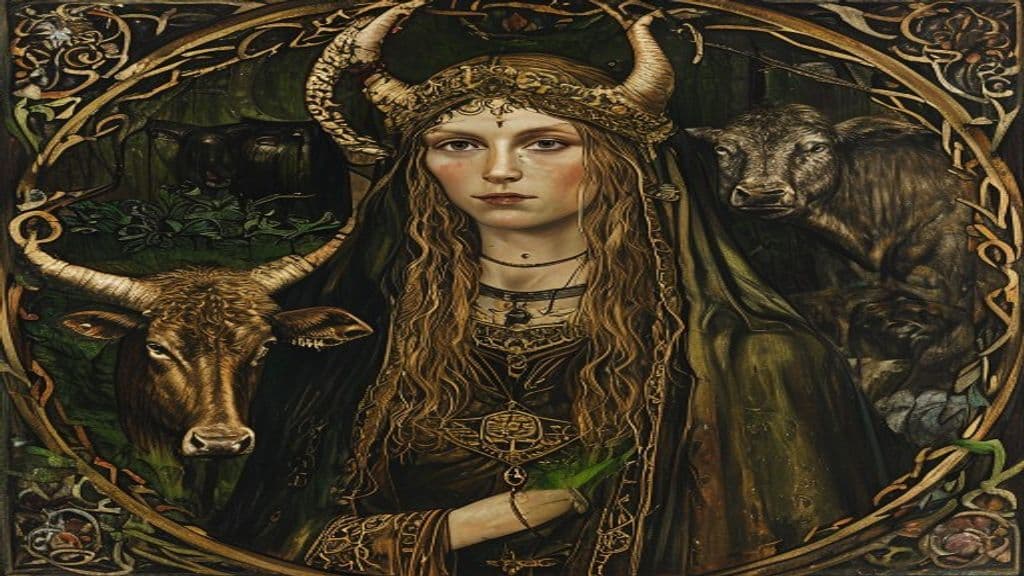
Traditionally described as an old, veiled or mantled woman — the 'veiled one' etymology underpins this motif. Regional and folklorist accounts add variants: Donald A. Mackenzie recorded a Beira image as a gigantic, one-eyed giantess with white hair, dark blue skin and rust-coloured teeth (a twentieth‑century folklorist formulation/local variant). Isle of Man lore includes a shape‑changing motif in which she appears as a gigantic bird on St Bride's day carrying sticks in her beak. Sources stress variation and do not present any single universal visual description.
Personification and ruler of winter: she causes storms, frost and snow (her staff is said to freeze the ground) and is said to 'fight' the coming spring in seasonal conflict narratives. Landscape-former: many Scottish and Irish tales credit her with creating mountains, hills and valleys — commonly explained as her dropping rocks from a creel or using a hammer to shape the land. Seasonal provisioning motifs include gathering firewood on festival days (e.g., Là Fhèill Brìghde / Imbolc) with the amount gathered determining winter's length; in some accounts she washes a great plaid/féileadh mòr (sometimes in the Corryvreckan whirlpool) and once whitened it blankets the land in snow. Some traditions hold a cyclical life/death pattern in which she turns to stone at Bealltainn (Beltane) and returns to humanoid form at Samhain (Samhain) or otherwise undergoes seasonal transformations.
Weaknesses
- conditionseasonal limitation (turning to stone or inactivity at Bealltainn/Beltane in some accounts)
Wards
- ritualfestival-day weather omen-observation (Là Fhèill Brìghde / Imbolc weather watching)
Community Record
- [1]Cailleach - Wikipedia. Wikipedia: 'In Gaelic (Irish, Scottish and Manx) myth, the Cailleach ... is a divine hag, associated with the creation of the landscape and with the weather, especially storms and winter.'; etymology and many folkloric motifs summarized there.wiki
- [2]Cailleach Invocation | ADF. ADF ritual summary: modern invocation addressing the Cailleach (Hag of Baere) in Samhain liturgy.other
- [3]Nigheanan nan Cailleach / Bandia pages. Modern Celtic reconstructionist/ecofeminist material discussing the Cailleach, her motifs and modern devotional approaches.folk
- [4]An Cailleach | Emerald Isle Irish and Celtic myths. Popular retelling and summary of Cailleach motifs and regional variants (Hag of Beara, landscape-forming deeds).folk
- [5]Shee-Eire: Celtic Goddess Cailleach Beara. Compilation of traditional tales and regional epithets linking the Cailleach to Beara and related place-lore.folk
- [6]Donald A. Mackenzie (folklorist summaries cited in source notes). Folklorist descriptions (as cited in source notes) giving a localized Beira image: one-eyed giantess with white hair, dark blue skin and rust-coloured teeth — noted as a folklorist's elaboration/variant rather than universal.folk