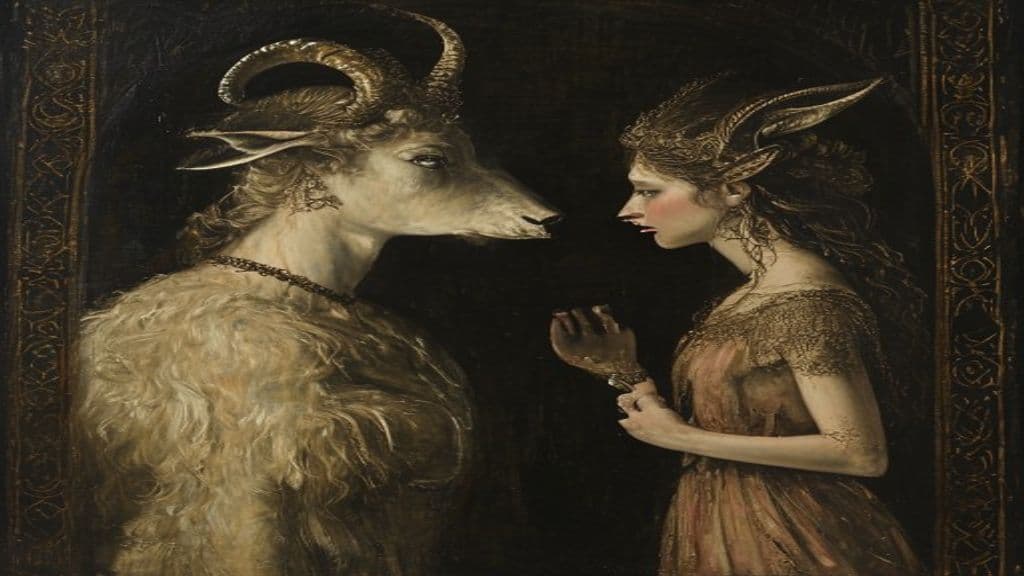
In classical Greco-Roman tradition Capella is associated with the goat Amalthea that suckled Zeus; the Latin name Capella (diminutive of capra) and the Greek Aix ('the Goat') reflect that pastoral association. Earlier Mesopotamian records list the star under names such as GAM/Gamlum (MUL.GAM in MUL.APIN), where it appears in omen and sky-list contexts and may have been represented as a crook or scimitar or as part of a larger constellation figure. These cultural origin associations position Capella within animal and tool-themed sky-schemas rather than as an individualized anthropomorphic deity.
To the naked eye Capella appears as a single very bright star — the sixth-brightest in the night sky and the third-brightest in the northern celestial hemisphere — occupying the alpha position in Auriga. Modern observation resolves Capella as a quadruple system: two bright yellow giants (Capella Aa, spectral class G8III, and Capella Ab, spectral class G0III) in a tight ~0.74 AU circular orbit with a ~104-day period, plus a widely separated pair of faint red dwarfs (Capella H and L) roughly 10,000 AU away.
As an astronomical object Capella's 'behaviors' are observational and astrophysical: the primary pair orbit one another producing Doppler-shifted spectra, the system is a strong coronal X-ray source (primarily from Capella Aa), and over geological timescales its apparent prominence has varied (it was the brightest night-sky star circa 210,000–160,000 years ago). Culturally, Capella functions as a weather and calendrical marker (classical sign of rain; Bedouin herd-of-goats schema), and as an architectural alignment target (e.g., heliacal rising alignment at Monte Albán Building J).
Community Record
- [1]Capella — Wikipedia. Wikipedia contributors. "Capella." Wikipedia, The Free Encyclopedia.wiki
- [2]Capella — Wikidata. Wikidata entry Q12970, Capella.other
- [3]Archive: QUICK HIT: The 'Yale Whiffenpoofs'. Archive.org item cited in source list.other