In the fragmentary Eleusinian/Triptolemus tradition preserved in Sophocles' fragments and summarized by later authors (notably Hyginus), Triptolemus travels under divine commission to spread agriculture. Charnabon is named as a king of the Getae in Thrace who received Triptolemus hospitably at first, then treacherously seized him and attempted to kill him. One of the serpents/dragons that pulled Triptolemus's chariot had been slain by Charnabon, preventing immediate escape. Demeter intervened, restoring the chariot by substituting another dragon and making Charnabon's remaining life unbearable; after his death she caused him to be placed among the stars as the constellation Ophiuchus as a memorial and punishment. The name appears in Greek as Χαρναβών (genitive Χαρναβώντος) and in Latin summaries as Carnabon.
Sources present Charnabon as a human monarch in the narrative accounts; no detailed physical description of his person survives. Mythic tradition reports that after his death Demeter fixed him in the sky as the constellation Ophiuchus, represented in astronomical lore as a man with a serpent entwined around him or a man holding a serpent — a postural image tied to the story of his attack on Triptolemus and the slaying of one of the chariot serpents.
The surviving sources portray Charnabon as a mortal king whose notable actions are human and political: he seized Triptolemus, attempted to kill him, and had killed one of the dragons/serpents that pulled Triptolemus's chariot. The narrative emphasizes that these human acts provoked direct divine intervention by Demeter; the sources do not attribute intrinsic supernatural powers to Charnabon himself.
Weaknesses
- otherSubject to divine punishment (as narrated); the sources record that Demeter made his remaining life unbearable and later placed him among the stars.
Wards
- otherNone attested in sources
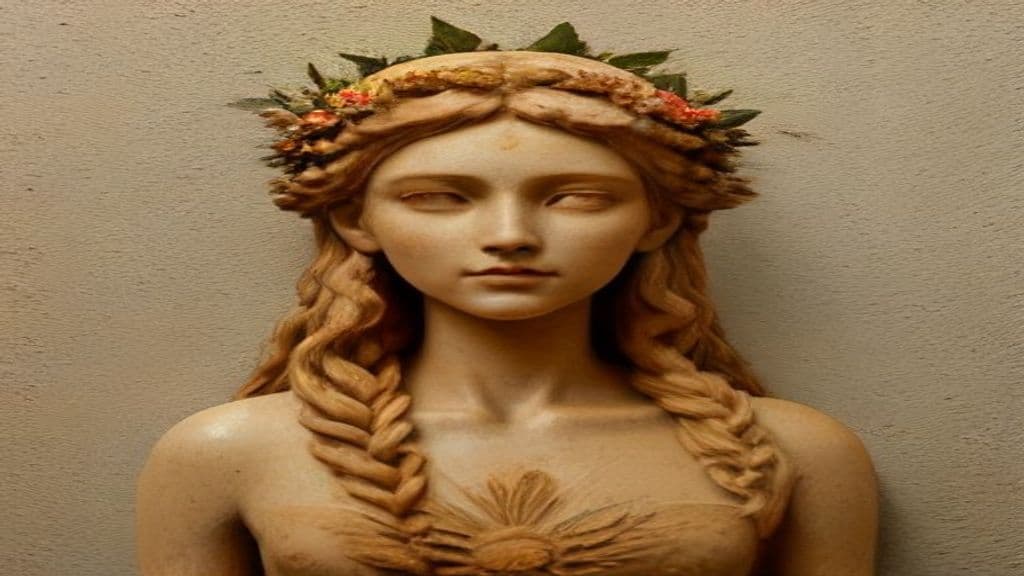
Demeter
Demeter is an Olympian goddess of ancient Greek religion who presides over agriculture, grain, and the fertility of the earth. She functions as a divine mother-figure and guardian of social customs, sacred law, and the cycle of life and death, and is central to the Eleusinian Mysteries alongside her daughter Persephone.

Cychreides
Cychreides (Greek Κυχρείδης) is a serpent- or dragon-like monster of Greek myth associated with the island of Salamis and, in some variants, with the goddess Demeter. Traditions differ: it is variously portrayed as a terrorizing beast slain or driven off by humans, a serpent kept by Demeter (including as one of the pair that drew her chariot), or as an epithet applied to the hot‑tempered Cychreus himself.
Community Record
- [1]Charnabon (Wikipedia). Wikipedia entry summarizing Hyginus and other sources on Charnabon/Carnabon.wiki
- [2]Carnabon (Wikidata). Wikidata item for Carnabon/Charnabon.wiki
- [3]Charnabon (My Eleusis). My Eleusis summary of the Charnabon episode in the Triptolemus tradition.other
- [4]Triptolemus characters (My Eleusis). My Eleusis material on Triptolemus and associated characters (context for Charnabon).other
- [5]Cychreides (Wikipedia). Article giving context for the serpents/dragons associated with Triptolemus's chariot; relates to the episode in which one serpent is slain by Charnabon.wiki