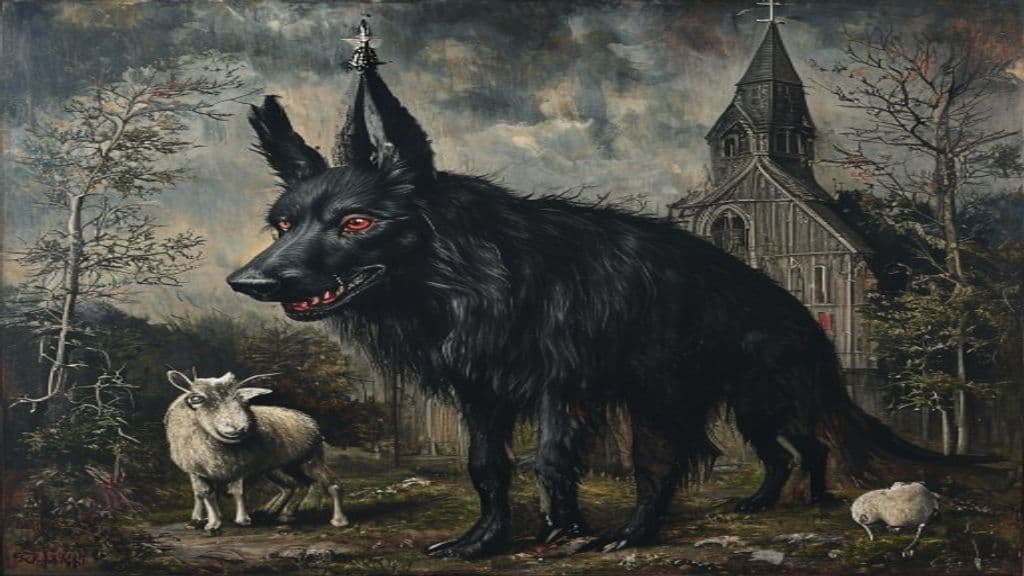
Regional accounts attribute the church grim's origin to practices or beliefs that bind a guardian to a church site. In English and Scandinavian traditions folklorists record a remembered custom of interring an animal beneath a church foundation or altar (England commonly cited a dog; Scandinavia commonly cited a lamb, boar, pig or horse) so that its spirit would serve as the building's protector. Scottish variants alternatively present the guardian as the spirit of the person most recently buried in the churchyard, charged with watching until succeeded by the next burial (the graveyard watch, faire chlaidh). Sources present these as attested folk explanations rather than a single uniform mythic origin.
Appearance varies by region. The English church grim is most commonly described as a large black dog with red eyes but may take other animal forms in some tales. Scandinavian accounts often describe a bound church-animal—frequently a lamb (sometimes said to have three legs) or other farm animals; specific ghost-animals such as a 'grave-sow' appear in local tales. Scottish descriptions include non-canine forms for graveyard watchers, e.g., a moving flame in some accounts of the faire chlaidh.
Primary function is protective custodianship of a particular church and its churchyard: keeping order, punishing profanation, and defending consecrated ground from thieves, vandals, witches and hostile spirits. Scandinavian tales record the grim fighting hostile sea-spirits (Strand-varsler) that attempt to enter the churchyard. The grim is also reported as an omen in some English strands (e.g., tolling the bell before a death; appearing during funerals with interpretable aspect). It dwells at the church (tower or other concealment) and patrols the grounds day and night, and is implicated in divinatory contexts in Sweden (adversary of the year-walker/Årsgång).
Weaknesses
- otherno documented folkloric weaknesses
Wards
- ritualfoundation animal burial (preventative substitution)
- conditionrespect for sanctity of church and avoidance of profanation
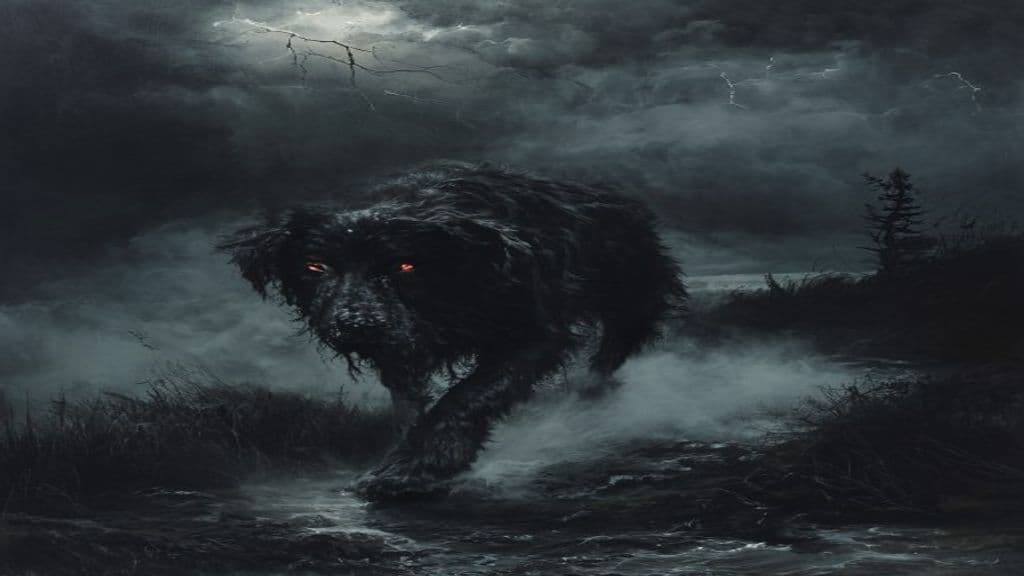
Black Shuck
A spectral black dog of East Anglian legend, with glowing red or green eyes. Its appearance is an omen of death. Its howl has been heard on clifftops during storms for centuries.
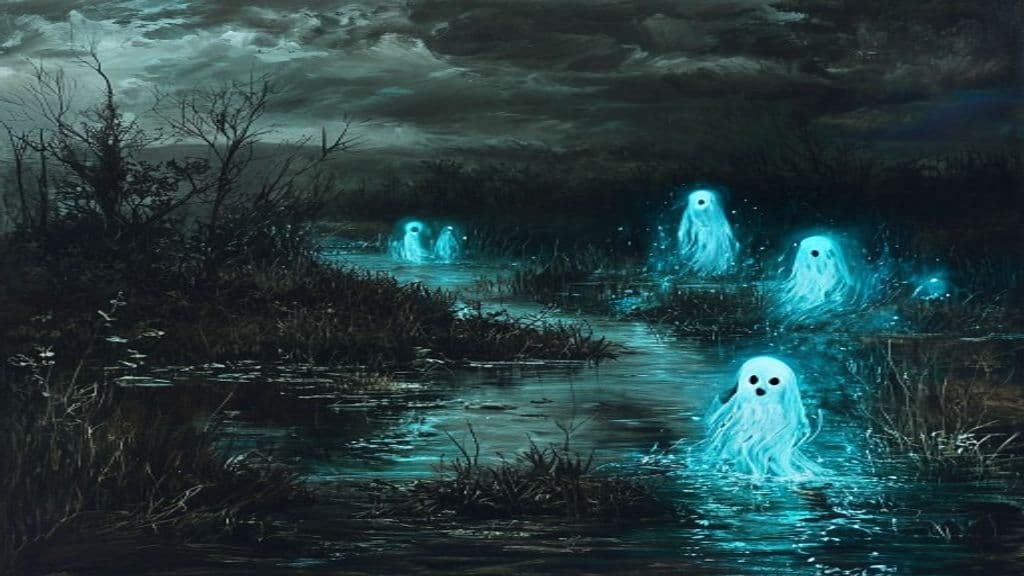
Will-o'-the-Wisp
A wandering light seen over marshy ground at night, leading travellers astray into bogs and fens. Possibly a spirit, possibly the soul of the unbaptised dead, possibly the devil himself.
Aos Sí
Aos Sí are a broad class of supernatural beings in Gaelic (Irish and Scottish) folklore associated with the mounds and liminal places of the landscape. They are variously described as descendants or later forms of the Tuatha Dé Danann, ancestral or nature spirits, or otherworldly folk who coexist with humans and can be helpful or dangerous when offended.
Bauchan
A household-associated hobgoblin from Scottish Highland folklore, the bauchan is portrayed as ambivalently belligerent and helpful; in at least one recorded tale it accompanies a human household across the Atlantic and can shapeshift into a goat.
Beithir
In Scottish Gaelic tradition the beithir is a very large snakelike creature—often called a serpent or dragon—associated with mountains, corries and bodies of water. It is portrayed as venomous and deadly in local tales, linked in etymology and interpretation to lightning/thunderbolt imagery, and classed among water-associated monsters (fuath).
Bergsrå
A place-bound mountain spirit (a form of Scandinavian 'rå') thought to inhabit and preside over a mountain, often described as keeping a household or court within the mountain and known for luring or taking humans into the mountain (bergtagning).
Biasd Bheulach
A named monster or spirit reported in Scottish folklore as haunting the Odal (Odal) Pass on the Isle of Skye. Attested primarily as a place‑bound uncanny being in modern summaries and lists of Scottish folk creatures, the entity is recorded with very limited detail in the cited sources.
Billy Blind
Billy Blind is a named household spirit from English and Lowland Scottish ballad tradition who appears as an advising helper in Child ballads, providing information, revelation, and stratagems that enable protagonists to resolve enchantment, identity, and childbirth crises. Attestations are narrative (ballads) and later literary/television adaptations draw on his advising role.
Black Dog (folklore)
A class of supernatural canine apparition in British vernacular folklore, often associated with liminal places and regarded as an omen-bearing or guardian hound. Local named forms (Black Shuck, Barghest, Gurt Dog, Gallytrot) show a range from malign, death-portending hellhounds to benevolent guide-figures.
Blunderbore
Blunderbore is a stock giant of English and Cornish folklore, appearing as a corporeal monstrous antagonist in tales such as Jack the Giant Killer and regional variants like Tom the Tinkeard. He is depicted through his actions—kidnapping, highway obstruction, and violent strength—and is typically overcome by a human folk-hero who frees captives and reasserts social order.
Bodach
A Gaelic folkloric personage literally meaning "old man" (Old Irish botach) who functions variously as a trickster, bogeyman, household figure and — in some accounts — an omen of death (Bodach Glas). The term also carries historical social meanings (tenant/peasant) and is sometimes identified with higher mythic figures (e.g., Manannán mac Lir) in specific tales.
Brown Man of the Muirs
A moorland guardian figure from Anglo-Scottish Border folklore. In a field account he appears as a solitary dwarf who reproves hunters and claims custodianship of upland animals; in later fairy-tale literature he appears as (or is related to) a tribe—the Brown Men of the Moors and Mountains—associated with stronger, more violent motifs and a compulsion-incantation.
Brownie
A household spirit from Scottish and related British traditions that performs nocturnal domestic labour in return for small offerings left by the hearth. Brownies are protective, place-tied domestic beings who work while humans sleep and will depart or become mischievous if offended.
Bugbear
A folkloric scare-figure historically invoked to frighten disobedient children, classed among boogeyman-type beings. Medieval descriptions in English sources portray it as a creepy, bear-like lurker in woods; modern popular culture and gaming have reimagined it as a large goblinoid monster.
Community Record
- [1]Church grim. Wikipedia: 'Church grim' article summarizing English, Scottish and Scandinavian traditionswiki
- [2]Wikidata: Church grim. Wikidata entry summarizing church-grim motifwiki
- [3]Bestiary Friday: The Church Grim | Fairy Tale Review. Fairy Tale Review summary and discussion of the church grim motifother