
In the classical account Circe is presented as a daughter of divine parents (commonly Helios and an Oceanid), placing her among solar and oceanic divinities and within a family that includes other magic‑associated figures (Aeëtes, Pasiphaë, Medea). Ancient authors variably call her a goddess, a nymph, or a witch; these labels indicate immortal or semi‑immortal status and an identity defined by specialized knowledge of herbs, potions, and rites rather than by a single moral category. Later classical authors and scholiasts place her dwelling on the island of Aeaea and sometimes link her movement to Helios' chariot or extraordinary conveyances (e.g., winged dragons in later poetic accounts).
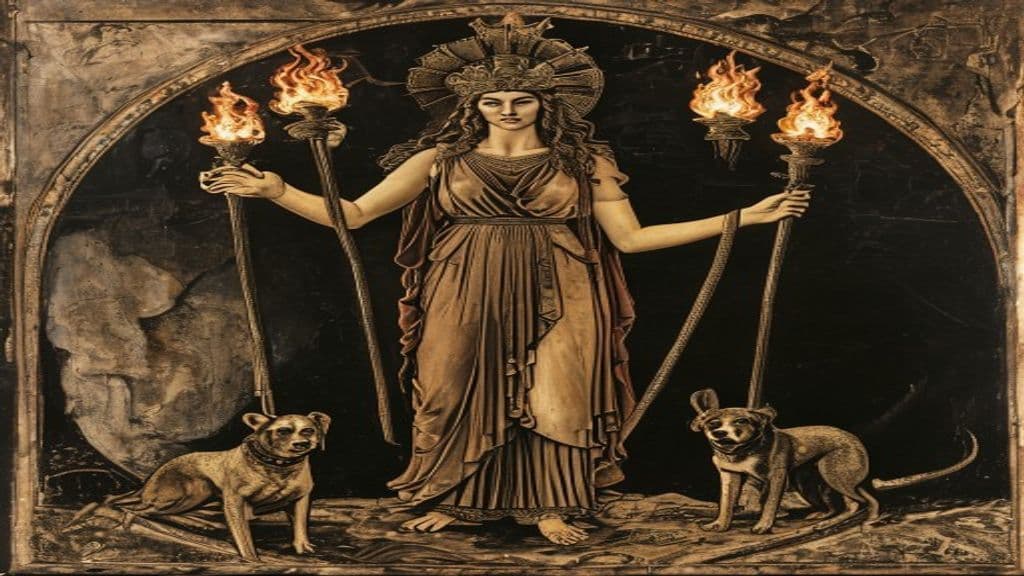
Classical sources present a mixture of awe and convention: Homer calls her "a dreadful goddess with lovely hair and human speech," while Hellenistic and Roman poets add luminous solar imagery—Apollonius attributes flashing golden eyes and other authors describe hair like fiery rays. She is often depicted in the company of uncanny animals described as primeval or composite beasts; the primary sources emphasize her imposing, liminal presence rather than a single fixed physical portrait.
Classical narratives attribute to Circe a vast knowledge of herbs and potions and the capacity to effect physical transformations—most famously turning members of Odysseus' crew into swine in the Homeric account—and to alter others in particular tales (e.g., Picus into a woodpecker; Ovidic traditions connecting her to Scylla's metamorphosis). Sources describe her using potions and, in some accounts, a wand or staff as instruments of her art. She also performs ritualized acts with social effect: in Apollonius' Argonautica she purifies the Argonauts for homicide by slitting the throat of a suckling pig and allowing the blood to drip on them, demonstrating that her agency includes formalized purification as well as personal enchantment. Her behavior toward humans is ambivalent: she can shelter and bear children with a hero (Odysseus) yet punish or transform those who offend or resist her. Later authors sometimes rationalize her powers as advanced herbal knowledge rather than supernatural force.
Weaknesses
- otherpersuasion / counter‑magic by a skilled hero
- substanceHermes' herb (moly) — attested in the wider Homeric tradition as aid to Odysseus
Wards
- otherdivine or magical assistance / antidote (e.g., herb given by a god)
Community Record
- [1]Circe — Wikipedia. Wikipedia contributors, 'Circe', Wikipedia, The Free Encyclopediawiki
- [2]Circe — Wikidata entry Q18588489. Wikidata: Circe (Q18588489)other
- [3]Archive mentions and supplementary materials (search results). Archive.org search / related itemsother