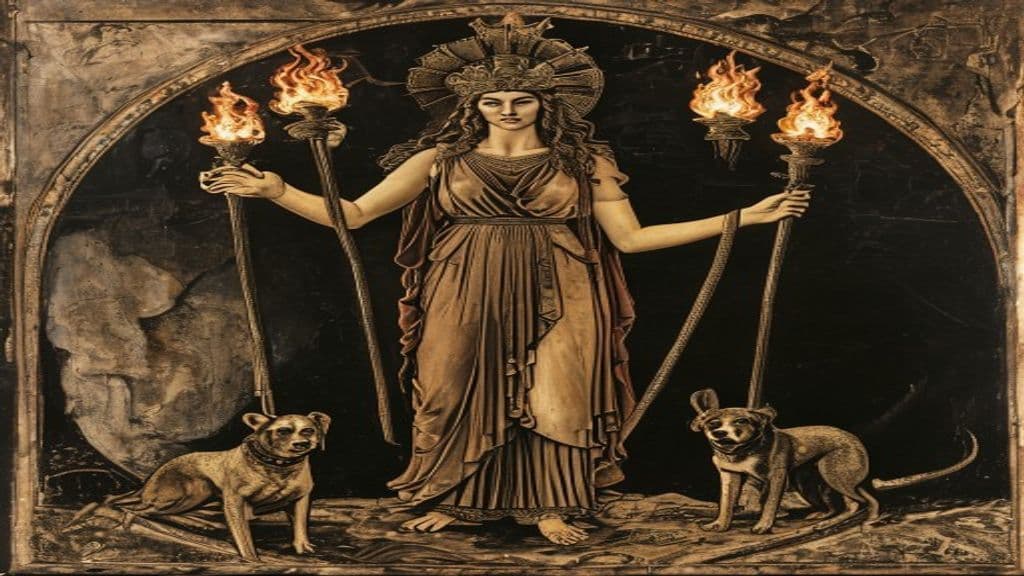
In Greek literary tradition Hecate appears early (Hesiod's Theogony, 8th century BCE) as a goddess honoured with domains in sky, earth, and sea. Regional cult evidence places important sanctuaries in places such as Selinunte (Sicily) and Lagina in Caria (Anatolia), where she functioned as a major local goddess. Scholarly discussion in the sources treats her origins as complex: some propose links to Greek words or to epithets such as Ἑκατός (Hekatos) and associations with Artemis or Apollo; others (e.g., Beekes) argue for a non-Greek (pre-Greek) substrate. Late sources such as the Chaldean Oracles reframe her in a theurgic/cosmic role (Soteira, Mother of Angels, Anima Mundi), showing how her figure could be reinterpreted in Hellenistic and late-antique esoteric contexts. These positions are presented in the sources as hypotheses or later developments rather than a single definitive origin narrative.
Iconographically Hecate is commonly shown holding a pair of torches, a key, or snakes, and frequently accompanied by dogs; in later periods she is often depicted as three-formed or triple-bodied. The earliest known representation cited in the sources is a small terracotta statue found in Athens showing a seated, single-formed goddess with a chaplet, indicating that early images could be singular. A 6th-century BCE pottery fragment from Boeotia has been suggested to depict a goddess in a maternal or fertility mode (crowned with leafy branches, flanked by lions), which some scholars propose may be Hecate — this illustrates variability and evolution in her visual presentation across regions and periods.
Across the cited materials Hecate's domains and functions include guardianship of crossroads ('three ways'), night and liminal hours, light (often by torch), magic and witchcraft, the Moon, and household protection (oikos) alongside household deities. She is described as a protector of travelers at junctions (Roman epithet Trivia reflects this). The Chaldean Oracles attribute to her a more expansive, metaphysical role — employing titles such as Soteira and Mother of Angels and linking her to the world soul (Anima Mundi) and rulership over earth, sea, and sky in that late-mystical context; the sources present this as a later, theurgic reinterpretation. The materials also note popular followings among witches in Thessaly, emphasizing her connection to magical practitioners. The overall portrait in the sources stresses ambivalence and polymorphous, liminal behavior rather than a single, uniform catalogue of powers.
Weaknesses
None recorded.
Wards
- otherHousehold veneration and offerings
- otherDedications at crossroads

Artemis
Artemis is an ancient Greek goddess of hunting, the wilderness and wild animals, transitions (especially childbirth and puberty), vegetation, and chastity. Twin sister of Apollo and daughter of Zeus and Leto, she functions as a protector of young children and maidens while also capable of inflicting disease or punishment for transgressions against her sacred laws.
Apollo
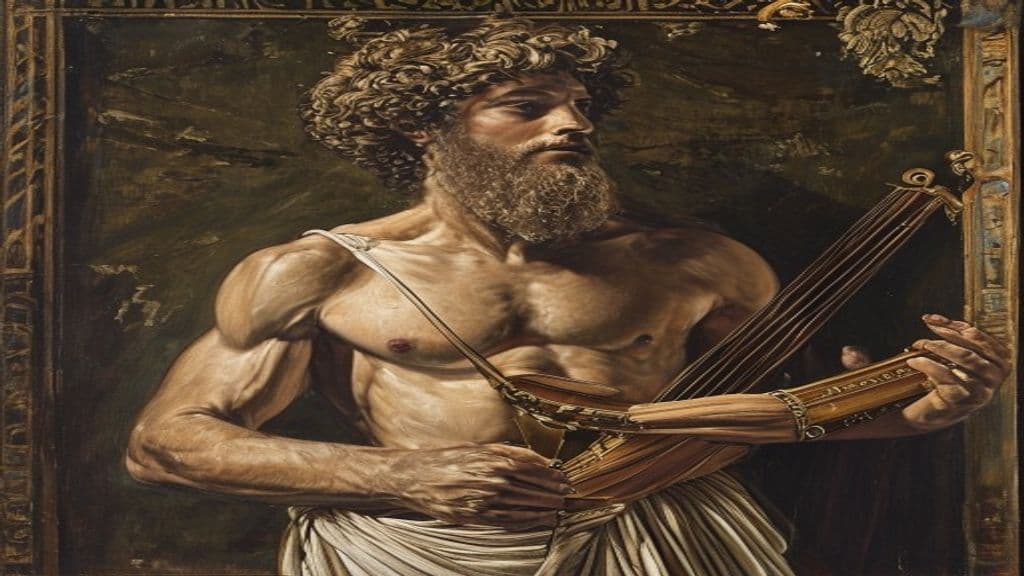
Olympian deity of ancient Greek religion associated with prophecy, healing, music, archery, purification, and civic order. Principal patron of the Delphic oracle, protector of youth and flocks, and ambivalently both healer and bringer of plague.
Community Record
- [1]Hecate - Wikipedia. Wikipedia contributors, 'Hecate,' Wikipedia, The Free Encyclopedia.wiki
- [2]Hecate - Wikidata. Wikidata entry Q131575.other
- [3]Hekate: Midnight Queen of the Dead (audio program listing). Archive.org listing for 'Hekate: Midnight Queen of the Dead'.other
- [4]Thingiverse listing (extraneous). Archive.org copy of a Thingiverse item (included among provided materials).other
- [5]Hecate Hardbroom Is In Lust (fanfic podfic). Archive.org fanfic/podfic item (included among provided materials).other