
The legend is localized in Pratdip; sources state the Dip has been part of local repertoire for a long time, appearing in visual records from 1602 and 1730 and on the escutcheon of Pratdip. Tradition holds that such dogs once frequented the locality and that, according to local belief, they disappeared in the nineteenth century.
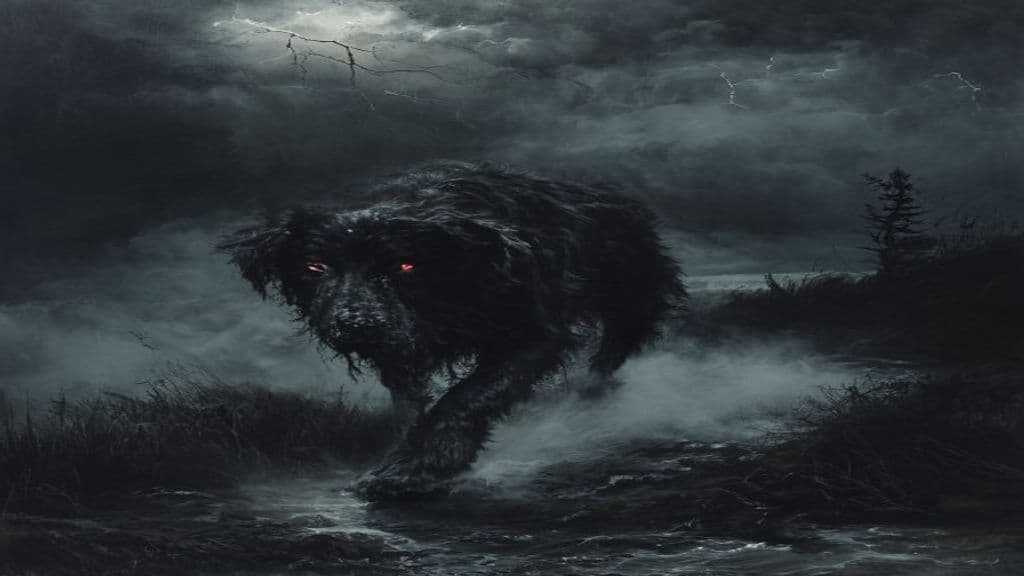
Described in the sources as an evil black hellhound. The Dip is depicted in local religious art (an altarpiece dated 1602 and another from 1730) and on the municipal escutcheon of Pratdip. Folkloric descriptions note that, like other demonic figures in Catalan myth, it is lame in one leg. A modern monument at the entrance to Pratdip offers a later, more stylized/kinder portrayal, but traditional references emphasize a frightening black dog-like creature.
Reported folkloric attributes present the Dip as a nocturnal predator and vampiric creature that 'sucks people's blood' and 'sucked the blood of cattle.' It acts at night and is said to have preyed on drunken villagers who lingered at taverns. Sources describe the Dip as an emissary or agent of the Devil; literary adaptations (e.g., Joan Perucho) expand its powers, but such expansions are distinguished from the traditional folkloric description.
Dione
Dione is primarily a proper name attested in ancient Greek myth (Διώνη, 'she who is under the authority of Zeus') borne by multiple mythological women, and is also used in modern taxonomy and astronomy (notably a moon of Saturn). The supplied sources do not present Dione as a single, consistent folkloric supernatural being with rituals or warding traditions.
Dionysus
Dionysus (Ancient Greek: Διόνυσος) is a major ancient Greek deity associated with wine and winemaking, vegetation and fertility, festivity and theatre, ritual ecstasy and possession, and liminal links with death and the underworld. He is an epiphany-god who travels between worlds, whose cult includes ecstatic rites and mystery initiation.
Diores
Diores (Ancient Greek: Διώρης, Diṓrēs) is not a single supernatural entity but a recurring personal name borne by several distinct mortal figures in Greek and Roman epic and mythographic tradition. The name appears attached to at least four human characters — fathers, leaders, princes, and husbands — across Homeric, mythographic, and Virgilian narratives.
Dios Buhawi
Sobriquet applied to Ponciano Elofre, a late 19th-century cabeza de barangay in Zamboanguita, Negros Oriental, who led a politico-religious revolt combining anti‑tax resistance with a revival of pre‑Spanish babaylan rites. Sources treat Dios Buhawi as a historical social and religious leader rather than a supernatural being.
Dioscuri (Castor and Pollux)
The Dioscuri, commonly rendered Castor and Pollux (Dioskouroi in Greek), are the twin half-brothers of Greek and Roman mythology who function as a paired mythic duo in classical literature and later cultural memory. They appear throughout ancient sources and have been reused as a durable cultural emblem of twinship, partnership, and martial or civic guardianship in art, monuments, and modern institutions.
Dioxippe (Heliades)
Dioxippe (Ancient Greek: Διωξίππη) is a named figure in Greek myth most commonly attested as one of the Heliades — daughters of Helios and the Oceanid Clymene — appearing in mythographic name-lists. The same personal name 'Dioxippe' also occurs for several unrelated female figures in Greek tradition (a Danaid, an Amazon, a wife of Agenor) and even as the name of one of Actaeon’s dogs in various sources.
Dirce
Dirce (Ancient Greek Δίρκη) is a figure of Greek myth traditionally remembered as a queen of Thebes, wife of Lycus, whose cruel treatment of Antiope led to her being killed by Antiope's sons, Amphion and Zethus. Her violent death — being tied to a bull and dragged to death — becomes aetiological for a spring associated with Dionysus and a site of local Theban ritual memory.
Dire Wraith
The Dire Wraiths are a Marvel Comics extraterrestrial species, described as an evolutionary offshoot of the Skrulls. Within the comics' internal cosmology they are a sentient, shape‑shifting race with a history of exile to a home called Wraithworld, internal gendered factionalism (technology‑oriented males and magic‑oriented females), and recurring antagonism toward the Spaceknights and Earth.
Disa
Disa is a legendary Swedish saga heroine and wise woman whose clever solution to a king's impossible test averts a planned mass culling and leads to a policy of drawing lots and resettlement. In the saga tradition her counsel becomes associated with the Midwinter blót (Disablot) and the Disting, and later early modern authors and artists memorialized her role in lawgiving and ritual memory.
Dispater (Dis Pater)
Dispater (classical Dis Pater) is a chthonic Roman deity originally associated with fertile soil and subterranean mineral wealth who in modern fantasy and gaming traditions is reinterpreted as Dispater, an arch‑devil and lord of the Iron City of Dis, a high‑ranking ruler within layered infernal cosmologies.
Diti
Diti (Sanskrit: दिति) is a Puranic mythological woman of divine lineage: a daughter of the Prajapati Daksha, wife of the sage Kaśyapa, and the ancestress of the daityas. In Puranic narratives she functions as a progenitor whose pregnancies and ascetic acts produce powerful adversaries of the devas and so figure in origin-stories of cosmic conflict.
Diting
Diting (Chinese: 谛听; pinyin: Dìtīng) is a divine mythical creature in Chinese Buddhist hagiography traditionally described as the steed and attendant guardian of the bodhisattva Kṣitigarbha (Dizang). Described as a composite beast with extraordinary hearing and discernment, Diting is associated in legend with guarding hell and distinguishing truth from falsehood in support of Kṣitigarbha's salvific activities.
Community Record
- [1]Dip (Catalan myth) - Wikipedia. Wikipedia, 'Dip (Catalan myth)'wiki
- [2]Catalan myths and legends - Wikipedia. Wikipedia, 'Catalan myths and legends'wiki
- [3]Obscure Life-Forms: Dip. Obscure Life-Forms, 'Dip'other
- [4]Arcanebeastsandcritters: Dip region of origin (blog post). Tumblr post, 'Dip Region of origin'other