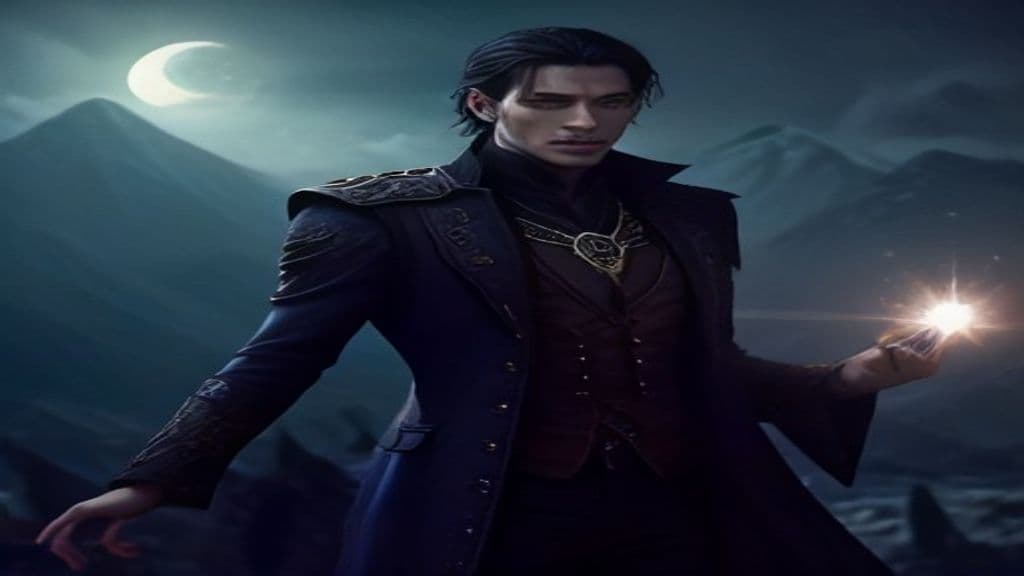
Literary origin: Dorian Hawkmoon is a creation of author Michael Moorcock appearing across four novels collected as The History of the Runestaff. Within the novels' internal cosmology he is presented as "a version of the Eternal Champion," a recurring heroic role that appears across ages and worlds in Moorcock's fiction. The character's provenance is narrative rather than folkloric; summaries locate his adventures in a post-nuclear-holocaust, far-future Europe dominated in part by the Dark Empire of Granbretan.
Primary summaries and reviews supply limited direct physical description. Noted plot elements recorded in available sources include a magical jewel embedded in Hawkmoon's forehead used by antagonists to coerce him; beyond this specific device, comprehensive physical details are not provided in the supplied materials.
In the sources Hawkmoon's capacities are those of a heroic human agent: martial courage, leadership in resistance to the Dark Empire of Granbretan, and the ability to undertake dangerous quests (for example, to remove a powerful amulet from the Mad God to save Kamarang). Supernatural effects associated with Hawkmoon derive chiefly from external artifacts (the Black Jewel, the Mad God's amulet, and a jewel implanted in his forehead) and from his role as an incarnation of the Eternal Champion motif rather than from documented innate magical powers.
Weaknesses
- otherVulnerability to coercive magical artifacts (e.g., a jewel embedded in his forehead; the Mad God's amulet)
Wards
- otherNone attested in supplied sources (control/resistance in‑universe concerns are mediated by artifacts rather than documented folk wards)
Dongui Bogam (동의보감)
The Dongui Bogam (東醫寶鑑) is a seminal 17th‑century Korean compendium of traditional Korean medicine compiled by the royal physician Heo Jun and first published in 1613 during the Joseon period. It is treated in modern Korea as an important cultural and scientific heritage item and has been issued in various modern media formats, including commercial CD editions.
Donn
Donn is an Irish otherworld figure linked to the dead and to a specific western locus, Tech Duinn ('house of Donn'). In medieval literature he functions as an ancestral host to whom the Gaels come after death; in later folk tradition he appears as a local otherworld lord and as a portentous nocturnal horseman.
Donn Cúailnge
Donn Cúailnge, the Brown Bull of Cooley, is the extraordinarily fertile stud bull at the center of the Ulster Cycle narrative Táin Bó Cúailnge (the Cattle Raid of Cooley). Originating in medieval Irish saga material, he functions as an agent within a tale that mixes otherworld transformation, social prestige in cattle, and widescale human conflict.
Donna Troy
Donna Troy is a fictional American comic-book superheroine, introduced as the original Wonder Girl and later known at times as Troia. Created within DC Comics continuity, she functions as a younger counterpart/protégé to Wonder Woman and as a founding member of the Teen Titans; her published origin has been revised multiple times by editorial continuity resets.
Doombot
A Doombot is a fictional robotic construct in the Marvel Comics narrative used to impersonate and stand in for the figure Doctor Doom. Doombots function as expendable proxies capable of combat and deception, appearing in stories to preserve the original's deniability or safety.
Doppelgänger
A supernatural double or look‑alike of a living person, frequently reported in folklore and literature as a haunting counterpart or an omen of misfortune. The motif appears across cultures with related but distinct concepts (e.g., Egyptian ka, Norse vardøger, Finnish etiäinen, Muslim karin/qareen).
Doridas
Doridas is attested in the supplied sources only as a proper name: a Wikidata label identifies 'Doridas' as a 'mythical king of Corinth', and a lexically similar form appears as the modern Greek place-name Dorida (Δωρίδα). The corpus contains no folkloric descriptions, rituals, or supernatural attributes for an entity named Doridas.
Dorieus
Dorieus (Ancient Greek: Δωριεύς) is a historical/mythohistorical Spartan prince of the Agiad line, portrayed in classical sources as an aristocratic exile who led failed colonizing ventures in Tripolitania and western Sicily in the early 6th century BC. His story functions as both historiography and aetiology explaining foundation attempts, dynastic dispute, and interaction with Phoenician/Carthaginian powers.
Dorippe
A figure associated with Anius, a king of Delos and priest of Apollo. Its significance is unclear due to lack of explicit supernatural characteristics. (Note: - Power tier: Should be Primordial (no clear connection to Anius or significant mythological status) - Abilities: Mention that "No explicit supernatural abilities or behaviors are described for Doripp)
Doris (Oceanid)
A figure named Doris appears in Greek myth as an Oceanid identified in the supplied sources as 'mother of the Nereids.' The provided material supplies only this genealogical label and does not include narratives, descriptions, or ritual material associated with her.
Dormammu
Dormammu is a fictional extra- and inter-dimensional supernatural being created for Marvel Comics. In Marvel continuity he is portrayed as the powerful ruler of the Dark Dimension, a recurring antagonist of Doctor Strange who commands denizens of his realm, bargains with sorcerers, and engages cosmic entities.
Dorotabō
No attested folkloric or mythological information for an entity named 'Dorotabō' is present in the provided source. The source is a Wikipedia list of Generation I Pokémon; it does not mention or describe Dorotabō.
Community Record
- [1]The History of the Runestaff (Wikipedia: Dorian Hawkmoon / omnibus summary). Wikipedia entry for The History of the Runestaff — omnibus summary noting Hawkmoon as 'a version of the Eternal Champion' and setting in far-future Europe dominated by the Dark Empire of Granbretan.wiki
- [2]Hawkmoon: The Mad God's Amulet (archive record / blurb). Archive record / book summary describing plot point that Hawkmoon 'must rip this amulet from the neck of the Mad God' and quoting 'A power that began at creation and calls heroes to arms throughout existence.'literary
- [3]The Jewel in the Skull (Wikipedia). Wikipedia entry noting The Jewel in the Skull is set in a post-nuclear holocaust future; part of Hawkmoon sequence.wiki
- [4]Fantasy Reviews Sep–Dec 2012 (Don D'Ammassa). Review noting plot detail that 'Dorian Hawkmoon is caught by the bad guys and coerced into acting against Brass thanks to a magical jewel embedded in his forehead.'other
- [5]Hawkmoon: The Sword of the Dawn (archive item). Archive record for another novel in the Hawkmoon sequence; part of the collected four novels.literary
- [6]Moorcography — 'Hawkmoon' entry. Reference site summarizing the Hawkmoon novels, characters, and relation to Moorcock's Eternal Champion motif.other
- [7]Savoy Comics: The Jewel in the Skull (adaptation info). Page noting a graphic-novel adaptation and the work's cultural afterlife.other
- [8]RPG Stackexchange discussion (adaptations / RPG interest). Discussion noting role-playing interest in Moorcock's non-Elric works, including Hawkmoon.other