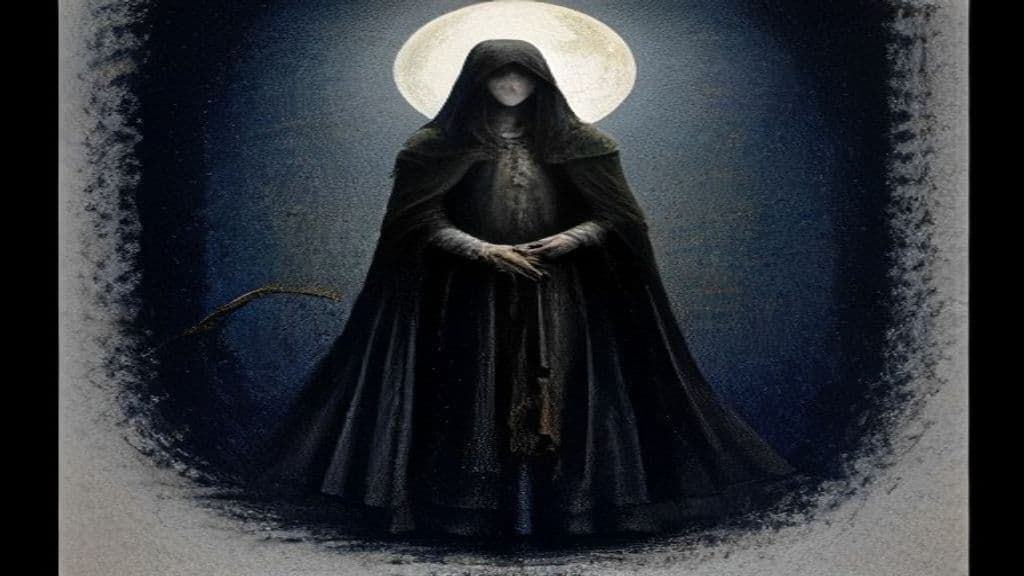
In early medieval materials Donn is presented as an ancestral figure associated with a western otherworld locus called Tech Duinn. The Metrical Dindshenchas relates that, after a storm caused by druidic incantations, Donn's ship foundered and his body was placed upon a high rock at the command of Amhairgne (Amarigen), which then became known as Tech Duinn; this narrative is one reported origin for the place-name. In the Christianized Lebor Gabála Érenn tradition Donn is historicized as Éber Donn, a Milesian ancestor whose drowning is folded into the foundation-mythic geography. Across sources Donn functions as an ancestral host whose house is the destination for souls in the Irish otherworldal geography.
Medieval and literary texts primarily portray Donn functionally (as an ancestral host and otherworld figure) rather than giving a fixed anthropomorphic description. In later local folklore Donn frequently appears as a phantom or night-horseman: the County Limerick figure Donn Fírinne is said to ride a white horse as a spectral rider, while west Clare variants (Donn na Duimhche / Donn Dumhach) record encounters with a night-horseman. Thus late popular imagery emphasizes a nocturnal mounted apparition tied to particular hills or dunes.
Literary sources attribute to Donn the custodial role of receiving and gathering the souls of the dead at Tech Duinn; a ninth-century poem records his dying wish that his folk should come 'to me, to my house' after death. Tech Duinn functions as a gathering-place or waypoint—some summaries note it may be where souls assemble before traveling on to a final otherworld destination or before reincarnation. Folk motifs associate Donn's riding with meteorological portents (thunder, lightning; cloud over his hill signalling he is 'gathering them together to make rain') and attribute to him the power to warn or punish those who interfere with his sacred hill. In some tales and poetic contexts Donn is explicitly called a 'king of the dead' and his horses are invoked by otherworld riders, linking him to martial and death-portent imagery; however the sources do not record systematic judicial or salvific procedures carried out by Donn.
Domar (Dómarr)
Domar (Old Norse Dómarr, 'Judge') is a legendary Swedish king of the Yngling dynasty attested in medieval Scandinavian genealogical sources. He is presented as a mytho-historical ancestral ruler whose long and peaceful reign follows the sacrificial death of his father Domalde and whose own death was marked by cremation at Fyrisvellir and erection of a memorial stone at Uppsala.
Dominion (angel)
In Christian angelology, Dominions (also Dominations or Lordships; Greek kyriotētes) are an order of created heavenly beings listed among categories such as thrones, principalities, and powers. Major theological sources (Colossians 1:16 as cited, Pseudo‑Dionysius the Areopagite, and the Second Book of Enoch) treat them as a ranked class within a hierarchical cosmos rather than as individual personalities encountered in folklore.
Domovoi
The house spirit of Slavic tradition — a small, invisible guardian of the home bound to a specific dwelling and its family. Protective when respected; dangerous when insulted or forgotten.
Domovoy
A Slavic household spirit bound to a particular kin/household, the Domovoy is an immanent domestic guardian and ancestral presence who protects the family's wellbeing, monitors moral conduct, and participates in domestic life; it is placated by regular offerings and specific household rites.
Dongti (Divine Punishment)
A manifestation of divine retribution in Korean mythology, serving as a concept rather than a specific supernatural being. (Note: * Power tier should be Lesser, not Greater, as it's a concept rather than a specific supernatural being. * Abilities description should reflect that the Dongti is an agent of retribution, but doesn't )
Dongui Bogam (동의보감)
The Dongui Bogam (東醫寶鑑) is a seminal 17th‑century Korean compendium of traditional Korean medicine compiled by the royal physician Heo Jun and first published in 1613 during the Joseon period. It is treated in modern Korea as an important cultural and scientific heritage item and has been issued in various modern media formats, including commercial CD editions.
Donn Cúailnge
Donn Cúailnge, the Brown Bull of Cooley, is the extraordinarily fertile stud bull at the center of the Ulster Cycle narrative Táin Bó Cúailnge (the Cattle Raid of Cooley). Originating in medieval Irish saga material, he functions as an agent within a tale that mixes otherworld transformation, social prestige in cattle, and widescale human conflict.
Donna Troy
Donna Troy is a fictional American comic-book superheroine, introduced as the original Wonder Girl and later known at times as Troia. Created within DC Comics continuity, she functions as a younger counterpart/protégé to Wonder Woman and as a founding member of the Teen Titans; her published origin has been revised multiple times by editorial continuity resets.
Doombot
A Doombot is a fictional robotic construct in the Marvel Comics narrative used to impersonate and stand in for the figure Doctor Doom. Doombots function as expendable proxies capable of combat and deception, appearing in stories to preserve the original's deniability or safety.
Doppelgänger
A supernatural double or look‑alike of a living person, frequently reported in folklore and literature as a haunting counterpart or an omen of misfortune. The motif appears across cultures with related but distinct concepts (e.g., Egyptian ka, Norse vardøger, Finnish etiäinen, Muslim karin/qareen).
Dorian Hawkmoon
Dorian Hawkmoon is a fictional human protagonist in Michael Moorcock's far-future fantasy sequence The History of the Runestaff. He is described in the texts and summaries as "a version of the Eternal Champion," a recurring heroic role in Moorcock's multiverse; his actions are shaped by that in‑universe motif and by powerful artifacts encountered in the novels.
Doridas
Doridas is attested in the supplied sources only as a proper name: a Wikidata label identifies 'Doridas' as a 'mythical king of Corinth', and a lexically similar form appears as the modern Greek place-name Dorida (Δωρίδα). The corpus contains no folkloric descriptions, rituals, or supernatural attributes for an entity named Doridas.
Community Record
- [1]Donn — Wikipedia. Wikipedia contributors, 'Donn', Wikipedia, The Free Encyclopediawiki
- [2]Metrical Dindshenchas (translation excerpt cited in Wikipedia). Quoted translation by E. Gwynn as cited in the Wikipedia article on Donn (Metrical Dindshenchas excerpt)literary
- [3]Acallam na Senórach (translation excerpt cited in Wikipedia). Ann Dooley and Harry Roe, translation of Acallam na Senórach, quoted in the Wikipedia article on Donnliterary
- [4]Topographical and folkloric accounts (County Limerick and Clare variants) — summaries cited in Wikipedia. Folklore summaries (Donn Fírinne, Donn na Duimhche / Donn Dumhach) as reported in the Wikipedia article on Donnfolk
- [5]Identification of Tech Duinn with Bull Rock — summary cited in Wikipedia. Geographic identification of Tech Duinn with Bull Rock as discussed in the Wikipedia article on Donnwiki