
The sources present the Dragon King as the continuation and syncretic adaptation of long-standing serpent/dragon imagery in Asia. Serpent-like creatures appear in Neolithic material culture (dated in the sources to ca. 7000–5000 BCE) and later religious systems folded these motifs into roles as rulers of waters and weather. In Chinese cosmology this developed into an ordered system (the Dragon Kings of the Four Seas 四海龍王), while Indian subcontinental Nāga kings (Nāgarāja) provided a related serpent-royal model that spread through South and Southeast Asia and was incorporated into Buddhist and local village practices. Regional names (lóng, Ryū, Yongwang, Nāgarāja) reflect local linguistic and ritual variations of a shared aquatic-royal concept. (Sources: Wikipedia: Dragon King; summary material in research notes.)
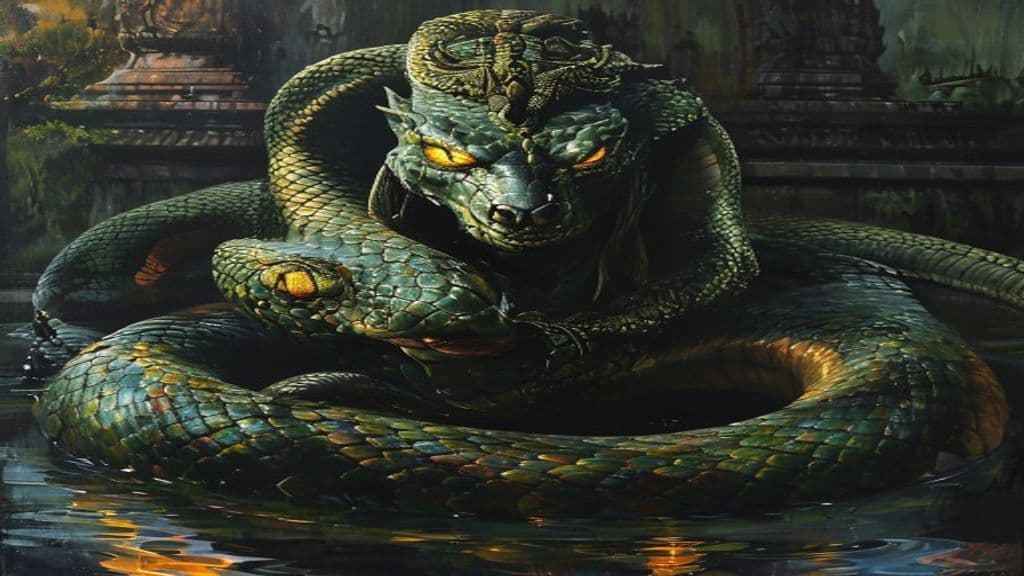
Source material emphasizes a serpent-like or dragon form without a single consistent anthropomorphic description. Representations vary by region and medium: stylized Chinese lóng and royal dragon imagery, Japanese Ryū depictions, Indian and Southeast Asian nāga serpents, and architectural motifs (for example, carved nāga railings on temple stairways and dragon heads on roofs). The Dragon King is commonly pictured in art and temple iconography as a dragon or nāga figure guarding thresholds or occupying underwater palatial scenes, but textual descriptions in the surveyed sources do not provide a uniform, detailed bodily description. (Sources: Wikipedia; research notes referencing temple imagery and archaeological continuity.)
Culturally attributed powers include control over water and weather (bringing rain, influencing storms, and regulating aquatic domains), territorial authority over seas, rivers, lakes, wells and springs, and rulership expressed as an underwater palace and court. The Dragon King functions ritually as a dispenser of rain and fertility and as a protector or tutelary presence for locales and sacred precincts (e.g., guardians of the Dharma in Southeast Asian Buddhist contexts). These are ritual and cosmological attributions recorded across Chinese, Japanese, Korean, South and Southeast Asian sources rather than experimentally demonstrated abilities. (Sources: Wikipedia: Dragon King; research notes.)
Weaknesses
None recorded.
Wards
- ritualmaintenance of local Dragon King shrines and seasonal rites
- ritualhousehold tablet ritual (Changli County): place a yellow paper tablet inscribed 'The position of the Dragon King of the Four Seas 四海龍王之位, Five Lakes, Eight Rivers and Nine Streams', sprinkle with water using willow withes, and burn incense next to it
- ritualnāga/dragon offerings (South and Southeast Asia): offerings of incense, milk, turmeric, and flowers at nāga shrines or stones
- ritualJapanese amagoi (雨乞い) rainmaking ceremonies: Shinto and Buddhist prayers, offerings and symbolic actions during drought
- ritualKorean Giuje (祈雨祭) rainmaking rites: community rites involving officials, Buddhist monks and female shamans
Community Record
- [1]Dragon King. Wikipedia: 'Dragon King' article (accessed as provided in research notes)wiki